Zing Forum

Reading

Nexusquant: KV Cache Compression Technology to Enable Longer Context for Large Models on Consumer GPUs

This article introduces the Nexusquant project, a KV cache compression scheme based on E8 lattice quantization and attention-aware token elimination. It can reduce memory usage by 10-33 times, enabling local deployment of large language models with longer contexts without additional training.

KV缓存量化大语言模型推理优化E8格点显存压缩本地部署
Published 2026-05-02 07:33Recent activity 2026-05-02 09:41Estimated read 5 min
Nexusquant: KV Cache Compression Technology to Enable Longer Context for Large Models on Consumer GPUs
1

Section 01

Nexusquant: KV Cache Compression Technology for Longer Context Large Models on Consumer GPUs

Nexusquant is a large model inference optimization project focused on KV cache compression. Using two key technologies—E8 lattice quantization and attention-aware token elimination—it can reduce KV cache memory usage by 10-33 times. This allows consumer GPUs (with 8-16GB memory) to locally deploy large language models supporting longer contexts without additional training.


2

Section 02

Background: KV Cache Bottleneck Restricts Local Deployment of Large Models on Consumer GPUs

During large language model inference, memory consumption mainly comes from model weights and KV cache. In long-text conversations, KV cache grows linearly with sequence length, which is the biggest obstacle to local deployment on consumer GPUs. Traditional solutions like weight quantization, using smaller models, or shortening context either lose model capability or fail to solve the root problem in long-text scenarios.

3

Section 03

Core Technologies: Innovative Application of E8 Lattice Quantization and Attention-Aware Token Elimination

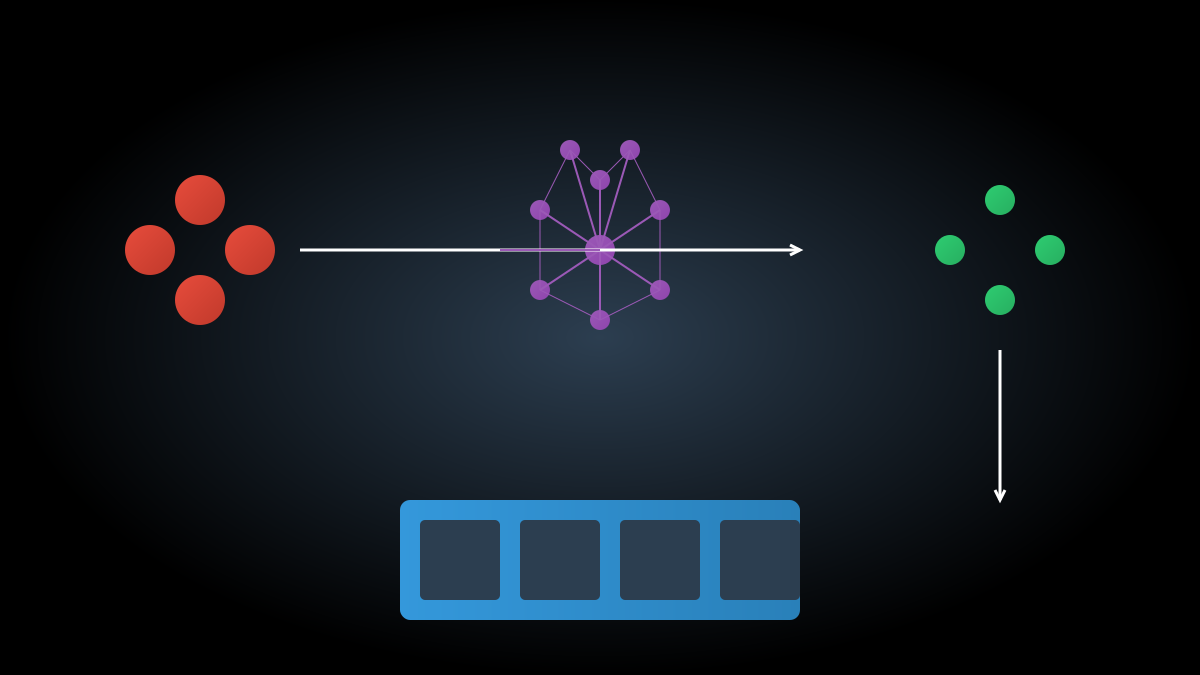
Nexusquant uses two key technologies: 1. E8 Lattice Quantization: Leveraging the optimal sphere packing property of the 8-dimensional highly symmetric lattice, it maps floating-point numbers in KV cache to discrete points, significantly reducing storage precision while preserving vector relative distances and semantic information. 2. Attention-Aware Token Elimination: By analyzing attention distribution, it dynamically removes tokens that contribute less to current predictions, intelligently filtering key context instead of simple sliding window truncation.

4

Section 04

Practical Effects: Unlocking Long-Text Application Scenarios for Consumer GPUs

Nexusquant achieves a KV cache compression ratio of 10-33 times, bringing the following effects: Models originally supporting 4K context can now handle 40K+; 7B models on 8GB memory can support longer multi-turn conversations; Long-document summarization, Q&A, and other applications can be experienced without high-end GPUs. Applicable scenarios include long-document Q&A, multi-turn dialogue systems, and large codebase assistance.

5

Section 05

Deployment Guide: Installation and Usage Steps for Nexusquant

Nexusquant is developed in Python and supports Windows 10/11 systems, NVIDIA GPUs with 8GB+ memory, and Python 3.10+ environments. Deployment steps: 1. Download the latest version from GitHub Releases; 2. Extract and enter the directory; 3. Install dependencies: pip install -r requirements.txt; 4. Run python main.py—the graphical interface will automatically apply compression optimization.

6

Section 06

Limitations and Recommendations: Key Points to Note When Using Nexusquant

Nexusquant has the following limitations: It only supports Windows systems and NVIDIA GPUs; Quantization introduces some precision loss; Attention-aware elimination may mistakenly remove key context. It is recommended that users test for specific scenarios before formal deployment to evaluate whether the output quality meets their needs.

7

Section 07

Significance for Open Source Ecosystem: Nexusquant Promotes Popularization of Large Model Inference Optimization

Nexusquant represents an important direction in large model inference optimization—reducing hardware thresholds through algorithmic innovation, allowing more users to explore large model applications. KV cache management will become a core battlefield for inference optimization, and its E8 lattice quantization demonstrates the possibility of combining mathematical theory with engineering practice, providing developers with a practical tool to run large models locally on consumer GPUs.

