Zing Forum

Reading

NexusMind: Intelligent Routing and Multimodal Retrieval Architecture for Modular AI Orchestration System

NexusMind is an open-source AI orchestration platform that routes queries to local LLM, RAG retrieval, web search, or deep research mode via an intelligent decision engine, achieving a dynamic balance between cost, speed, and accuracy.

AI编排RAG智能路由多模态检索LangGraphChromaDBOllamaStreamlitFastAPI本地LLM
Published 2026-06-10 23:34Recent activity 2026-06-10 23:50Estimated read 6 min
NexusMind: Intelligent Routing and Multimodal Retrieval Architecture for Modular AI Orchestration System
1

Section 01

NexusMind: Introduction to Intelligent Routing and Multimodal Retrieval Architecture for Open-Source AI Orchestration System

NexusMind is an open-source AI orchestration platform developed and maintained by ranapratapmajee (GitHub link: https://github.com/ranapratapmajee/nexusmind, released on June 10, 2026). Its core function is to dynamically route queries to local LLM, RAG retrieval, web search, or deep research mode via an intelligent decision engine, achieving a balance between cost, speed, and accuracy. This article will introduce it from aspects such as background, architecture, and routing mechanism.


2

Section 02

Project Background and Motivation: Addressing Limitations of Single Models

With the popularization of LLM applications, single models have limitations: local models are low-cost but have limited capabilities, cloud models are powerful but expensive, and RAG is suitable for specific fields but cannot access the latest information. NexusMind uses an intelligent orchestration layer to select the optimal processing path based on query characteristics, similar to an API gateway for the AI reasoning layer, optimizing cost-effectiveness and user experience.

3

Section 03

System Architecture: Layered Design and Core Components

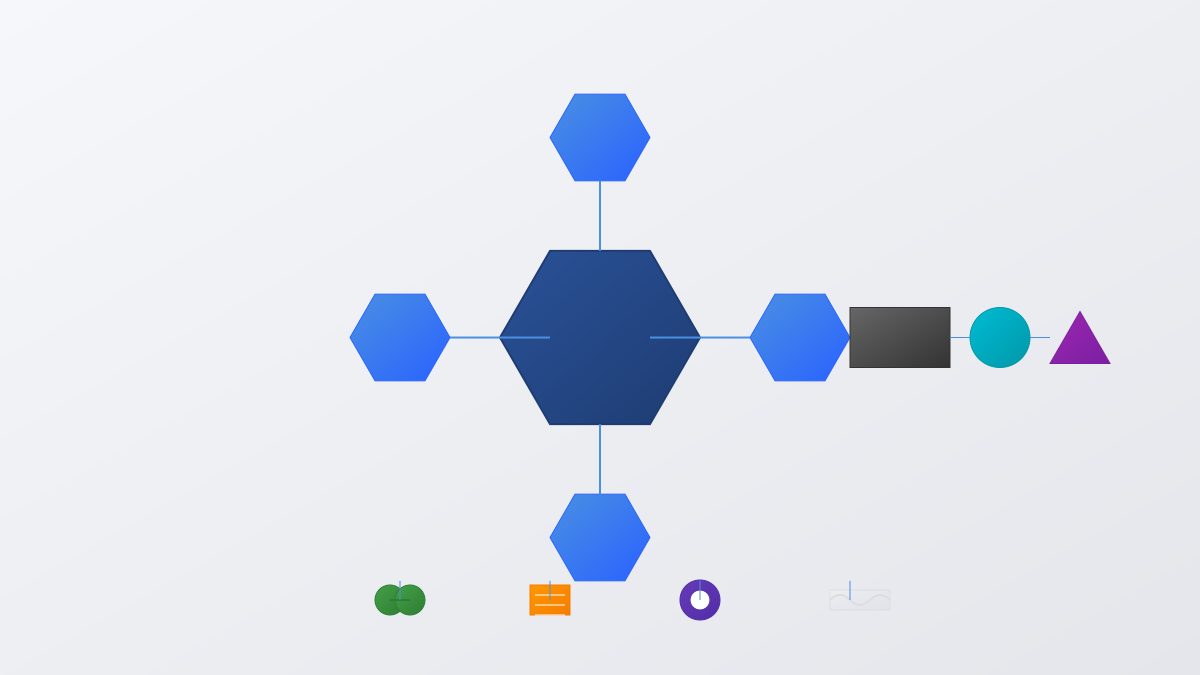
It adopts a layered architecture, with core components including:

  1. Frontend Layer (Nexa): A unified chat interface based on Streamlit, supporting mode/model selection and answer traceability display;
  2. Orchestrator Core: The "brain" of the FastAPI backend, coordinating service interactions following the strategy pattern;
  3. Service Layer: Provides five modes: Chat (direct dialogue), Search (web search), RAG (local document retrieval), Hybrid (hybrid mode), and Deep Research (LangGraph multi-step agent);
  4. Model Gateway: A unified LLM calling interface, supporting switching between Ollama local models and cloud APIs;
  5. Retrieval Service: PDF processing pipeline (loading/chunking/embedding/ChromaDB storage), supporting incremental indexing.
4

Section 04

Intelligent Routing Decision Mechanism: Dynamically Selecting Optimal Paths

The core innovation lies in intelligent routing, with decision-making based on:

  • Query complexity analysis: Simple queries use Chat mode, complex queries trigger Deep Research;
  • Cost-quality trade-off: Prioritize low-cost solutions that meet quality requirements (e.g., local Ollama models);
  • Timeliness judgment: Tend to use Search or Hybrid mode when involving the latest information;
  • User preference learning: Record historical choices to optimize processing methods for similar queries.
5

Section 05

Answer Traceability and Transparency: Enhancing User Trust

NexusMind emphasizes interpretability, with each answer accompanied by traceability information:

  • Routing path: Displays the processing mode;
  • Used model: Specific model name and provider;
  • Retrieval fragments: Quoted document fragments in RAG mode;
  • Processing time: Time consumption statistics for each stage. This is crucial for building user trust in enterprise scenarios.
6

Section 06

Deployment and Technology Selection: Containerization and Ecosystem Integration

In terms of deployment, Docker Compose configuration is provided to start all services (frontend/backend/ChromaDB/Ollama) with one click, reducing operation and maintenance complexity. The tech stack adopts modern Python AI best practices: FastAPI (high-performance asynchronous), Streamlit (fast interface), LangGraph (agent workflow), ChromaDB (lightweight vector database), Ollama (local LLM operation), balancing functionality and deployment simplicity.

7

Section 07

Application Scenarios and Future Outlook: A Pragmatic Approach to AI Orchestration

Application scenarios include personal knowledge management (private knowledge base + web search), enterprise customer service (internal documents + external information), development assistance (code interpretation/technical research), and educational tutoring (teaching materials + web resources). Summary: NexusMind leverages the advantages of multiple models through intelligent orchestration, aligning with AI development trends; its open-source nature lowers the adoption threshold, and it will play a more important role in AI application development in the future.

