Zing Forum

Reading

NexusFlow: The Intelligent Conductor for Multi-Model AI Workflow Orchestration

This article introduces the NexusFlow project, a LangGraph-based multi-model AI workflow orchestration system that enables seamless collaboration between multiple AI models like GPT-4 and Claude through intelligent routing, model collaboration, and adaptive learning.

LangGraph多模型编排AI工作流智能路由LangChainGPT-4Claude模型协作自适应学习AI应用架构
Published 2026-06-07 01:15Recent activity 2026-06-07 01:21Estimated read 7 min
NexusFlow: The Intelligent Conductor for Multi-Model AI Workflow Orchestration
1

Section 01

NexusFlow: The Intelligent Conductor for Multi-Model AI Workflow Orchestration

Core Overview

NexusFlow is a LangGraph-based multi-model AI workflow orchestration system developed by Asir11 (hosted on GitHub). It addresses the pain point of manual multi-model API management by acting as an 'intelligent conductor'—enabling seamless collaboration between models like GPT-4, Claude, and specialized tools via smart routing, adaptive learning, and stateful workflow design. Its goal is to complement model strengths and mitigate limitations, creating a harmonious synergy of AI capabilities.

Basic Project Info

  • Author/Maintainer: Asir11
  • Source: GitHub (langgraph-agentic-workflows-tutorial / NexusFlow)
  • Release Date: 2026-06-06
2

Section 02

Background: Challenges in Multi-Model AI Coordination

With the explosion of large language models, developers face key challenges:

  1. Single Model Limitations: Each model has distinct strengths (GPT-4 for creativity, Claude for reasoning) and weaknesses.
  2. Cost & Reliability: Different models vary in pricing and stability; relying on one risks failure or high costs.
  3. Innovation Barriers: A single model’s perspective limits breakthrough solutions.

NexusFlow was built to solve these by orchestrating multiple models to work in tandem, leveraging their respective advantages.

3

Section 03

Core Design & Methodologies

Three-Layer Smart Routing

NexusFlow uses a tiered decision system to assign tasks:

  1. Complexity Assessment: Route reasoning-heavy tasks to Claude 3.5 Sonnet.
  2. Creative Demand: Route creative tasks (writing, storytelling) to GPT-4 Turbo.
  3. Cost Sensitivity: Use GPT-4o Mini for low-cost tasks or specialized tools for professional analysis.

LangGraph-Driven Workflow

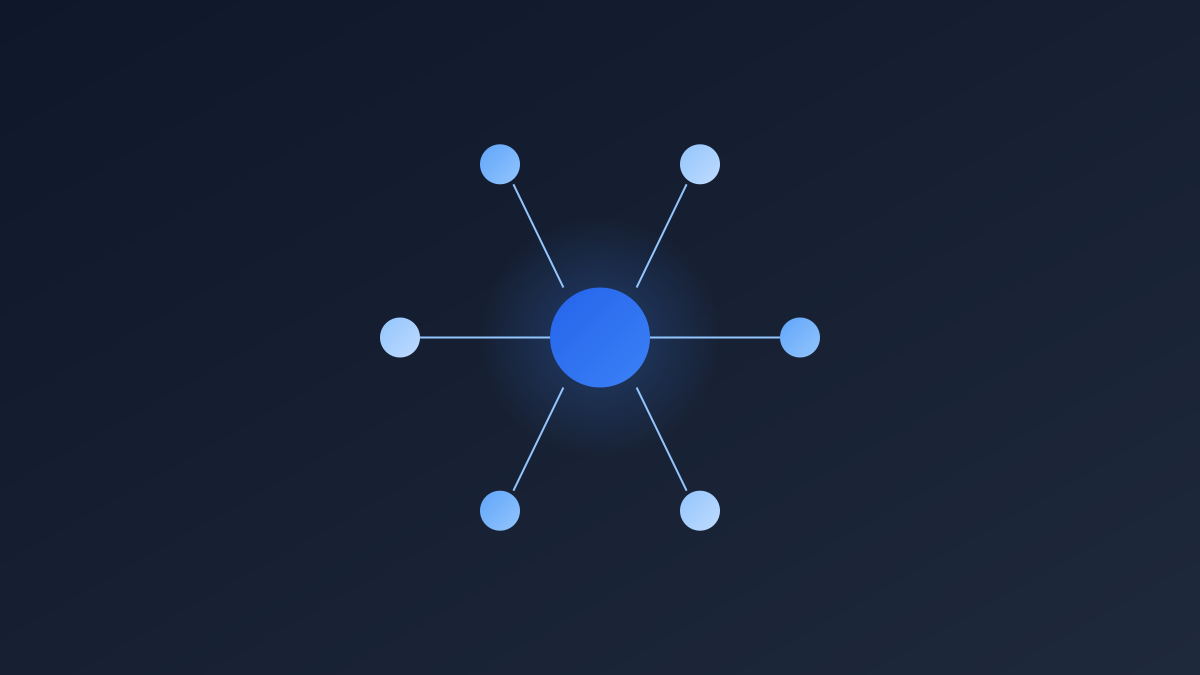
The system uses a graph structure: User Request → Nexus Router → Complexity/Creative/Cost Assessment → Response Synthesizer → Unified Response → Feedback Loop This enables state management, parallel processing, and continuous optimization via feedback.

Adaptive Learning

The system learns from interactions to refine routing, using metrics like task success, historical model performance, and cost-benefit ratio.

Multi-Model Fusion Example

For legal document analysis:

  1. Claude extracts key clauses (structured reasoning).
  2. GPT-4 translates legal jargon to plain language.
  3. Embedding models find relevant precedents.
  4. Results are synthesized into a unified answer.
4

Section 04

Key Features & Practical Use Cases

Workflow Templates

Pre-built templates for common scenarios:

  • Research Assistant: Claude (depth analysis) + GPT-4 (cross-validation) + 5 iterations.
  • Creative Writing: GPT-4 Turbo (generation) + Claude 3 Opus (quality) + style consistency.
  • Tech Analysis: Parallel GPT-4o/Claude + 0.8 consensus threshold + human fallback.

Multi-Provider Support

  • OpenAI: GPT-4 Turbo (creativity), GPT-4o (balance), GPT-4o Mini (cost).
  • Anthropic: Claude 3.5 Sonnet (reasoning), Claude 3 Opus (high quality).
  • Local: Ollama (Llama3.1, Mistral) as backup.

Usage Examples

  • Basic Query: nexus "Explain quantum entanglement to a 10-year-old" (auto-selects optimal model).
  • Research Workflow: nexus --workflow research_assistant --input climate_change_impacts.pdf.
  • Parallel Analysis: nexus --parallel --query "Ethical impacts of neural interfaces" --providers openai anthropic local.
5

Section 05

Value & Future Outlook

Developer Value

  • Decouple Model Dependencies: Apps are not tied to a single provider.
  • Cost Optimization: Choose cost-effective models for each task.
  • Reliability: Multi-model backups reduce single-point failures.
  • Capability Expansion: Combine models to exceed individual limits.

Ecosystem Impact

  • Shift to Orchestration: Focus moves from choosing models to designing optimal workflows.
  • Cost Awareness: Developers prioritize reasoning cost optimization.
  • Multi-Modal Norm: Future apps will default to multi-model collaboration.

Future

As AI models grow in number, orchestration systems like NexusFlow will become essential. Mastering multi-model orchestration will be a core skill for next-gen AI developers, with NexusFlow serving as a best-practice reference.



