Zing Forum

Reading

NEXUS: A Hybrid AI Inference Kernel for Mobile Devices —— Fusion Practice of Mamba and Graph-RAG

NEXUS is a hybrid AI inference kernel optimized for ARM64 and Android environments, innovatively combining State Space Model (Mamba) and Graph Retrieval-Augmented Generation (Graph-RAG) technologies to bring efficient local AI inference capabilities to mobile devices.

MambaGraph-RAG状态空间模型移动AIARM64优化TermuxAndroid边缘推理知识图谱本地AI
Published 2026-04-21 06:34Recent activity 2026-04-21 06:50Estimated read 6 min
NEXUS: A Hybrid AI Inference Kernel for Mobile Devices —— Fusion Practice of Mamba and Graph-RAG
1

Section 01

NEXUS Project Guide: Innovative Practice of Hybrid AI Inference on Mobile Devices

NEXUS is a hybrid AI inference kernel optimized for ARM64 and Android environments, innovatively integrating State Space Model (Mamba) and Graph Retrieval-Augmented Generation (Graph-RAG) technologies. It aims to address challenges such as limited resources on mobile devices, and issues like latency, privacy concerns, and offline unavailability in cloud-based solutions, thereby achieving efficient local AI inference capabilities.


2

Section 02

Current Status and Challenges of Mobile AI Inference

With the migration of Large Language Models (LLMs) to edge devices, mobile devices face problems such as limited computing resources, memory constraints, and high power consumption requirements, making it difficult to run large Transformer models directly. Traditional cloud API calling solutions have pain points like network latency, privacy risks, and offline unavailability. How to achieve efficient local AI inference on resource-constrained devices has become an important topic.

3

Section 03

Core Technologies of NEXUS: Fusion Architecture of Mamba and Graph-RAG

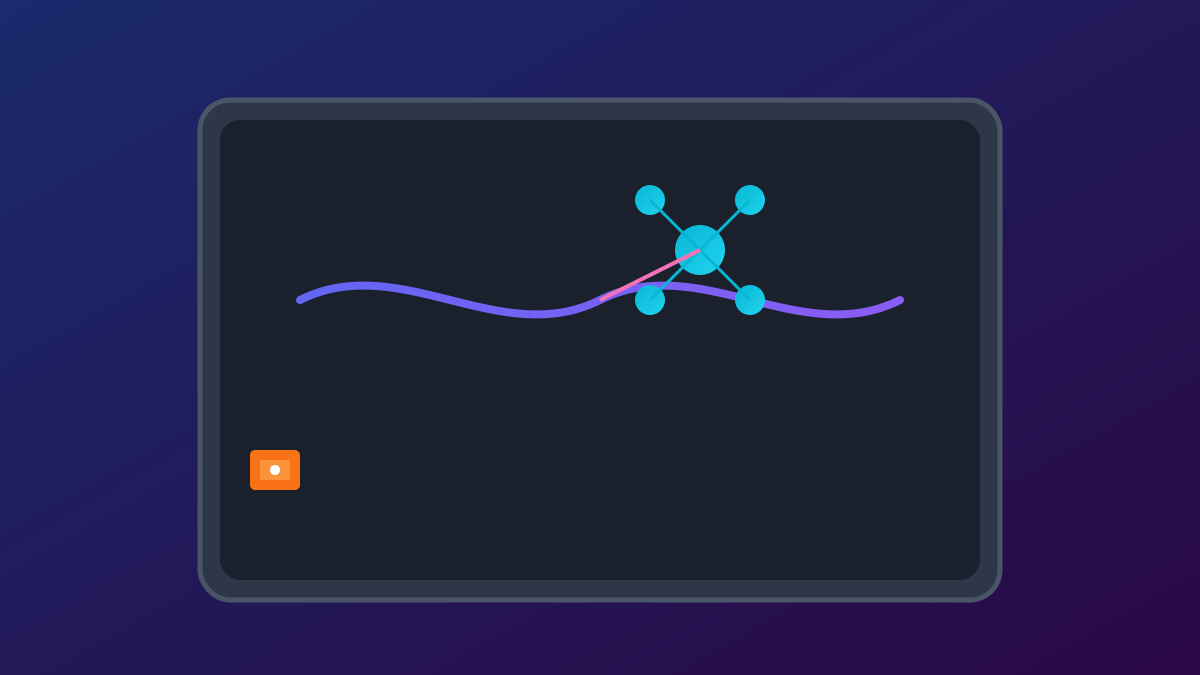
NEXUS adopts a hybrid architecture of Mamba + Graph-RAG:

  1. Advantages of Mamba: Linear complexity (O(N)), state compression, hardware-friendly, more efficient than Transformer;
  2. Advantages of Graph-RAG: Structured knowledge representation, relation-aware retrieval, reasoning path tracking, solving issues of knowledge timeliness and accuracy;
  3. Fusion Process: User query → Graph retrieval → Relevant subgraph → Mamba inference → Augmented generation, balancing efficiency and quality, supporting modular expansion.
4

Section 04

Technical Implementation and Performance Comparison of NEXUS

Termux Environment Optimization: ARM64 native compilation, memory management optimization, storage compression, quantization support (INT8/INT4), dynamic batching, background serviceization; Technical Details: Includes embedding layer, graph encoder, Mamba inference layer, output generator; supports knowledge graph formats like RDF/OWL and property graphs; adopts KV cache management, graph index compression, and adaptive computing strategy; Performance Comparison: Compared with cloud LLMs, mobile quantized Transformers, and local RAG, NEXUS has advantages such as native mobile adaptation, built-in knowledge enhancement, and full offline capability (see comparison table for details).

5

Section 05

Typical Application Scenarios of NEXUS

  1. Offline Intelligent Assistant: Local knowledge Q&A, document summarization, code assistance;
  2. Privacy-Sensitive Applications: Personal document analysis, sensitive information processing, local chat record analysis;
  3. Edge Computing Nodes: IoT control, on-site data collection and analysis, edge end of distributed inference;
  4. Development Prototype Verification: Mamba+Graph-RAG architecture verification, mobile AI prototype development, edge performance benchmark testing.
6

Section 06

Open Source Value and Future Evolution of NEXUS

Open Source Contributions: Provides reproducible hybrid architecture, Termux optimization experience, mobile AI performance benchmarks, and modular expansion framework; Future Directions: Multimodal expansion (vision/speech), federated learning support, hardware acceleration (NPU/GPU), cross-platform porting (iOS/embedded Linux).

7

Section 07

Significance and Summary of the NEXUS Project

Through architectural innovation (Mamba+Graph-RAG) and system optimization, NEXUS achieves practical AI capabilities on resource-constrained mobile devices without blindly pursuing model size. It is an open-source project worth attention in the fields of edge AI, mobile development, and privacy computing.

