Zing Forum

Reading

Nexus AI Agent: A Multi-Agent Telegram Bot Architecture for Production Environments

Nexus AI Agent is an offline-first multi-agent Telegram bot designed for automation, task management, and intelligent conversations, demonstrating how to apply multi-agent architecture to production-grade AI workflows.

AI Agent多智能体架构Telegram机器人自动化任务管理智能对话生产级AI
Published 2026-05-29 05:14Recent activity 2026-05-29 05:17Estimated read 8 min
Nexus AI Agent: A Multi-Agent Telegram Bot Architecture for Production Environments
1

Section 01

[Introduction] Nexus AI Agent: Core Overview of Production-Grade Multi-Agent Telegram Bot Architecture

Nexus AI Agent is an offline-first multi-agent Telegram bot designed for automation, task management, and intelligent conversations, demonstrating how to apply multi-agent architecture to production-grade AI workflows. Original author/maintainer: bot523h, Source platform: GitHub, Original link: https://github.com/bot523h/nexus-ai-agent, Release time/Update time: 2026-05-28T21:14:38Z.


2

Section 02

Background: Evolution from Single-Agent to Multi-Agent Architecture

With the continuous enhancement of large language model capabilities, the concept of AI Agents is moving from academic research to practical applications. Early AI assistants mostly adopted a single-agent architecture—one model handling all tasks. However, as application scenarios become more complex, single-agent architectures face issues such as role confusion, task conflicts, and context explosion. The multi-agent architecture emerged as a solution, achieving clearer division of responsibilities and more efficient collaboration by assigning different functions to specialized agents.

3

Section 03

Core Design: Offline-First and Multi-Agent Collaboration Mechanism

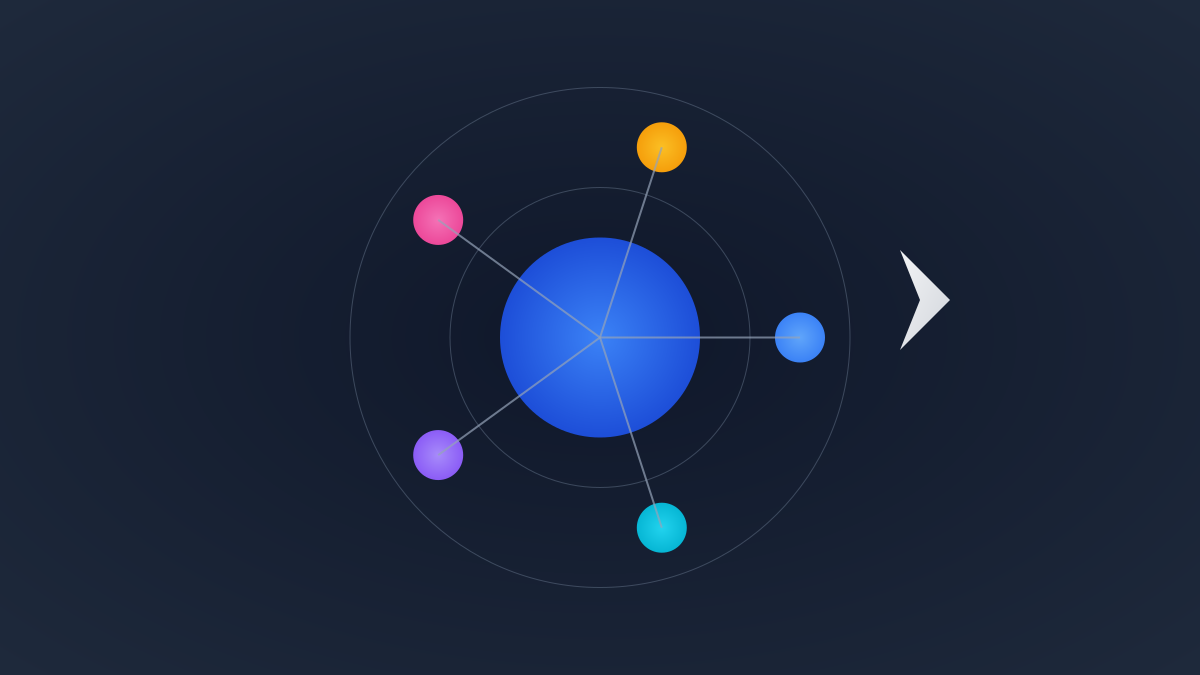
The most prominent feature of Nexus AI Agent is its adoption of a multi-agent architecture. Its 'offline-first' design ensures basic functionality remains available when the network is unstable or disconnected, which requires careful design of local caching, message queues, and synchronization mechanisms. In the multi-agent collaboration mechanism, different agents have clear divisions of labor: the Dialogue Agent handles natural language interaction and user intent understanding; the Task Management Agent is responsible for task creation, tracking, and status updates; the Automation Agent executes predefined automated workflows; and the Coordination Agent manages inter-agent communication and conflict resolution.

4

Section 04

Technical Implementation: Telegram Integration and Production-Grade Architecture

Nexus requires deep integration with the Telegram Bot API to handle message types such as text, images, and files, manage session states, and utilize features like inline keyboards and command menus. The project emphasizes 'scalable and production-ready', with careful design in code structure, error handling, logging, and monitoring. Additionally, the system has task management and automation capabilities, possibly integrating workflow engines or task scheduling mechanisms to execute complex multi-step tasks based on user commands or preset rules.

5

Section 05

Application Scenarios: Personal, Team, and Automated Workflows

The multi-agent architecture of Nexus has significant value in multiple scenarios: in personal assistant scenarios, it can help manage schedules, set reminders, and record to-do items; in team collaboration scenarios, it can track project progress, assign tasks, and send notifications; in automated workflow scenarios, it can perform tasks such as scheduled report sending, specific event monitoring, and integration with other services to improve work efficiency.

6

Section 06

Advantages and Challenges of Multi-Agent Architecture

Advantages: Clear responsibilities (each agent focuses on a specific domain), parallel processing (multiple agents working simultaneously improves response speed), modularity (easy to add/modify functions), fault tolerance (failure of a single agent does not affect the whole system). Challenges: Coordination complexity (inter-agent communication and conflict resolution require careful design), context management (difficulty in sharing and synchronizing context between multiple agents), resource consumption (running multiple agents requires more computing resources), debugging difficulty (behavior tracking and problem localization are more complex).

7

Section 07

Developer Insights and Future Directions

Insights: Architecture design is as important as model selection; engineering considerations (offline support, error handling, scalability) are key to transforming prototypes into production systems; choosing appropriate platforms (such as Telegram) can reduce user acquisition costs. Future Directions: Smarter coordination mechanisms (using large language models to coordinate multi-agents), vision-language fusion (integrating multi-modal capabilities), cross-platform integration (supporting more communication platforms), personalized learning (adjusting behavioral preferences based on user habits).

8

Section 08

Conclusion: Value and Significance of Nexus AI Agent

Nexus AI Agent represents an important direction in AI Agent applications—combining multi-agent architecture with mature communication platforms to create practical and scalable intelligent assistants. For developers and researchers interested in AI Agent technology, this is an open-source project worth paying attention to. It not only demonstrates the technical feasibility but also provides valuable experience in transforming AI capabilities into practical products.

