Zing Forum

Reading

Nexus AI: Multi-Model Intelligent Orchestration System, Building a Unified Cognitive Layer

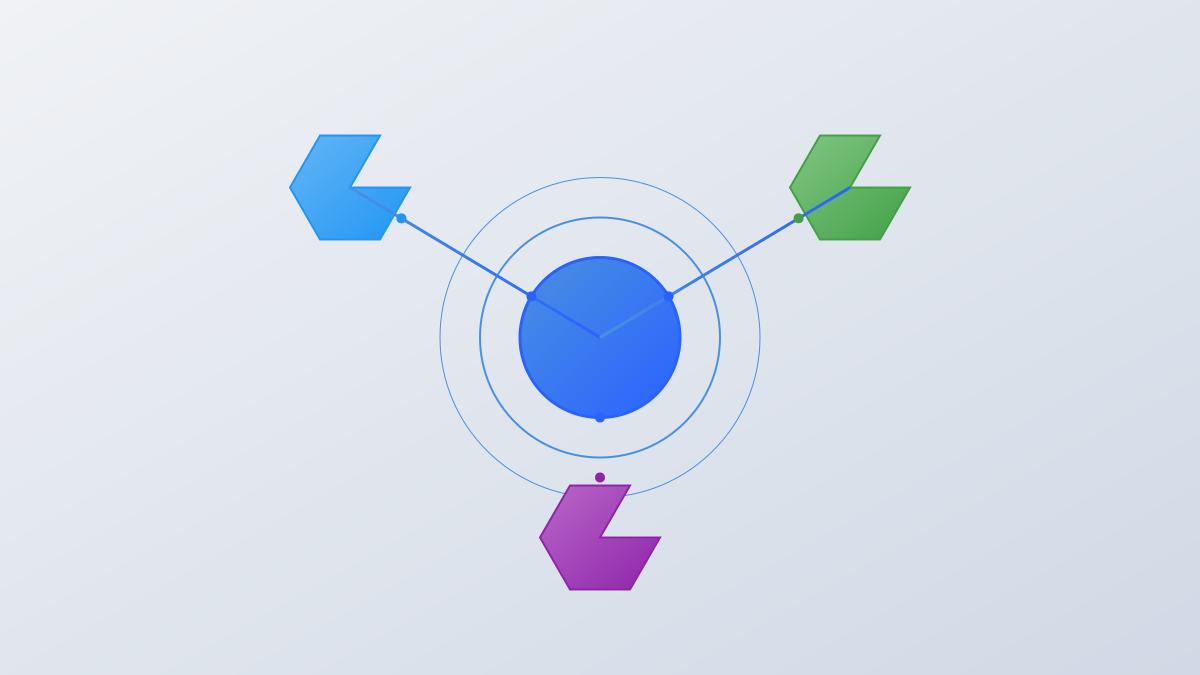
Nexus AI is an advanced multi-model intelligent orchestration platform that builds a unified cognitive system with reasoning, planning, and decision-making capabilities by coordinating multiple large language models such as OpenAI, Gemini, and DeepSeek.

多模型编排AI 智能系统LLM 协调OpenAIGeminiDeepSeek集体智能模型路由
Published 2026-05-28 05:31Recent activity 2026-05-28 05:47Estimated read 7 min
Nexus AI: Multi-Model Intelligent Orchestration System, Building a Unified Cognitive Layer
1

Section 01

Nexus AI: Core Guide to the Multi-Model Intelligent Orchestration System

Nexus AI: Core Guide to the Multi-Model Intelligent Orchestration System

  • Original Author/Maintainer: Diab-software
  • Source Platform: GitHub
  • Release Date: May 27, 2026

Nexus AI is an innovative multi-model intelligent orchestration platform. Its core design concept is to break the limitations of a single model, coordinate multiple mainstream AI engines like OpenAI, Google Gemini, and DeepSeek, and build a unified cognitive system with reasoning, planning, and decision-making capabilities. Through intelligent orchestration, each model can leverage its strengths, compensate for the shortcomings of a single model, and provide more comprehensive and reliable intelligent services.


2

Section 02

Background of Nexus AI: Limitations of Single LLMs

Background of Nexus AI: Limitations of Single LLMs

The current large language model market is flourishing, but each model has inherent limitations: OpenAI's GPT series excels in general dialogue and code generation but may lack depth in specific domain knowledge; Google Gemini has advantages in multimodal understanding and long-context processing; emerging models like DeepSeek specialize in mathematical reasoning and Chinese context comprehension. Choosing a single model requires trade-offs between cost, speed, accuracy, and specific capabilities. Nexus AI proposes a multi-model collaboration approach, analogous to how team members with different expertise collaborate to complete complex tasks.

3

Section 03

Core Architecture and Working Mechanism of Nexus AI

Core Architecture and Working Mechanism of Nexus AI

The core is the Orchestration Layer, which is responsible for receiving user requests, analyzing task types, selecting appropriate model combinations, and integrating outputs. When facing complex problems, it first decomposes and classifies tasks (e.g., splitting a comprehensive task into sub-tasks like code logic analysis, document writing, performance evaluation), assigns them to models with corresponding expertise; after each model completes its task, the orchestration layer integrates the results, resolves contradictions to ensure consistency and coherence, and improves task accuracy and complex problem-solving capabilities.

4

Section 04

Practical Application Scenarios of Nexus AI

Practical Application Scenarios of Nexus AI

  • Software Development Field: Call models for code generation, test case generation, and document writing to automate the complete process from requirement analysis to code implementation and test coverage.
  • Content Creation Scenario: Coordinate models for creative generation, fact-checking, and language polishing to ensure content is both creative and accurate/reliable.
  • Scientific Research/Business Analysis: Different models analyze from multiple angles to provide comprehensive insights.
  • Enterprise-Level Applications: Provide a unified access layer, flexibly allocate model resources, optimize cost and performance, and avoid single-vendor lock-in.
5

Section 05

Technical Challenges and Countermeasures of Nexus AI

Technical Challenges and Countermeasures of Nexus AI

Challenges: Coordination and consistency assurance between models (differences in output style, confidence level, response time), latency control (network overhead and computing costs of multi-model calls).

Solutions:

  • Intelligent routing mechanism: Dynamically select the optimal model combination;
  • Result fusion algorithm: Integrate outputs via weighted voting and confidence evaluation;
  • Feedback learning mechanism: Continuously optimize model selection and task allocation;
  • Latency control: Reduce response time through parallel calls, caching mechanisms, and predictive loading.
6

Section 06

Future Trends and Recommendations for Nexus AI

Future Trends and Recommendations for Nexus AI

  • Trends: From single-model competition to multi-model collaboration; orchestration capabilities will become more important; future AI systems will focus on how to combine multiple models rather than choosing a single one.
  • Recommendations: Developers and enterprises can flexibly choose model combinations to reduce vendor lock-in risks; emerging models gain a more fair competitive environment, promoting healthy ecosystem development.

Conclusion: Nexus AI represents a new stage of AI from "model capability competition" to "system integration innovation". Collaboration creates more value than competition, and it is worth continuous attention.

