Zing Forum

Reading

Nexus: Architecture and Practice of an Enterprise-Grade Multi-Agent Knowledge Retrieval Platform

An in-depth analysis of an enterprise-grade RAG platform integrating multi-agent swarm, knowledge graph, and on-premises deployment, exploring how it achieves high-precision information extraction and intelligent document management.

RAG知识图谱多智能体Neo4j企业知识管理FAISS语义搜索本地部署文档检索智能策展
Published 2026-04-25 11:15Recent activity 2026-04-25 11:22Estimated read 7 min
Nexus: Architecture and Practice of an Enterprise-Grade Multi-Agent Knowledge Retrieval Platform
1

Section 01

Introduction / Main Floor: Nexus: Architecture and Practice of an Enterprise-Grade Multi-Agent Knowledge Retrieval Platform

An in-depth analysis of an enterprise-grade RAG platform integrating multi-agent swarm, knowledge graph, and on-premises deployment, exploring how it achieves high-precision information extraction and intelligent document management.

2

Section 02

Challenges and Opportunities in Enterprise Knowledge Management

The knowledge assets of modern enterprises are experiencing explosive growth, but these valuable pieces of information are often scattered across various documents, emails, and databases, forming serious information silos. Traditional keyword retrieval methods struggle to capture semantic relationships between documents, leading to:

  • Low retrieval recall rate: Users find it difficult to locate truly relevant information
  • Lack of context understanding: Inability to grasp the real intent behind queries
  • Lagging information updates: New knowledge is hard to quickly integrate into existing systems
  • Security and compliance risks: Insufficiently granular access control for sensitive information

The Nexus platform was built to address these issues. Through its multi-agent architecture, knowledge graph, and on-premises deployment capabilities, it provides enterprises with a powerful yet controllable knowledge management solution.

3

Section 03

Multi-Agent Swarm Architecture

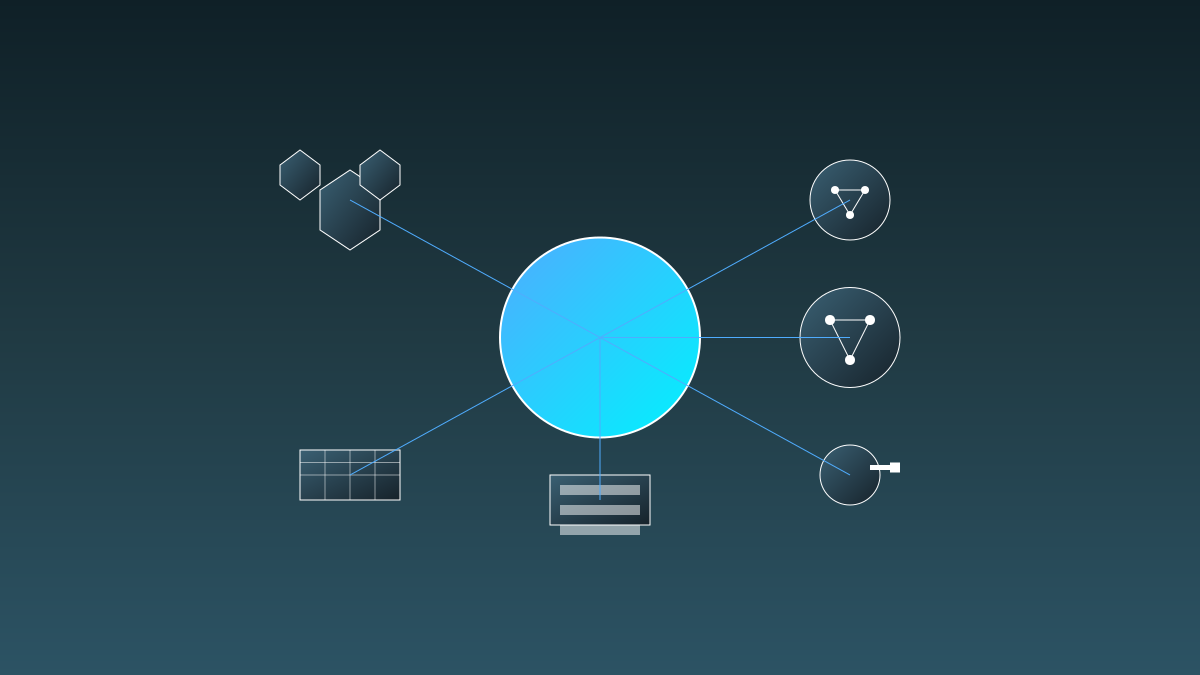
The core innovation of Nexus lies in its multi-agent swarm architecture. Unlike traditional single-model processing workflows, the platform decomposes document processing tasks into specialized agents that collaborate to complete them:

  • Extraction Agent: Responsible for extracting entities and relationships from documents
  • Validation Agent: Audits the accuracy and completeness of extraction results
  • Curation Agent: Manages the quality and relevance of the knowledge base
  • Response Agent: Generates the final user response

This division of labor and collaboration not only improves processing efficiency but also ensures that each link has specialized optimization and quality control.

4

Section 04

Knowledge Graph Integration (Neo4j)

The platform uses Neo4j as the knowledge graph storage engine to realize visual mapping of entity relationships. Through the knowledge graph, the system can:

  • Identify implicit relationships between documents
  • Support complex semantic reasoning queries
  • Provide interactive network topology visualization

In the visualization interface, high-importance nodes are highlighted in gold, while secondary connections are rendered with high contrast, allowing users to intuitively understand the structure of the knowledge network.

5

Section 05

Vector Retrieval and Semantic Search

The platform uses FAISS for vector indexing, supporting semantic-level document retrieval. After intelligent preprocessing, documents are converted into semantic vectors for storage, so retrieval is no longer limited to keyword matching but can understand the deep meaning of queries.

6

Section 06

Real-Time Analysis and Monitoring

The platform provides a tactical dashboard to monitor the following key metrics in real time:

  • Asset health: Document index status and quality scores
  • Vector density: Semantic coverage of the knowledge base
  • System latency: Query response time and throughput
  • Agent performance: Efficiency metrics for each processing link

This comprehensive observability enables the operation and maintenance team to promptly identify and resolve potential issues.

7

Section 07

Human-Machine Collaborative Approval Process

In enterprise deployments, data security is crucial. Nexus integrates a Slack approval workflow to ensure sensitive documents must undergo manual review before being stored in the library. This mechanism includes:

  • Automated Slack notifications
  • Role-based access control
  • Complete audit logs
8

Section 08

On-Premises Sovereign Deployment

Unlike many RAG platforms that rely on cloud services, Nexus supports full on-premises deployment, with all data processing completed within the enterprise's own infrastructure. This meets:

  • Data privacy compliance requirements (e.g., GDPR, data localization regulations)
  • Deployment needs for offline environments
  • Avoidance of vendor lock-in


