Zing Forum

Reading

NanoCamelid: A Rust-Native LLM Inference Engine for ARM64 and Raspberry Pi

Explore the NanoCamelid project, a high-performance large language model (LLM) inference engine written in Rust, optimized for ARM64 architecture and edge devices like Raspberry Pi.

RustARM64树莓派边缘推理LLM推理引擎NEON SIMD量化模型本地AI嵌入式设备
Published 2026-05-23 10:03Recent activity 2026-05-23 10:29Estimated read 7 min
NanoCamelid: A Rust-Native LLM Inference Engine for ARM64 and Raspberry Pi
1

Section 01

Introduction / Main Post: NanoCamelid: A Rust-Native LLM Inference Engine for ARM64 and Raspberry Pi

Explore the NanoCamelid project, a high-performance large language model (LLM) inference engine written in Rust, optimized for ARM64 architecture and edge devices like Raspberry Pi.

2

Section 02

Original Author and Source

3

Section 03

Project Background and Motivation

The deployment of large language models (LLMs) is expanding from the cloud to edge devices. With improvements in model efficiency and hardware capabilities, running AI models in resource-constrained environments like Raspberry Pi and embedded devices has become a reality. However, most existing inference engines are optimized for x86 architecture and high-end GPUs, and their performance on ARM devices is often unsatisfactory.

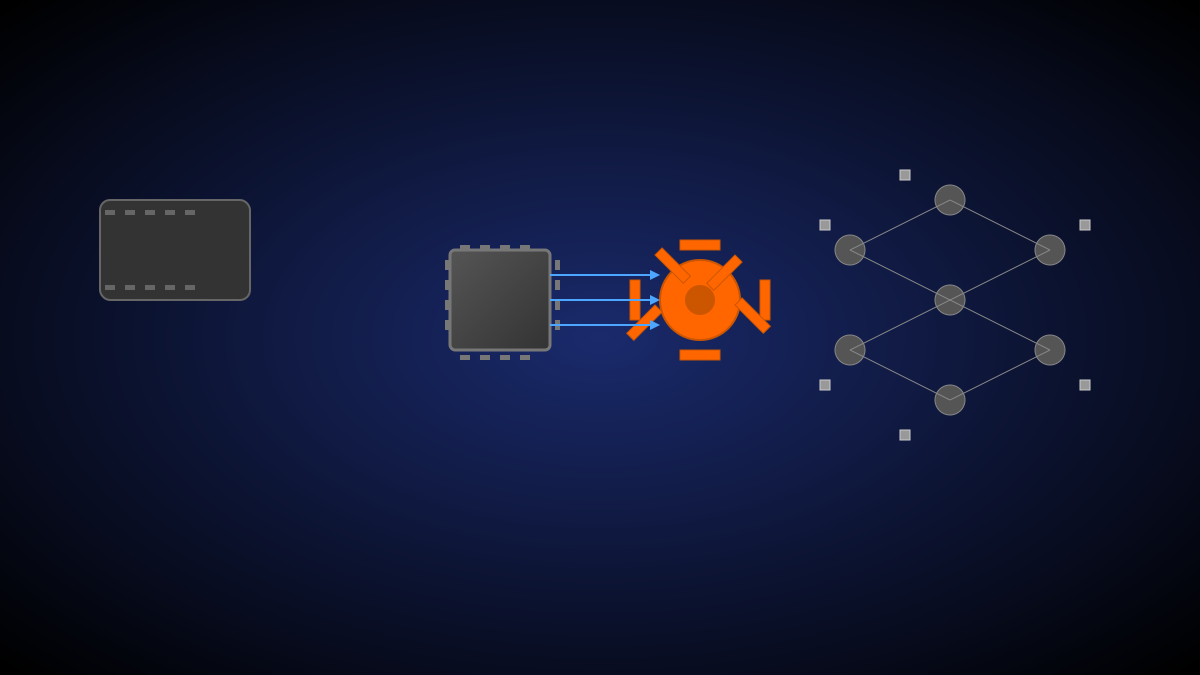
The NanoCamelid project was born out of this need—it is a Rust-native LLM inference engine specifically designed for ARM64 architecture (including Raspberry Pi). The project uses Rust as its implementation language, leveraging Rust's zero-cost abstractions, memory safety, and high-performance features to provide a lightweight yet powerful inference solution for edge AI scenarios.

4

Section 04

Performance Advantages of Rust-Native Implementation

Choosing Rust as the implementation language brings multiple advantages:

Memory Safety and Zero-Cost Abstractions

Rust's ownership system and borrow checker eliminate memory safety issues at compile time without introducing runtime overhead. For performance-sensitive applications like inference engines, this means:

  • No garbage collection pauses, making inference latency more predictable
  • Compile-time memory safety checks to avoid runtime crashes
  • Zero-cost abstractions, so advanced features do not sacrifice performance

Cross-Platform Compilation Support

Rust's excellent cross-compilation capabilities make it easy to build optimized binaries for ARM64 targets:

  • Native support for ARM NEON SIMD instruction set
  • Optimizable for specific ARM cores (Cortex-A72, A76, etc.)
  • Static linking to generate standalone executables
5

Section 05

ARM64 Architecture Optimizations

NanoCamelid has been specifically optimized for ARM64 architecture:

NEON SIMD Acceleration

ARM NEON is an advanced SIMD (Single Instruction Multiple Data) extension for ARM architecture. NanoCamelid uses NEON instructions to accelerate matrix operations:

  • Vectorized matrix multiplication kernels
  • Parallel attention computation
  • Optimized activation function implementations

These optimizations can bring significant performance improvements on NEON-supported devices like Raspberry Pi 4.

Memory Layout Optimization

The memory bandwidth and cache hierarchy of ARM devices are different from x86. NanoCamelid addresses these characteristics:

  • Optimized memory layout of weight matrices to improve cache hit rate
  • Reduced memory allocation and copy operations
  • Supports memory-mapped model loading to reduce startup time and memory usage
6

Section 06

Edge Device-Friendly Design

Low Memory Footprint

Edge devices usually have limited memory (Raspberry Pi 4 has 1-8GB RAM). NanoCamelid reduces memory requirements through the following methods:

  • Supports 4-bit and 8-bit quantized models
  • Streams model weights without loading the entire model at once
  • Memory pool management to reduce fragmentation

Low Power Operation

For battery-powered edge devices, power consumption is a key consideration:

  • Efficient CPU utilization to reduce idle waiting
  • Supports batch processing to amortize overhead
  • Optional asynchronous inference mode
7

Section 07

Local AI Assistant on Raspberry Pi

Raspberry Pi is a popular platform for education, prototyping, and lightweight deployment. NanoCamelid makes it possible to run local LLMs on Raspberry Pi:

  • Smart Home Control: Voice command understanding and scenario reasoning
  • Educational Programming: Students can experiment with AI on familiar hardware
  • Offline Document Processing: Local document summarization and Q&A
8

Section 08

Industrial Edge Gateway

In Industrial Internet of Things (IIoT) scenarios:

  • Device Log Analysis: Real-time parsing and classification of device logs
  • Predictive Maintenance: Fault diagnosis based on text descriptions
  • Operation Guidance: Natural language-based device operation queries


