Zing Forum

Reading

AI Weather Agent Based on n8n: A Complete Workflow from Data Acquisition to Natural Language Report Generation

This is an AI automation project for beginners, demonstrating how to build a weather agent using the n8n visual workflow platform. The project implements an end-to-end process from real-time weather data acquisition to natural language report generation, making it an excellent example for getting started with AI agent development.

n8nAI自动化天气智能体工作流低代码LLMAgent可视化编排
Published 2026-04-26 05:14Recent activity 2026-04-26 05:19Estimated read 5 min
AI Weather Agent Based on n8n: A Complete Workflow from Data Acquisition to Natural Language Report Generation
1

Section 01

Introduction to the n8n-based AI Weather Agent Project

This is an AI automation project for beginners, demonstrating how to build a weather agent using the n8n visual workflow platform. The project implements an end-to-end process from real-time weather data acquisition to natural language report generation, covering core elements such as external API integration, data transformation, LLM calls, and output formatting, making it an excellent example for getting started with AI agent development.


2

Section 02

Project Background and Positioning

For novice developers who want to get started with AI automation, finding practical and easy-to-understand projects is a big challenge. The weather-agent-n8n project was created by developer Khalid-Salah-ai as his first AI automation practice project. Positioned as an introductory example, it fully covers the core elements required to build production-level AI applications: external API integration, data transformation, LLM calls, and output formatting.

3

Section 03

Core Features of the n8n Platform

n8n is an open-source visual workflow automation tool using the fair-code licensing model, allowing users to build automation processes by dragging and dropping nodes. Its core advantages include: 1. Self-hosting capability for data control; 2. Visual editing to lower the entry barrier; 3. Rich integrations (400+ nodes); 4. Native AI support (built-in LangChain nodes).

4

Section 04

Project Architecture and Data Flow Analysis

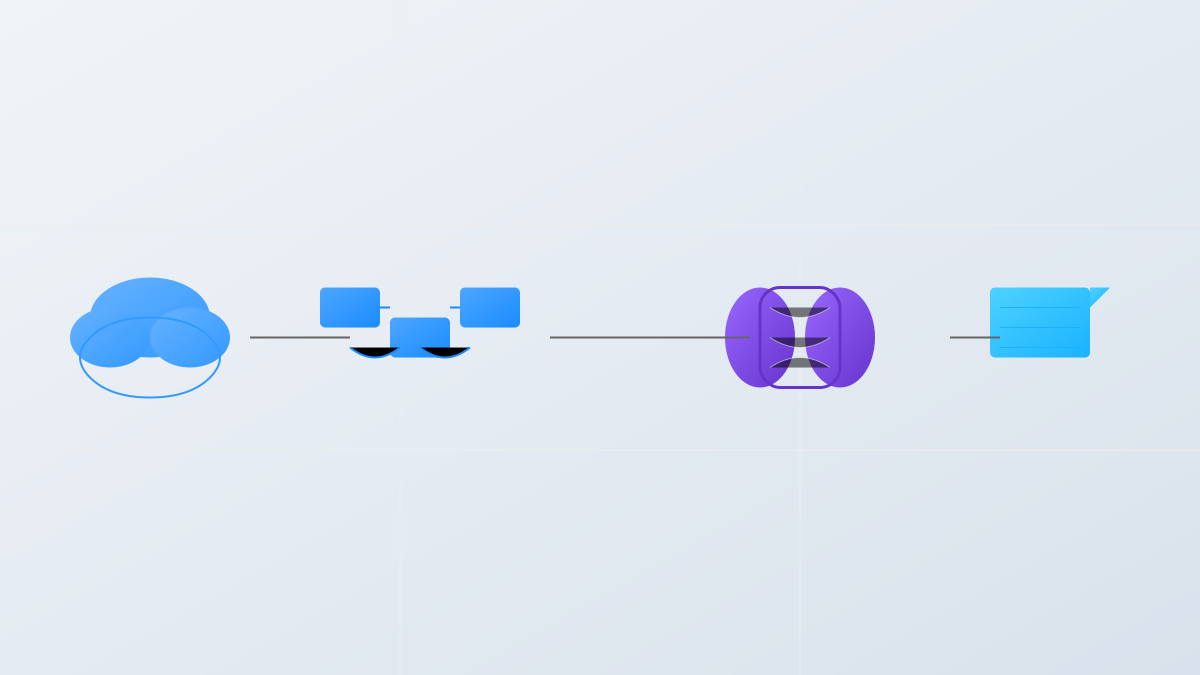
The project workflow follows a clear pipeline: User input → Geolocation parsing → Weather API call → Data cleaning → LLM report generation → Output delivery. Key components include: 1. Trigger and input nodes (receiving geolocation); 2. Weather data acquisition nodes (integrating APIs like OpenWeatherMap to get information such as temperature and humidity); 3. AI Agent nodes (calling LLM to generate natural language reports); 4. Output and notification nodes (delivery channels like email and Slack).

5

Section 05

Key Technical Implementation Details

Technical details include: 1. Prompt engineering: Structured prompts ensure consistent output (e.g., meteorologist role, including weather overview, temperature recommendations, etc.); 2. Error handling: API rate limit handling, data validation, fallback for failed model calls; 3. Data transformation: Converting raw JSON data into LLM-friendly formats (e.g., temperature from Kelvin to Celsius).

6

Section 06

Project Expansion and Improvement Suggestions

Expansion directions include feature enhancements (multi-day forecasts, disaster warnings, personalized recommendations, voice broadcasts) and architecture upgrades (data persistence, user management, scheduled tasks, intelligent geolocation recognition).

7

Section 07

Learning Value and Reference Significance of the Project

For beginners: Clear concepts (working principles of AI Agents), modern tech stack (low-code trend), strong practicality; For experienced developers: Fast prototype verification, visual debugging, team collaboration-friendly.

8

Section 08

Deployment Guide and Project Summary

Deployment steps: 1. Install n8n via Docker; 2. Obtain a weather API key; 3. Configure LLM credentials; 4. Import the workflow and configure parameters. Summary: The project fully presents the modern AI automation paradigm (deterministic processes + generative AI), serving as an excellent starting point for getting into AI workflow development. Mastering hybrid architectures is an essential skill for future developers.

