Zing Forum

Reading

MultiProxy: A High-Performance Multi-Backend Aggregation Proxy for Local LLM Inference

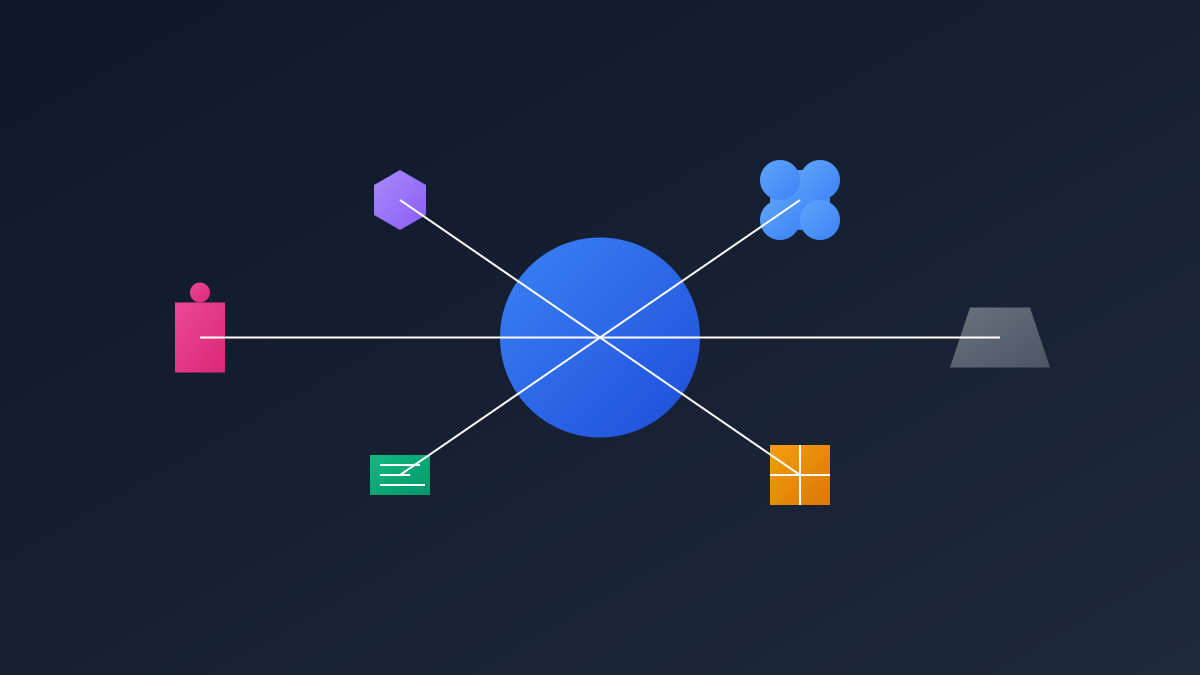
MultiProxy is an open-source multi-backend proxy tool that aggregates multiple llama-server instances into a unified OpenAI/Anthropic-compatible API endpoint, and comes with a real-time HTMX dashboard for monitoring token flows and performance metrics.

LLMproxyllama.cppOpenAIAnthropicHTMX本地部署API网关负载均衡
Published 2026-04-19 09:43Recent activity 2026-04-19 09:50Estimated read 5 min
MultiProxy: A High-Performance Multi-Backend Aggregation Proxy for Local LLM Inference
1

Section 01

MultiProxy: Introduction to the High-Performance Multi-Backend Aggregation Proxy for Local LLM Inference

MultiProxy is an open-source multi-backend aggregation proxy tool designed for local LLM inference scenarios. It integrates multiple llama-server instances into a unified OpenAI/Anthropic-compatible API endpoint and provides a real-time monitoring dashboard based on HTMX. It addresses core pain points in local deployment such as complex multi-backend management, inconsistent protocols, and lack of monitoring, providing teams with a lightweight and complete private AI infrastructure solution.


2

Section 02

Background: Management Pain Points of Local LLM Deployment

With the development of open-source LLMs (such as LLaMA, Qwen), local deployment (represented by llama.cpp) has become a trend, but multi-backend management faces challenges:

  • Clients need to hardcode multiple endpoint URLs
  • Inconsistent API protocols across different backends
  • Lack of a unified monitoring view
  • Failover needs to be implemented manually, which is high-risk.
3

Section 03

Core Positioning and Dual Protocol Compatibility Features

MultiProxy is an intelligent traffic routing and aggregation platform (not an inference engine). It supports dual protocol compatibility: OpenAI Endpoints: /v1/chat/completions (conversation completion), /v1/responses (structured response) Anthropic Endpoints: /v1/messages (Claude-style messages), /v1/messages/count_tokens (token counting) Clients can switch to local backends with zero modifications, and request/response formats are automatically translated.

4

Section 04

Intelligent Routing and Model Mapping Configuration

Flexible configuration via config.yaml:

  • Model ID mapping: Map model names requested by clients (e.g., gpt-4-turbo) to specific backends
  • Default fallback: Route to a preset backend when the model is not found
  • Context window pre-check: Query backend context limits at startup and reject requests exceeding the window in advance.
5

Section 05

HTMX Real-Time Dashboard: Out-of-the-Box Observability

Built-in HTMX-based web dashboard (default port 8080), no complex build required:

  • Core metrics: Tokens per second, first token time, aggregated usage
  • Real-time activity stream: Server-Sent Events dynamically refresh request status Uses server-side rendering + progressive enhancement to reduce maintenance complexity.
6

Section 06

Elasticity and Fault Tolerance Mechanisms: Production-Grade Reliability

Multi-layer fault tolerance design:

  • Graceful failover: Automatically try other nodes when a backend errors out or times out
  • Error semantic translation: Convert backend-specific errors to standard formats
  • SSE stream protection: Ensure clients receive termination signals when streaming responses are disconnected.
7

Section 07

Deployment Guide and Applicable Scenarios

Deployment Steps:

  1. Python 3.14+ environment
  2. Install dependencies: pip install -r requirements.txt
  3. Create config.yaml
  4. Start: ./start.sh API listens on port 8001, dashboard on port 8080. Applicable Scenarios: Multi-model labs, team-shared infrastructure, A/B testing, cost-sensitive inference clusters.
8

Section 08

Open Source Ecosystem and Conclusion

MultiProxy uses the MIT license, allowing free commercial use and modification. Its code structure is clear (implemented in Python), making it a reference for learning proxy architectures. It fills the infrastructure gap in local LLM deployment, lowers the threshold for multi-backend management and operation, and provides a lightweight and complete starting point for private AI teams.

