Zing Forum

Reading

Multimodal Outpost: A One-Stop Collection of Practical Notebooks for Multimodal Vision-Language Models

A carefully curated open-source notebook collection covering Colab implementations of 30+ cutting-edge multimodal vision-language models (VLMs), spanning core scenarios like OCR, image captioning, and video understanding

多模态视觉语言模型VLMOCR图像描述视频理解ColabQwen2.5-VLFlorence-2开源AI
Published 2026-04-28 21:02Recent activity 2026-04-28 21:19Estimated read 9 min
Multimodal Outpost: A One-Stop Collection of Practical Notebooks for Multimodal Vision-Language Models
1

Section 01

Introduction: Multimodal Outpost – A One-Stop Collection of Practical Notebooks for Multimodal VLMs

Multimodal Outpost is a carefully curated open-source notebook collection covering Colab implementations of 30+ cutting-edge multimodal vision-language models (VLMs), spanning core scenarios like OCR, image captioning, and video understanding. This project aims to lower the barrier for developers and researchers to get started with VLMs, adopting a ready-to-use design. All notebooks are optimized for the Google Colab environment, allowing cloud-based execution without the need to configure complex deep learning environments locally.


2

Section 02

Project Background and Positioning

This project was created and maintained by developer PRITHIVSAKTHIUR, aiming to lower the threshold for using multimodal vision-language models. Unlike traditional code repositories, the project adopts a "ready-to-use" design philosophy, with all notebooks optimized for the Google Colab environment. Its design principle is to transform cutting-edge research results into executable, educational code examples, helping developers quickly validate ideas, learn model features, and integrate them into applications.

3

Section 03

Core Features and Technical Coverage

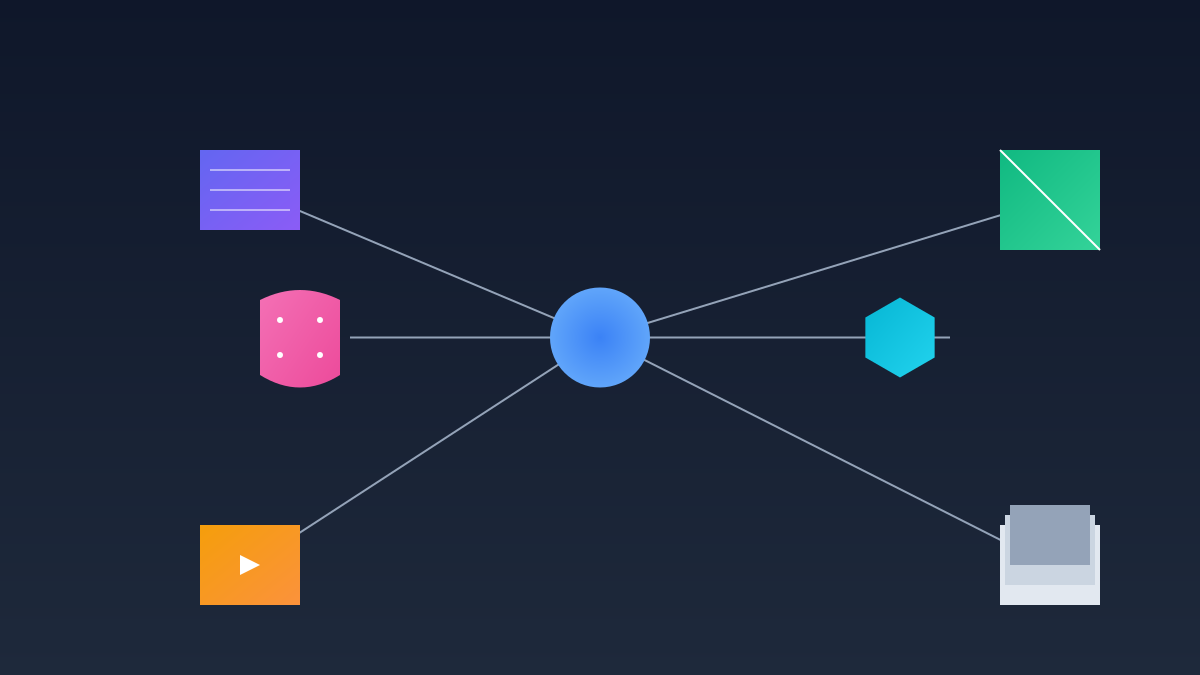
Multimodal Outpost covers three core application scenarios:

  1. OCR: Includes models like Camel-Doc-OCR, MonkeyOCR, Megalodon-OCR-Sync, OCRFlux3B, nanonets-OCR, olmOCR-Qwen2-VL, and typhoon-OCR series, covering everything from simple text extraction to complex document structure recognition.
  2. Image Captioning and Understanding: Includes models like Florence-2-Models-Image-Caption, Qwen2.5-VL-3B/7B-Abliterated-Caption-it, moondream2-2025-06-21, and Inkscope-Captions-2B, supporting image caption generation and visual question answering.
  3. Video Content Understanding: Includes models like Aya-Vision-8B-VideoUnderstanding, Gemma3-VL-VideoUnderstanding, Qwen2-VL/2.5-VL-VideoUnderstanding, MiMo-VL-7B-RL/SFT-VideoUnderstanding, Lumian-VLR-7B/2-VLR-7B-Thinking, and Imgscope-OCR-2B-VideoUnderstanding, capable of processing temporal information to understand video content.
4

Section 04

In-Depth Analysis of Featured Models

Notable featured models in the project include:

  1. Qwen2.5-VL Series: Alibaba's open-source VLM benchmark, offering lightweight instruction-tuned versions, image captioning-optimized versions, and OCR-specialized fine-tuned versions. It supports multiple languages and performs excellently in document understanding and chart analysis.
  2. Liquid AI's LFM2-VL Series: Adopts a liquid neural network architecture, including LFM2-VL-450M (450 million parameters) and LFM2-VL-1.6B (1.6 billion parameters), achieving excellent multimodal understanding capabilities with small parameter sizes.
  3. SmolDocling-256M: A 256 million-parameter document understanding model launched by Hugging Face, focusing on converting documents into structured Docling format, proving the practical value of small models in specific tasks.
5

Section 05

Technical Implementation and User Experience

The project's technical architecture prioritizes user experience:

  • Environment Compatibility: All notebooks are built based on the Gradio SDK, explicitly supporting Gradio ≤5.47.1. For component errors, it is recommended to downgrade to v4.57.1 to avoid dependency conflicts.
  • Automated Dependency Management: Each Colab notebook has built-in automatic dependency installation logic, eliminating the need to manually configure frameworks like PyTorch and Transformers, enabling zero-configuration onboarding.
  • Output Format Support: Integrates libraries like ReportLab, supporting export of results to DOCX and PDF formats while preserving images and structured text.
6

Section 06

Application Scenarios and Practical Value

The project has a wide range of application scenarios:

  1. Document Digitization Workflow: Batch processing of scanned documents, invoices, and contracts to convert them into searchable and editable digital formats.
  2. Content Moderation and Annotation: Automatically generating image text labels to support automated understanding for content management, e-commerce, and social media.
  3. Video Content Analysis: Extracting key frames, generating summaries, and identifying scene actions, providing a foundation for video search, recommendation, and security.
  4. Education and Learning: Demonstrating complete workflows for model loading, inference, and post-processing, serving as an excellent teaching material for understanding VLM principles.
7

Section 07

Community Contributions and Continuous Development

As an active open-source project, Multimodal Outpost continuously tracks the latest progress in multimodal AI and regularly updates to include the newest open-source models. The project's open nature encourages community contributions; developers can create variants, fine-tune for specific domains, or integrate into other frameworks.

8

Section 08

Summary and Outlook

Multimodal Outpost represents the open-source community's effort to lower the barrier to AI technology, providing developers with a treasure trove for rapid prototyping, researchers with an experimental platform, and learners with a systematic tutorial. In the future, the project will continue to expand, incorporating more innovative models and application scenarios, and offering out-of-the-box solutions for needs like OCR, image captioning, and video understanding.

