Zing Forum

Reading

MultiAgent Editorial Workflow: A LangGraph-based Multi-Agent Automated News Writing System

Introduces an open-source multi-agent editorial workflow system that uses the LangGraph framework to enable automated news writing, focusing on solving the large model hallucination problem and supporting Generation Engine Optimization (GEO).

LangGraph多智能体新闻自动化LLM幻觉GEO优化RAG内容生成AI写作
Published 2026-06-07 08:15Recent activity 2026-06-07 08:18Estimated read 7 min
MultiAgent Editorial Workflow: A LangGraph-based Multi-Agent Automated News Writing System
1

Section 01

【Introduction】MultiAgent Editorial Workflow: A LangGraph-based Multi-Agent Automated News Writing System

Introduces an open-source multi-agent editorial workflow system that uses the LangGraph framework to enable automated news writing, focusing on solving the large model hallucination problem and supporting Generation Engine Optimization (GEO). Through a multi-agent collaborative architecture, the system decomposes the news editing process into specialized nodes, improving efficiency while controlling hallucination risks to adapt to the AI-driven information distribution environment.


2

Section 02

Background and Motivation: Core Challenges of LLM News Writing

With the improvement of LLM capabilities, automated content generation has become a hot topic in the news industry, but it faces two major challenges:

  1. Hallucination Problem: Generating seemingly reasonable but incorrect information, which damages media credibility and leads to legal risks;
  2. Generation Engine Optimization (GEO): Content needs to be both human-friendly and effectively understood and cited by AI systems. Traditional single models are difficult to solve these issues, so the multi-agent collaborative architecture emerged.
3

Section 03

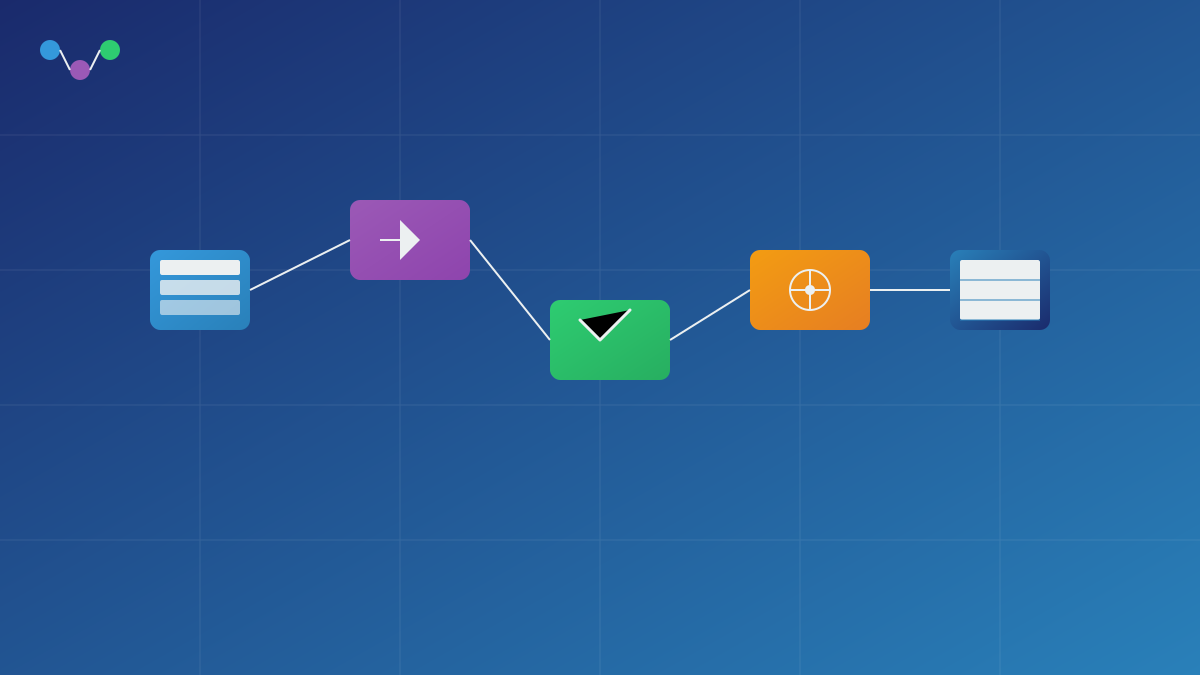
System Architecture: Multi-Agent Division of Labor and LangGraph Workflow

Multi-Agent Division of Labor

  • Topic Planning Agent: Analyzes hot topics and determines reporting directions;
  • Data Collection Agent: Relies on external data sources to obtain real information and suppress hallucinations;
  • Writing Agent: Converts data into structured manuscripts;
  • Fact-Checking Agent: Cross-validates content to reduce hallucination probability;
  • Editing and Optimization Agent: Polishes and performs GEO optimization.

LangGraph Workflow

Supports human-machine collaboration (manual review at key nodes), loop iteration (reprocesses when problems are triggered), and trajectory recording (facilitates audit and traceability).

4

Section 04

Key Technologies: Hallucination Suppression and GEO Optimization Strategies

Hallucination Suppression

  • Source Mandatory Constraint: Only uses cited information provided by the data collection agent (RAG mode);
  • Cross-Validation: Key facts are verified by at least two independent sources;
  • Confidence Scoring: Low-confidence content is marked or rewritten;
  • Structured Output: Strict templates reduce the space for free play.

GEO Optimization

  • Semantic Structuring: Uses JSON-LD/microdata to annotate key information;
  • Citation Standardization: Academic standard format + original links;
  • Q&A-Friendly Writing: Generates Q&A pairs matching user queries;
  • Multimodal Support: Reserves interfaces for image/video processing.
5

Section 05

Application Scenarios: Suitable for Various News Production Needs

  • Breaking News Alerts: Completes the entire process in minutes to provide a first draft;
  • Data News: Automatically generates data-driven reports;
  • Vertical Domain Daily Reports: Automatically generates daily reports in fields like finance/sports;
  • Multilingual Localization: Quickly generates multilingual versions to support global distribution.
6

Section 06

Technical Highlights and Current Limitations

Technical Highlights

  • Modular Design: Agents are independent and replaceable/upgradable;
  • Observability: Detailed logs track to meet transparency requirements;
  • Fault Tolerance: Automatic degradation/switching to backup solutions;
  • Cost Optimization: Lightweight models handle simple tasks to control API costs.

Limitations

  • Creative Writing Limitations: Feature articles are templated;
  • Insufficient Emotional Understanding: Lacks humanistic warmth;
  • Real-Time Dependence: Effectiveness is affected by the real-time nature of external data sources.
7

Section 07

Future Outlook and Summary: Human-Machine Collaboration is the Right Path for AI News

Future Outlook

  • Introduce professional domain knowledge bases;
  • Develop adaptive learning mechanisms;
  • Explore multimodal content generation;
  • Build industry-specific fact-checking knowledge graphs.

Summary

This system represents an important direction for AI-assisted news writing, improving efficiency and controlling hallucination risks through multi-agent collaboration. Tools do not replace human editors but liberate human resources to focus on creativity and judgment; human-machine collaboration is the correct path for implementation.

