Zing Forum

Reading

multi-llm: A Multi-Model Inference Service Architecture Based on LiteLLM and Langfuse

multi-llm is a multi-LLM inference service deployment solution that integrates LiteLLM as a unified interface layer and Langfuse as an observability platform, supporting application-based configuration and model registration management.

LiteLLMLangfuseLLM服务多模型可观测性API网关生产部署
Published 2026-06-14 06:15Recent activity 2026-06-14 06:22Estimated read 7 min
multi-llm: A Multi-Model Inference Service Architecture Based on LiteLLM and Langfuse
1

Section 01

[Introduction] multi-llm: Core Introduction to the Multi-Model Inference Service Architecture Based on LiteLLM and Langfuse

multi-llm is a production-oriented multi-LLM inference service architecture project developed by basatti. It integrates LiteLLM as a unified interface layer and Langfuse as an observability platform, and supports application-based configuration and model registration management. This project aims to address core challenges in enterprise-level LLM applications, such as managing multiple model providers, unifying interfaces, monitoring costs and performance, and provides enterprises with a production-ready LLM service deployment solution.


2

Section 02

Project Background and Problem Statement

In enterprise-level LLM applications, common challenges include: managing multiple model providers simultaneously, unifying access interfaces, monitoring costs and performance, and configuring model strategies for different application scenarios. The multi-llm project was open-sourced by basatti on GitHub in June 2026 (link: https://github.com/basatti/multi-llm) to address these issues specifically.

3

Section 03

Core Component Analysis: LiteLLM Unified Interface Layer

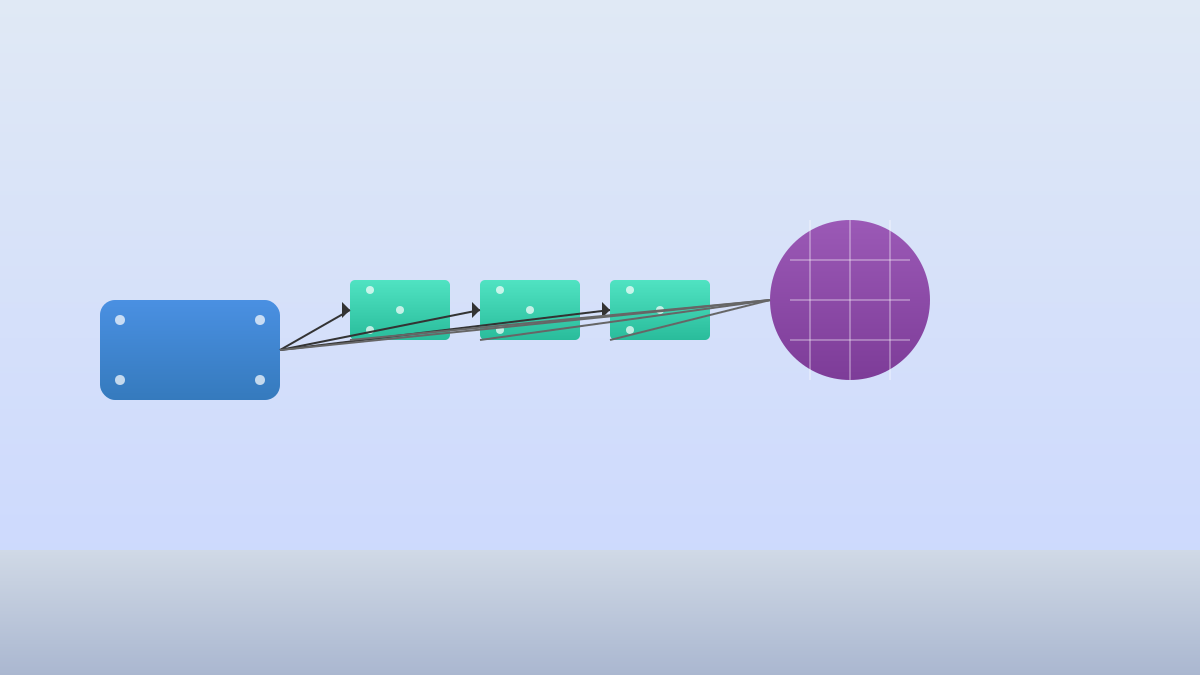
LiteLLM is one of the core components of the multi-llm architecture. It provides a unified interface compatible with the OpenAI API format and supports over 100 LLM providers (such as OpenAI, Anthropic, Azure, local models, etc.). Its key values include:

  • API standardization: Frontend calls uniformly use the OpenAI-compatible format, regardless of the backend model;
  • Load balancing: Distribute requests among multiple model endpoints to improve availability;
  • Failover: Automatically switch to alternative models;
  • Rate limit management: Track and comply with the rate limits of major providers. In the architecture, LiteLLM acts as an "intelligent router" to route requests to the appropriate model.
4

Section 04

Core Component Analysis: Langfuse Observability Platform

Langfuse provides key visualization and analysis capabilities for multi-llm and is an essential infrastructure for production environments. Its features include:

  • Request tracing: Record input, output, latency, and token usage for each call;
  • Cost analysis: Track cost consumption of different models and applications;
  • Performance monitoring: Analyze latency distribution, error rate, and throughput;
  • Debugging support: Trace call chains of complex LLM applications (such as RAG, Agent workflows). It helps users understand where costs go, resource consumption, and model response quality.
5

Section 05

Architecture Design: Application-Based Configuration and Model Registration Mechanism

A key feature of multi-llm is "application-based configuration and model registration", which supports multi-tenant scenarios: Application-level configuration isolation: Different applications can have independent configurations, such as model whitelists, budget limits, priority policies, and fallback strategies; Model registry: A centralized model directory that includes model metadata (capabilities, cost, latency), version management, health checks, and dynamic discovery (automatic registration of new models).

6

Section 06

Typical Deployment Scenarios

multi-llm is suitable for various enterprise scenarios:

  1. Multi-model provider integration: Unified access to OpenAI, Anthropic, Azure, and internal open-source models to simplify client-side code;
  2. Cost optimization: Route simple tasks to cheaper models (e.g., GPT-3.5), use high-performance models (e.g., GPT-4) for complex tasks, cache common queries, and use backup providers during peak periods;
  3. Compliance and data residency: Sensitive data is only sent to local/specific region models, non-sensitive data uses cloud services, and audit logs are fully recorded via Langfuse.
7

Section 07

Project Significance and Summary Outlook

multi-llm represents the evolution direction of LLM infrastructure from prototype verification to production readiness, demonstrating how to combine open-source tools like LiteLLM and Langfuse to build an enterprise-level LLM service layer. For enterprises, it provides a reference architecture blueprint; as LLM applications diversify, the combination of "model routing + observability + configuration management" will become a standard component of enterprise LLM platforms.

