Zing Forum

Reading

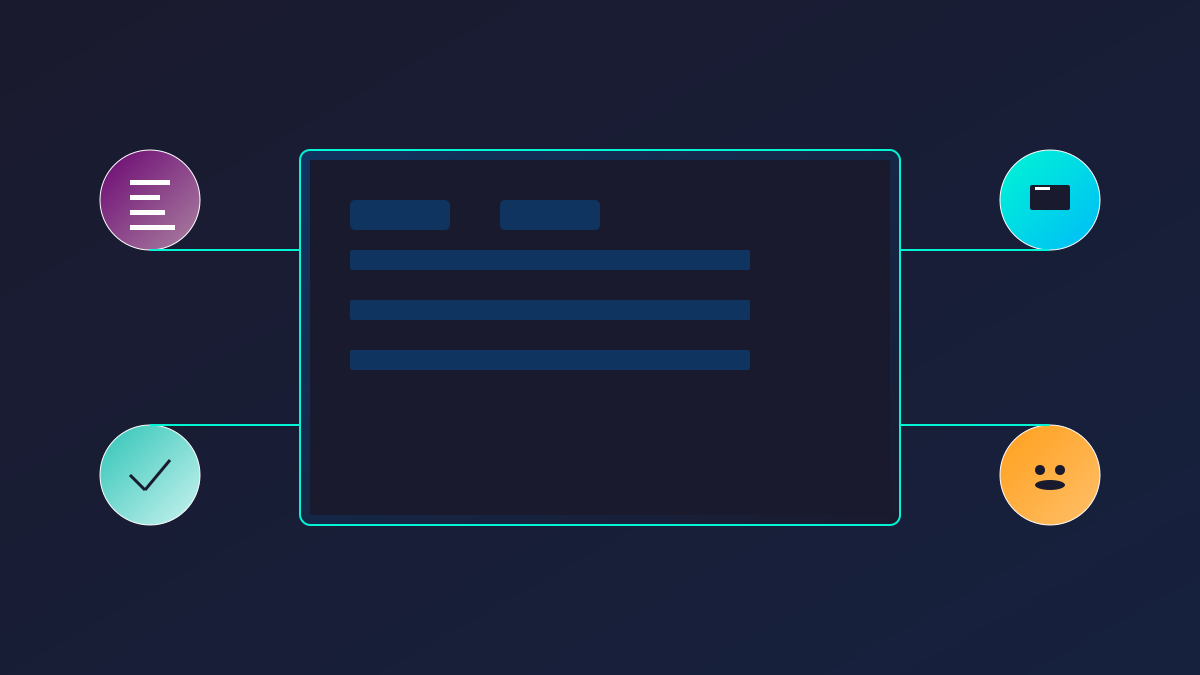
Multi-Agents Sample: A Multi-Agent WebUI Debugging Workflow Based on Codex and Playwright

A sample project supporting multi-agent WebUI debugging, providing reusable workflow templates designed specifically for integration and customization with OpenAI Codex and Playwright, helping developers automate the testing and debugging processes of web applications.

WebUI测试多智能体PlaywrightCodex自动化测试视觉回归端到端测试AI测试浏览器自动化测试工作流
Published 2026-04-15 01:15Recent activity 2026-04-15 01:35Estimated read 6 min
Multi-Agents Sample: A Multi-Agent WebUI Debugging Workflow Based on Codex and Playwright
1

Section 01

Multi-Agents Sample: Guide to the Multi-Agent WebUI Debugging Workflow Based on Codex and Playwright

Multi-Agents Sample is a multi-agent WebUI debugging framework. By deeply integrating OpenAI Codex and Playwright, it helps developers describe testing intentions in natural language and automate the testing and debugging processes of web applications. It aims to solve problems in traditional WebUI testing such as fragile selectors, complex interactions, and high maintenance costs, providing an intelligent and flexible testing solution.


2

Section 02

Traditional Dilemmas in WebUI Testing

Traditional WebUI testing faces multiple challenges:

  1. Selector Fragility: Tests relying on CSS/XPath easily fail due to UI adjustments;
  2. Interaction Complexity: Scenarios like drag-and-drop and asynchronous loading require significant engineering effort;
  3. Visual Regression Blind Spots: Functional tests struggle to catch visual issues such as style misalignment;
  4. High Maintenance Cost: Maintaining test suites consumes 20-30% of the team's time;
  5. Cross-Browser Compatibility: Need to ensure consistent performance across multiple browsers.
3

Section 03

Core Technical Architecture: Integration of Codex and Playwright

The project is built on two key technologies:

  • OpenAI Codex: Converts natural language testing intentions into code, understands failure reasons and generates repair suggestions, and produces robust selectors and assertion logic;
  • Playwright: Provides an auto-wait mechanism to reduce unstable tests, supports modern web features (Shadow DOM, iframes, etc.), and enables cross-browser parallel execution.
4

Section 04

Multi-Agent Collaboration Model

The project adopts a multi-agent architecture with clear division of labor:

  • Exploration Agent: Analyzes DOM structure, identifies interactive elements, builds navigation graphs, and generates semantic descriptions of elements;
  • Execution Agent: Converts test instructions into Playwright operations, handles waiting/retry, and captures screenshots and logs;
  • Verification Agent: Checks page state and visual elements, and compares results to generate reports;
  • Repair Agent: Analyzes failure causes, generates repair code, and suggests UI improvements.
5

Section 05

Examples of Typical Use Cases

The project applies to multiple scenarios:

  1. Regression Test Automation: Automatically execute core user journeys in CI/CD, with AI adapting to UI fine-tuning;
  2. Cross-Browser Compatibility Verification: Parallel testing across multiple browsers, identifies differences and generates comparison reports;
  3. Visual Regression Testing: Compares baseline screenshots to identify subtle visual differences;
  4. Exploratory Testing Assistance: AI autonomously explores the application, records anomalies and converts them into reproducible use cases.
6

Section 06

Implementation Recommendations

Recommendations for adopting the project:

  1. Pilot First: Choose core user journeys to verify applicability;
  2. Establish Benchmarks: Record test coverage and defect escape rate before adoption;
  3. Human-Machine Collaboration: AI testing supplements manual testing instead of replacing it;
  4. Continuous Optimization: Adjust prompts and verification strategies based on execution performance;
  5. Cost Monitoring: Track AI API usage to avoid budget overruns.
7

Section 07

Summary and Future Directions

Multi-Agents Sample reshapes WebUI testing by combining Codex and Playwright to provide an intelligent and flexible solution. Future directions include: supporting local models to reduce cost and latency, optimizing agents with reinforcement learning, cross-application testing, automatic test data generation, etc. This tool will become an important part of the modern web development toolchain.

