Zing Forum

Reading

Multi-Agent Orchestrator: A LangGraph-Based Multi-Agent Workflow Orchestration Framework

A lightweight, tested Python framework that coordinates multi-agent workflows using the Supervisor pattern, supporting integrations with tools like OpenAI, Anthropic, and Tavily

多AgentLangGraph工作流编排PythonSupervisor模式AI协作LLM
Published 2026-04-06 17:15Recent activity 2026-04-06 17:21Estimated read 7 min
Multi-Agent Orchestrator: A LangGraph-Based Multi-Agent Workflow Orchestration Framework
1

Section 01

[Introduction] Multi-Agent Orchestrator: A Lightweight Multi-Agent Workflow Orchestration Framework

Introduction to Multi-Agent Orchestrator

With the improvement of large language model capabilities, a single agent can hardly meet the needs of complex tasks. Multi-agent collaboration has become a trend, but there are challenges in coordinating workflows. This project provides a lightweight Python framework based on LangGraph, which uses the Supervisor pattern to coordinate multi-agent workflows and supports integrations with tools like OpenAI, Anthropic, and Tavily, helping developers quickly build multi-agent collaboration systems.


2

Section 02

Background: Necessity and Challenges of Multi-Agent Collaboration

Background: Necessity and Challenges of Multi-Agent Collaboration

When a single agent handles complex tasks, prompts are complex and hard to maintain, and the professionalism of subtasks decreases. The multi-agent architecture solves this problem through responsibility separation, but faces coordination difficulties: how to allocate subtasks, manage information transfer, and ensure sequential execution of workflows? Multi-Agent Orchestrator is designed to address these issues.

3

Section 03

Methodology: Supervisor Pattern Architecture Design

Methodology: Supervisor Pattern Architecture

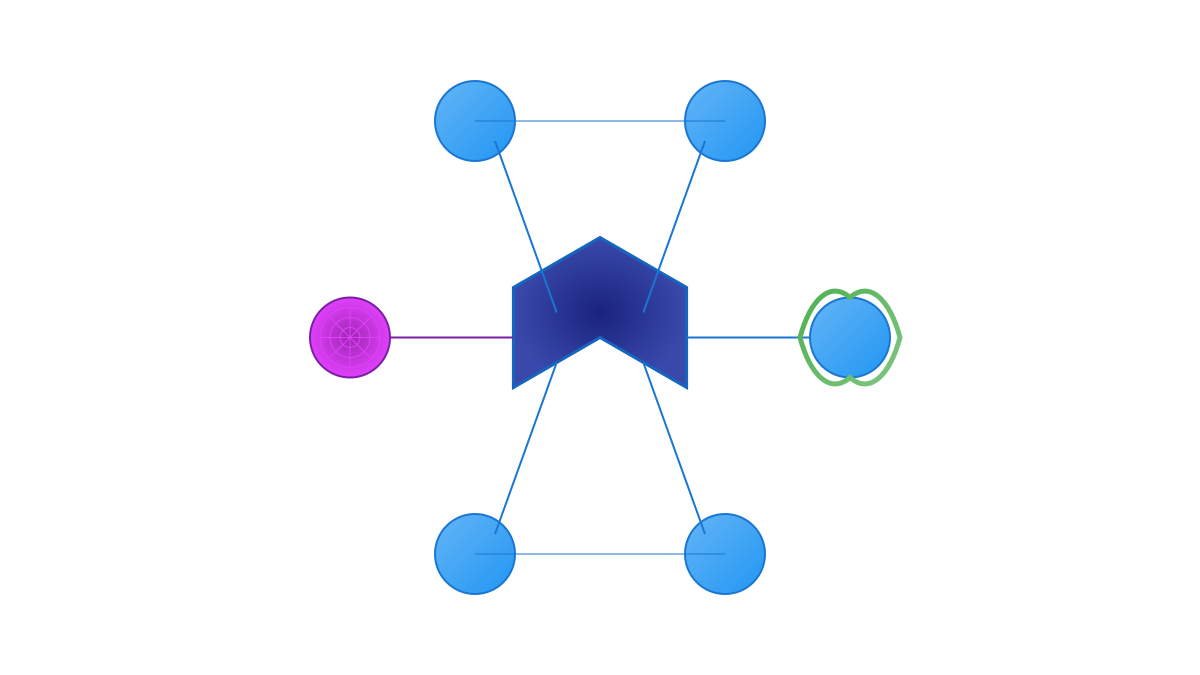
Adopting the classic Supervisor pattern: the main Supervisor Agent is responsible for understanding requests, analyzing tasks, routing subtasks to specialized agents, and integrating results to return to users. Workflow example: User input → Supervisor analysis → Distribute subtasks → Agent execution → Integrate results → Output. Advantages: Clear responsibilities, easy extension (adding a new agent only requires registering routing logic).

4

Section 04

Technical Implementation: A Lightweight Framework Based on LangGraph

Technical Implementation: A Lightweight Framework Based on LangGraph

Built on LangGraph (an agent workflow framework developed by the LangChain team), it has capabilities like state management and node orchestration. Framework features: Python3.11+ support, full test coverage, lightweight design, modular architecture. Integration capabilities: Supports OpenAI API (GPT series), Anthropic API (Claude series), and Tavily (web search).

5

Section 05

Typical Application Scenarios: Multi-Role Collaboration Practice Cases

Typical Application Scenarios

Suitable for multi-step and multi-role collaboration scenarios:

  • Content creation and editing: Research → Writing → Editing pipeline
  • Research support: Information retrieval → Fact-checking → Analysis
  • Task planning and execution: Planning → Execution → Monitoring
  • Multi-step Q&A: Multi-hop reasoning for information retrieval, analysis, and generation
  • Workflow automation: Mapping enterprise SOPs to agent workflows
6

Section 06

Quick Start and Best Practices Guide

Quick Start and Best Practices

Quick Start (for Windows users):

  1. Meet system requirements (Win10/11, Python3.10+, 8GB RAM)
  2. Download and unzip the project
  3. Create and activate a virtual environment
  4. Install dependencies: pip install -r requirements.txt
  5. Configure API keys in the .env file
  6. Run the startup command (e.g., streamlit run app.py)

Design Philosophy and Best Practices:

  • Conciseness first, testability, incremental adoption, clear interfaces
  • Best practices: Define clear agent responsibilities, concise routing logic, unified data format, utilize state management, add logging and monitoring
7

Section 07

Comparison and Conclusion: Framework Positioning and Value

Comparison and Conclusion

Comparison with other solutions:

  • Compared to complex agents in LangChain: More explicit collaboration model
  • Compared to heavyweight frameworks like AutoGen: Fewer dependencies and simpler concepts
  • Compared to custom solutions: Provides validated architecture templates

Conclusion: This framework provides a concise and practical starting point for multi-agent application development. Based on mature architecture and technology stack, it is suitable for quick concept validation or building medium-complexity applications. It is a low-threshold entry to explore the potential of multi-agent collaboration, worth trying and contributing to.

