Zing Forum

Reading

Multi-Agent Dev OS: A Workflow Where One Person Directs Three AI Agent Engineers

An AI agent coordination system developed by an 18-year-old Taiwanese high school student. Through role division, handover document protocols, and multi-layered security gating, it completed 3 projects in parallel within 16 days, producing 50,000 lines of code and over 600 handover documents.

AI代理多智能体系统工作流自动化人机协作LLM应用软件工程项目管理
Published 2026-05-25 10:15Recent activity 2026-05-25 10:20Estimated read 6 min
Multi-Agent Dev OS: A Workflow Where One Person Directs Three AI Agent Engineers
1

Section 01

[Introduction] Multi-Agent Dev OS: An Efficient Workflow for Directing Three AI Agents by One Person

Multi-Agent Dev OS is an AI agent coordination system developed by an 18-year-old Taiwanese high school student. Through role division, handover document protocols, and multi-layered security gating mechanisms, it enables one person to direct three AI agents to work in parallel. The system completed 3 projects within 16 days, producing over 50,000 lines of production code and more than 600 handover documents. Its core is to upgrade AI from an auxiliary tool to a 'human-AI collaboration operating system' where AI acts as team members.


2

Section 02

Background & Motivation: Transition from AI Tools to AI Team Members

Currently, most developers regard AI as a passively responsive auxiliary tool. With the improvement of LLM capabilities, the key question becomes 'Can AI be a real team member?' Multi-Agent Dev OS was born based on this concept. The creator verified the feasibility of AI team collaboration by coordinating three AI agents. Its core is not technical stacking, but the design of a complete collaborative workflow.

3

Section 03

System Architecture: Three AI Agent Roles with Clear Division of Labor

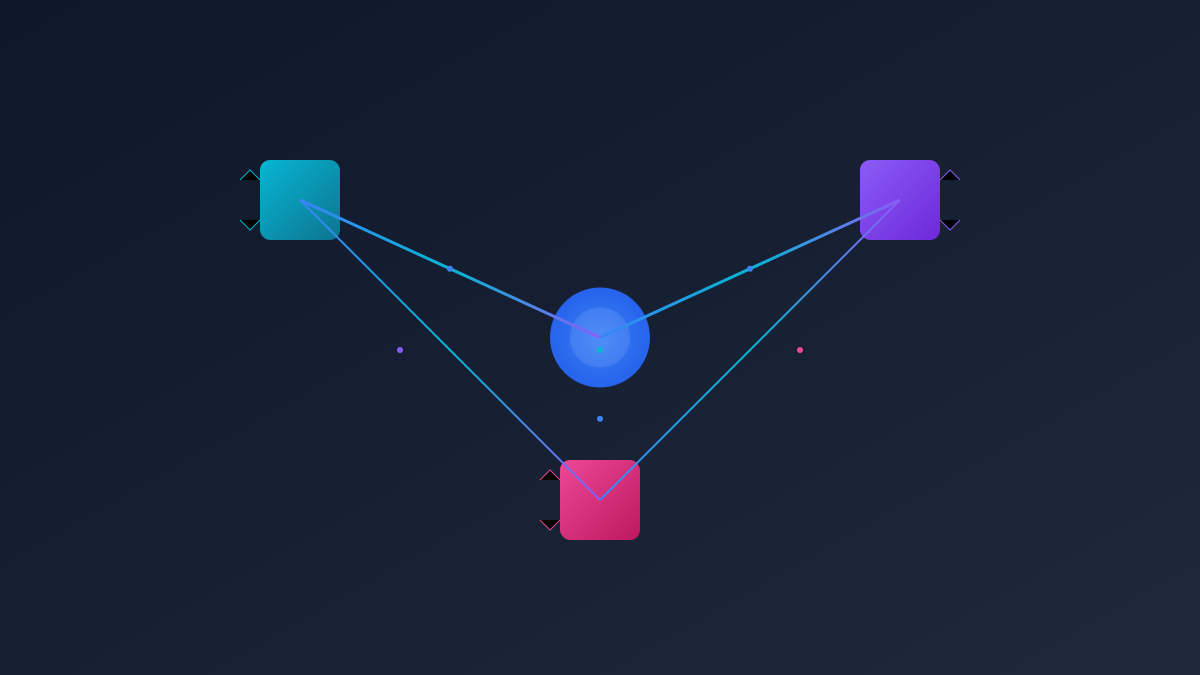
The system defines three clear AI roles:

  • Hermes: Central scheduler, responsible for task allocation, progress tracking, security gating, and memory management; does not write code directly;
  • Cowork (Claude): Strategy and architect, focusing on high-level strategy, content direction, and architecture review;
  • Codex/Claude Code: Execution layer agent, responsible for code implementation, review, and detail fixes, receiving architecture guidance and task allocation.
4

Section 04

Core Mechanisms: Structured Handover & Hierarchical Memory Governance

Handover Document Protocol

Each handover document includes task background and objectives, description of completed work, blockages and solutions, next-step instructions, and links to referenced artifacts. This eliminates information silos and enables seamless context transfer.

Memory Governance Model

Four types of memory are distinguished: persistent memory (cross-project general knowledge), project handover memory (project-specific context), project notes (temporary information), and conversation backtracking (interaction history), balancing consistency and flexibility.

5

Section 05

Practical Results: Productivity Performance of Completing 3 Projects in Parallel in 16 Days

Three projects were advanced in parallel within 16 days:

  • Network Security Automation (sensitive operation workflows);
  • YouTube Shorts Automation (content creation and distribution pipeline);
  • Thematic Intelligence System (information collection and analysis workflow). Output data: Over 50,000 lines of production-grade code, 600+ structured handover documents, versioned artifacts, and multi-layered security gating (scope control, strategy review, rendering quality check).
6

Section 06

Security & Boundary Control: Risk Prevention Measures for Sensitive Operations

To meet the needs of sensitive projects, the system has built-in multi-layered security mechanisms:

  • Authorization Priority Principle: Sensitive operations require explicit authorization;
  • Local Lab Isolation: Sensitive work is executed in an isolated environment;
  • Release Scanner: Automatically detects private paths, credential patterns, and untracked local deny list items to prevent sensitive information leakage or dangerous operations.
7

Section 07

Practical Value & Insights: Key Principles for AI Team Collaboration

Core insights from Multi-Agent Dev OS:

  1. Role Specialization: Different agents focus on problems at different levels to improve output quality;
  2. Structured Handover: Clear context transfer is key to collaboration;
  3. Security Gating: As AI capabilities enhance, constraint mechanisms need to evolve synchronously. Advice for developers: This system provides an actionable blueprint, showing how to upgrade AI to team members and establish a sustainable human-AI collaboration model.

