Zing Forum

Reading

multi-agent-data-pipeline: An Intelligent Data Analysis Pipeline System Based on LangGraph

multi-agent-data-pipeline is a multi-agent data analysis system orchestrated using LangGraph, enabling an automated workflow for data ingestion, cleaning, validation, and insight generation. This article analyzes its architectural design, technical implementation, and application scenarios.

多智能体数据分析LangGraph数据流水线自动化数据清洗洞察生成智能体编排
Published 2026-05-01 02:43Recent activity 2026-05-01 02:54Estimated read 8 min
multi-agent-data-pipeline: An Intelligent Data Analysis Pipeline System Based on LangGraph
1

Section 01

multi-agent-data-pipeline: Introduction to the Intelligent Data Analysis Pipeline System Based on LangGraph

multi-agent-data-pipeline: Introduction to the Intelligent Data Analysis Pipeline System Based on LangGraph

multi-agent-data-pipeline is a multi-agent data analysis system orchestrated based on LangGraph, aiming to automate the complete process of data ingestion, cleaning, validation, and insight generation. It addresses issues such as low efficiency and repetitive work in traditional data analysis workflows. Through multi-agent collaboration and flexible workflow design, it allows analysts to focus on high-value insight extraction while lowering the threshold for business users to use data analysis.


2

Section 02

Background and Technical Foundation

Background and Technical Foundation

Traditional data analysis workflows face challenges like low efficiency, repetitive work, and difficulty in knowledge precipitation. With the maturity of LLM and agent technologies, data analysis is moving toward automated transformation. As a key library in the LangChain ecosystem, LangGraph provides graph-structured agent workflow orchestration capabilities, supporting state management, checkpoint mechanisms, human-machine collaboration interfaces, and streaming output—laying the foundation for building flexible data analysis pipelines.

3

Section 03

System Architecture: Four Core Agents

System Architecture

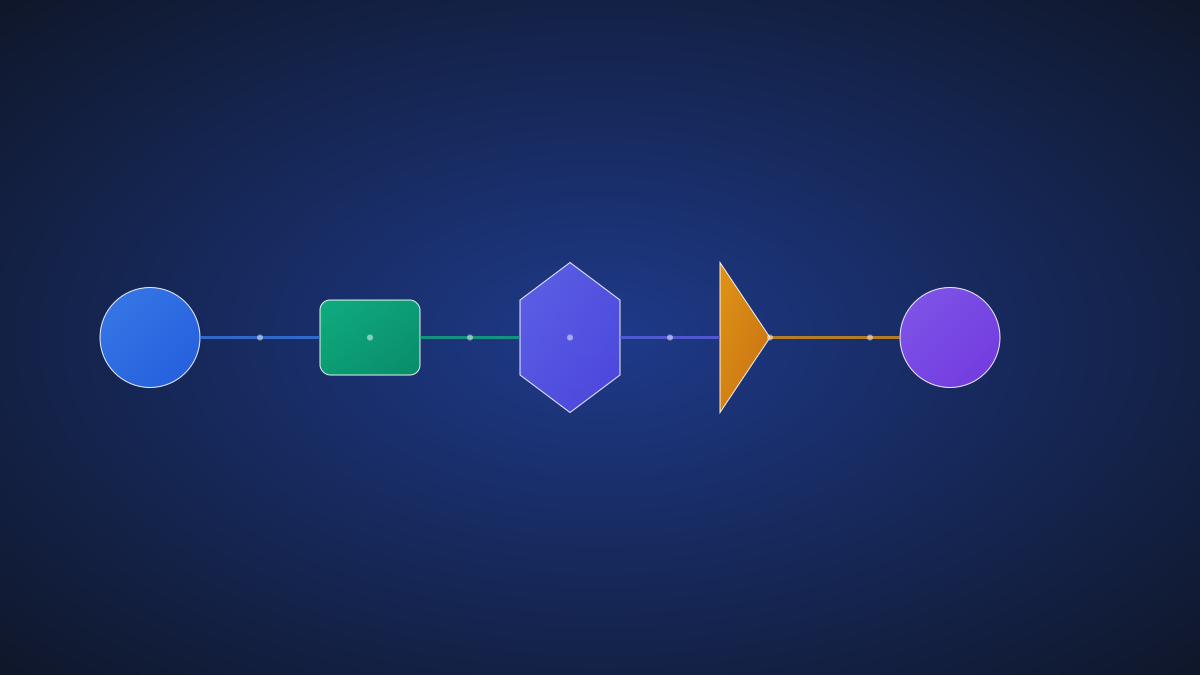
The system is built around four core agents:

  1. Data Ingestion Agent: Acquires raw data from multiple sources such as databases, APIs, and file systems, handling format parsing and incremental synchronization.
  2. Data Cleaning Agent: Adaptively handles issues like missing values, outliers, and duplicate records, selecting appropriate cleaning strategies.
  3. Data Validation Agent: Performs checks on data types, ranges, consistency, etc., automatically repairing or marking issues requiring manual handling.
  4. Insight Generation Agent: Analyzes data to generate insights such as descriptive statistics and trends, converting them into natural language and providing visualization suggestions.
4

Section 04

Workflow Orchestration: Flexible and Efficient Processing Mode

Workflow Orchestration

The system workflow is designed based on LangGraph's graph structure:

  • Iterative optimization: Cleaning and validation can be executed cyclically until data quality meets standards.
  • Conditional branching: Selects different processing paths based on data characteristics (structured/unstructured, time series/cross-section).
  • Human intervention: Introduces manual review at key nodes (e.g., complex quality issues, important decision insights).
  • Parallel processing: Supports parallel tasks to accelerate the workflow.
5

Section 05

Application Scenarios and Business Value

Application Scenarios and Value

The system is suitable for various scenarios:

  • Exploratory Data Analysis (EDA): Quickly generates data overviews to accelerate in-depth analysis.
  • Regular report generation: Automatically acquires data and updates business reports on a scheduled basis.
  • Data quality monitoring: Continuously monitors key datasets and alerts to issues in a timely manner.
  • Self-service data analysis: Non-technical users complete analysis via natural language.
  • Data migration/integration: Automates cleaning and validation, reducing manual workload.

Value: Improves analyst efficiency, lowers the threshold for business users, and provides scalable enterprise data analysis infrastructure.

6

Section 06

Comparison and Technical Challenges

Comparison and Challenges

Comparison:

  • More adaptive than traditional ETL, supporting natural language interaction.
  • More focused on automation of data preparation than BI platforms.
  • More suitable for productionization and repeated execution than Notebooks.
  • Has the advantage of multi-agent specialization over single AI tools.

Challenges and Solutions:

  • Data privacy: Desensitization, access control, private deployment.
  • Interpretability: Display reasoning processes, data sources, and analysis methods.
  • Error recovery: Fault tolerance mechanisms and automatic recovery strategies.
  • Cost control: LLM call optimization (caching, batch processing, model selection).
  • System integration: Seamless integration with existing data infrastructure.
7

Section 07

Future Directions and Conclusion

Future Directions and Conclusion

Future Directions:

  • Multi-modal data analysis (processing images, audio, etc.).
  • Real-time stream processing capabilities.
  • Collaborative analysis functions (interaction among multiple analysts).
  • Continuous learning mechanisms (optimization from historical analysis).
  • Domain-specific versions (industries like finance, healthcare).

Conclusion: multi-agent-data-pipeline transforms data analysis workflows through AI and multi-agent technologies, automating tedious tasks and unlocking the value of analysts. It is an important exploration of AI-driven data analysis automation and will drive the field toward a more intelligent and efficient direction.

