Zing Forum

Reading

Multi-Agent Code Orchestrator: A Multi-Agent Workflow Construction Skill Based on Claude Code

This project is a skill that enables conversational interaction with Claude Code, allowing users to build complex multi-agent workflows through natural language descriptions and realize task orchestration and coordination from the master agent to multiple sub-agents.

多智能体Claude CodeAgent Skill工作流编排智能体协作自然语言编程AI辅助开发
Published 2026-05-07 14:14Recent activity 2026-05-07 14:19Estimated read 6 min
Multi-Agent Code Orchestrator: A Multi-Agent Workflow Construction Skill Based on Claude Code
1

Section 01

【Introduction】Multi-Agent Code Orchestrator: A Multi-Agent Workflow Construction Skill Based on Claude Code

Multi-Agent Code Orchestrator is an open-source project that serves as a skill module for Claude Code. It allows users to build complex multi-agent workflows through natural language conversations, lowering the barrier to developing multi-agent systems and enabling task orchestration and coordination between the master agent and sub-agents. The core idea is to let developers design agent collaboration networks via conversations without writing complex code.


2

Section 02

Background: Core Concepts of Agent Skills and Multi-Agent Workflows

Agent Skill

In the Claude Code ecosystem, a skill is an extension mechanism that includes predefined instructions, tool call specifications, and context, making Claude more professional and efficient in specific domains. This project encapsulates multi-agent orchestration capabilities into reusable modules.

Core of Multi-Agent Workflow

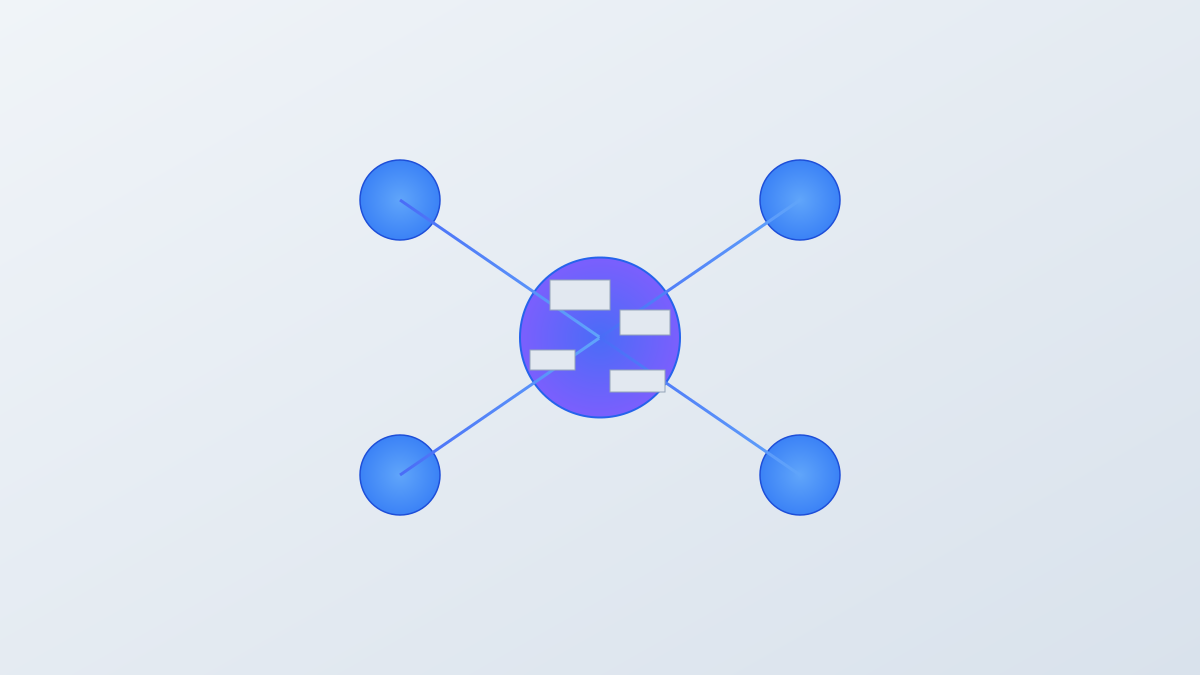
  • Master Agent: Coordination center responsible for task decomposition, status monitoring, and result integration
  • Sub-Agent: Executes specific tasks (e.g., code analysis, document generation), can communicate or report independently
  • Workflow Orchestration: Involves task decomposition, scheduling, communication protocols, and state synchronization, requiring a balance between correctness and efficiency
3

Section 03

Technical Implementation Mechanism: Conversational Workflow Construction Method

Integration with Claude Code

Deeply leverages Claude's code understanding and generation capabilities to guide it in analyzing task structures, identifying parallel sub-tasks, and generating agent configurations

Dynamic Agent Generation

Creates sub-agents with specific capabilities on demand, and recycles or retains them after tasks to enhance flexibility and scalability

Conversational Design

No need to learn DSL or configuration files; automatically builds workflows by describing tasks in natural language (e.g., "Analyze code → Generate document → Write tests")

4

Section 04

Application Scenarios: Practical Implementation of Multi-Agent Workflows

  1. Full-Process Automation of Software Development: Covers requirement analysis, architecture design, code implementation, test verification, and document writing, with each link handled by a dedicated agent
  2. Complex Data Processing Pipeline: Builds data flows such as data cleaning, feature extraction, model training, and result evaluation, and modifies the pipeline via conversations
  3. Research Task Collaboration: Assigns agents to handle literature retrieval, reading, summarization, and analysis, forming an efficient research network
5

Section 05

Technical Challenges and Solutions

Agent Communication Protocol

Adopts a message queue pattern, with the master agent acting as the message bus and sub-agents communicating asynchronously via publish-subscribe, ensuring loose coupling and flexible routing

State Management and Persistence

Implements a checkpoint mechanism to save workflow states regularly, supporting resume from breakpoints and suitable for long-duration, large-scale tasks

Error Handling and Fault Tolerance

Built-in multiple strategies to automatically retry, rollback, or reassign tasks based on task characteristics and failure reasons

6

Section 06

Significance of Open-Source Ecosystem: A New Paradigm for AI-Assisted Programming

This project represents the evolution of AI-assisted programming toward higher-level abstraction, exploring a new development paradigm from writing code to describing intent, and from manual orchestration to automatic coordination. As Claude Code becomes more popular, such skills will become an important part of developers' toolkits.

7

Section 07

Future Development Directions: Expansion and Optimization

The project can evolve in the following directions:

  • Support more agent backends (not limited to Claude)
  • Introduce a visual workflow editor
  • Integrate performance monitoring and optimization suggestions
  • Build a community-shared agent template market These will further lower the adoption threshold for multi-agent systems and promote the widespread application of the technical paradigm.

