Zing Forum

Reading

MuAiFlow: Multi-Agent Collaborative Development Workflow, Keeping Humans in Control of Key Decisions

A structured multi-AI agent collaboration framework that ensures code quality while maintaining human control over key nodes through mandatory cross-review and manual approval mechanisms.

多智能体AI协作代码审查人工介入工作流软件开发质量控制人机协同
Published 2026-05-06 12:13Recent activity 2026-05-06 12:23Estimated read 8 min
MuAiFlow: Multi-Agent Collaborative Development Workflow, Keeping Humans in Control of Key Decisions
1

Section 01

MuAiFlow: Multi-Agent Collaborative Development Framework, Guide to Human Control of Key Decisions

MuAiFlow is a structured multi-AI agent collaborative development framework. Its core uses mandatory cross-review and manual approval mechanisms to address the limitations of single AI assistants in complex projects (such as missing edge cases, falling into local optima, and losing context), while avoiding chaos in multi-AI collaboration, ensuring humans always control key decision nodes, and balancing development efficiency and quality control.


2

Section 02

Background: Limitations of Single AI and Challenges of Multi-AI Collaboration

With the improvement of large language model capabilities, single AI can complete tasks like code writing and document generation, but it has limitations in complex projects: missing edge cases, falling into local optima, and losing context in long-term tasks. Multi-AI collaboration is a solution, but how to collaborate effectively without chaos is an engineering challenge. As a complete workflow framework, MuAiFlow defines collaboration norms, review mechanisms, and human intervention points. Its core concept is that AIs perform their respective duties, supervise each other, and key decisions are controlled by humans.

3

Section 03

Methodology: Three-Layer Collaborative Architecture Design

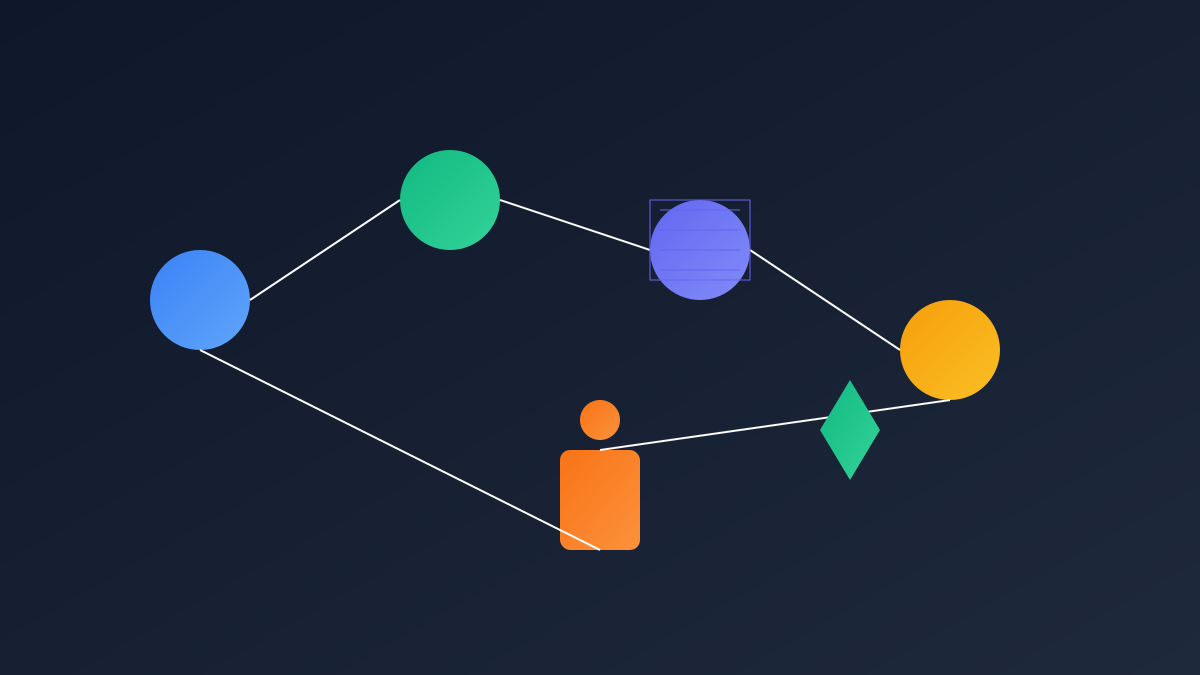
MuAiFlow follows a three-layer architecture of "Division of Labor - Review - Decision":

  1. Task Decomposition Layer (Orchestrator) : An AI agent that receives requirements, analyzes complexity, breaks down subtasks, and identifies dependencies and risks;
  2. Agent Execution Layer : Predefined role agents (architect, developer, tester, documenter, reviewer), each with responsibilities and output formats. After completing tasks, they submit to the review queue (separation of writing and review);
  3. Cross-Review Layer : Subtask outputs need to be independently reviewed by at least two agents of other roles (e.g., code is reviewed by testers and reviewers);
  4. Manual Decision Layer : Mandatory manual approval for key nodes (architecture confirmation, core module merging, final release). Approvers can see all AI outputs, review comments, and disagreements.
4

Section 04

Methodology: Core Mechanisms of Mandatory Cross-Review

Cross-review is the core of quality assurance, with implementation details including:

  1. Review Allocation Algorithm : Load balancing + avoidance strategy, selecting agents of other roles with low load and no recent review of the agent's output;
  2. Review Standard Template : Predefined structured prompt lists (e.g., null pointers, resource leaks, coding standards for code reviews), customizable;
  3. Disagreement Handling : When there are review disagreements, they are summarized and submitted to humans, triggering an arbitration agent to analyze the reasons and provide suggestions;
  4. Review Chain Tracking : Tamper-proof logs record all review activities, facilitating audit and strategy optimization.
5

Section 05

Design Principles for Human Intervention Points

MuAiFlow's human intervention follows four principles:

  1. Importance Principle : Set checkpoints only at key nodes (e.g., architecture design);
  2. Risk Hedging Principle : Set checkpoints at irreversible change nodes (e.g., main branch merging, production deployment);
  3. Efficiency Balance Principle : Dynamically adjust checkpoint density (reduce if AI collaboration is stable, increase if there are anomalies);
  4. Transparency Principle : The approval interface displays requirements, AI outputs, review comments, disagreements, and suggestions, and decision records are traceable.
6

Section 06

Application Scenarios: Practical Value of MuAiFlow

MuAiFlow is suitable for various development scenarios:

  1. Large-scale Feature Development : Architects design solutions, multiple developers implement in parallel, testers write use cases synchronously, and review nodes ensure quality;
  2. Legacy Code Refactoring : Reviewers identify implicit dependencies, testers verify consistency, and humans control key refactoring points to reduce risks;
  3. Multi-language Projects : Assign dedicated agents to each tech stack, architects ensure consistency, and humans confirm integration points;
  4. Open-source Project Maintenance : Automatic multi-agent review after PR submission, maintainers focus on disagreements and key decisions to improve efficiency.
7

Section 07

Summary and Future Outlook

MuAiFlow represents the evolution direction of AI-assisted development: from single assistant to collaborative team, achieving the optimal balance of human-AI collaboration through division of labor, cross-review, and human control (AI handles pattern recognition, code generation, and batch checks; humans focus on architecture, risk assessment, and value judgment). Current limitations include context window constraints, rigid roles, review quality depending on model capabilities, and a steep learning curve. Future plans include optimizing hierarchical context management, supporting custom roles, improving review standards, and enhancing documentation and plugins to lower the entry barrier.