Zing Forum

Reading

Multimodal Biomarker Framework: Integrating Cerebrospinal Fluid, MRI, and Cognitive Signals to Predict Alzheimer's Disease Severity

This article introduces an open-source multimodal Alzheimer's disease assessment framework that integrates cerebrospinal fluid biomarkers, structural MRI, language cognitive features, and behavioral signals. It evaluates the model's generalization ability on ADNI and COMPASS-ND datasets through cross-cohort validation.

阿尔茨海默病多模态学习生物标志物脑脊液MRI跨队列验证机器学习神经退行性疾病ADNI医疗AI
Published 2026-06-05 05:10Recent activity 2026-06-05 05:22Estimated read 5 min
Multimodal Biomarker Framework: Integrating Cerebrospinal Fluid, MRI, and Cognitive Signals to Predict Alzheimer's Disease Severity
1

Section 01

Introduction: Multimodal Biomarker Framework Aids in Predicting Alzheimer's Disease Severity

This article introduces an open-source multimodal Alzheimer's disease assessment framework that integrates cerebrospinal fluid biomarkers, structural MRI, language cognitive features, and behavioral signals. It evaluates the model's generalization ability via cross-cohort validation (ADNI and COMPASS-ND datasets), providing a comprehensive solution for predicting AD severity.


2

Section 02

Background: Limitations of Single-Modal Diagnosis for Alzheimer's Disease

Alzheimer's disease is a complex neurodegenerative disorder whose pathological mechanisms involve interactions between molecular pathology, neurodegeneration, cognitive decline, and behavioral disturbances. Traditional single-modal diagnosis (e.g., only cerebrospinal fluid or MRI) faces insufficient cross-cohort generalization ability. Model performance decreases due to differences in dataset collection standards, patient heterogeneity, and varying disease stage manifestations, creating an urgent need for a multimodal integration framework.

3

Section 03

Methods: Composition of the Framework's Multimodal Biomarkers

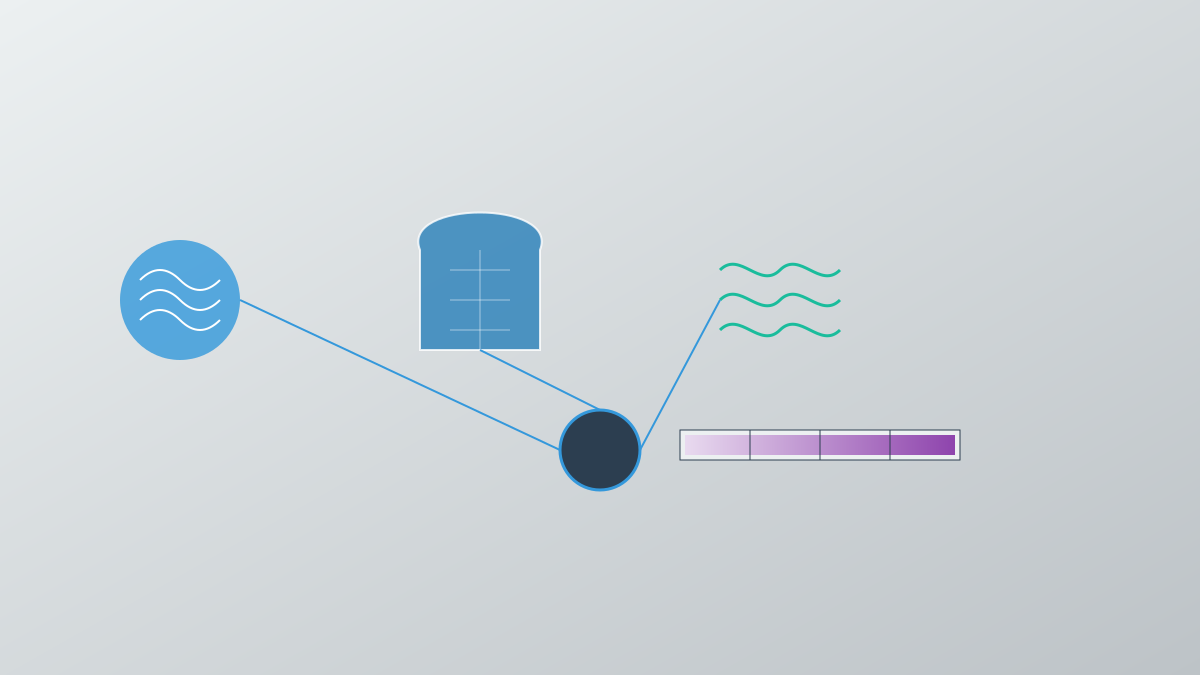
The framework integrates four complementary biomarker domains: 1. Cerebrospinal fluid biomarkers (pathological indicators such as β-amyloid, tau protein, and their phosphorylated forms); 2. Structural MRI markers (neurodegenerative indicators like hippocampal volume, cortical thickness, and ventricular enlargement); 3. Language cognitive indicators (early cognitive decline signals extracted from speech and text); 4. Behavioral and sleep signals (warning signs such as sleep disorders and changes in daily behavior).

4

Section 04

Methods: Design of the Multimodal Fusion Model

The core of the framework is a multimodal fusion model that integrates heterogeneous data sources using machine learning techniques. It considers the complementarity and redundancy between modalities and adopts feature-level or decision-level fusion strategies to improve diagnostic accuracy and robustness (other modalities can compensate when one is missing).

5

Section 05

Evidence: Cross-Cohort Validation Demonstrates Model Generalization Ability

The framework uses rigorous cross-cohort validation: ADNI dataset for training, and COMPASS-ND/CCNA datasets for external validation. The two cohorts differ in geography, ethnicity, equipment, and clinical protocols. Validation results show that the model has good generalization ability, addressing the generalization challenge of medical AI.

6

Section 06

Open-Source Value: Supporting Research Reproducibility and Transparency

The repository provides end-to-end implementation (data preprocessing, feature extraction, model training, cross-cohort evaluation) including experimental scripts and Jupyter Notebooks to ensure result reproducibility. Note that original datasets need to be applied for through official channels.

7

Section 07

Practical Significance and Future Outlook

Clinical value includes improving diagnostic accuracy, early identification of high-risk individuals, monitoring disease progression and treatment response, and optimizing non-invasive screening resources. Future directions: integrating genomic data, expanding to other neurodegenerative diseases, developing real-time monitoring systems, and using wearable devices to enhance the practicality of behavioral and sleep data collection.

