Zing Forum

Reading

MotionCore: An Intelligent Dance Movement Analysis and Teaching System Based on Large Language Models

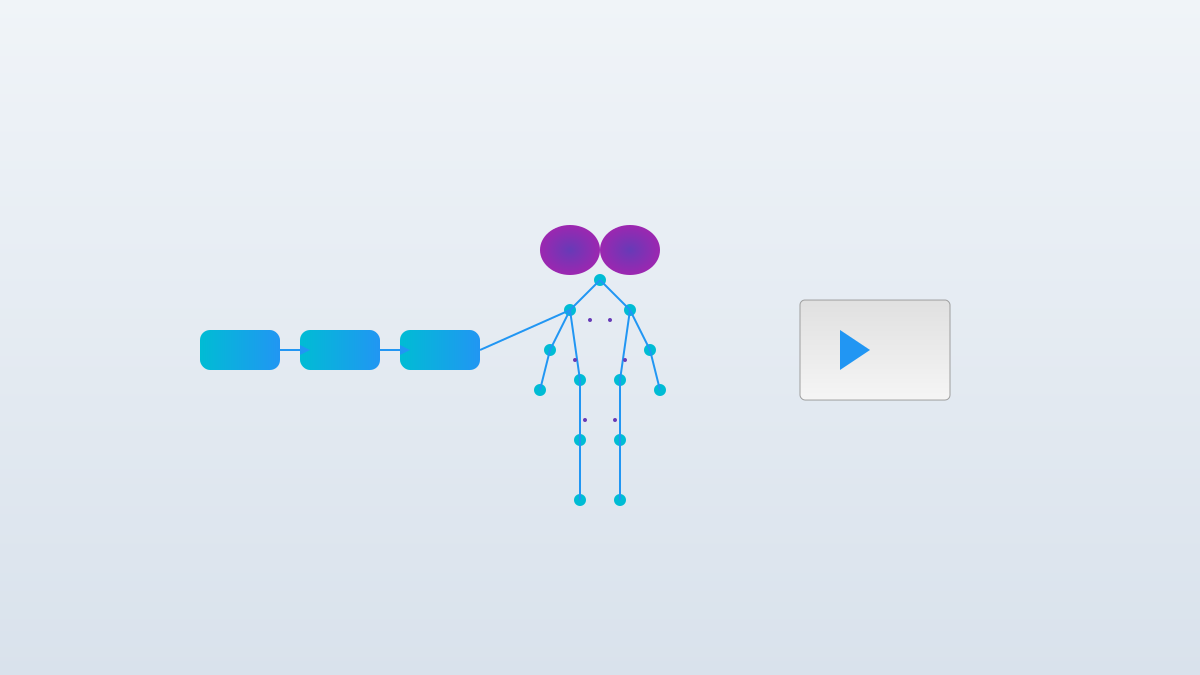
MotionCore is a dance analysis system integrating computer vision and large language models (LLMs). It extracts 3D skeleton sequences via MediaPipe pose estimation, generates real-time streaming analysis reports using LLMs, and provides an audio-aligned dual-video synchronous comparison player, offering an intelligent solution for dance teaching and movement correction.

舞蹈分析姿态估计大语言模型MediaPipeFastAPI视频分析AI教学动作识别多模态AI
Published 2026-05-17 22:11Recent activity 2026-05-17 22:19Estimated read 7 min
MotionCore: An Intelligent Dance Movement Analysis and Teaching System Based on Large Language Models
1

Section 01

MotionCore: Guide to the AI-Powered Intelligent Analysis System for Dance Teaching

MotionCore is an open-source dance movement analysis system integrating computer vision and large language models (LLMs). Its core functions include extracting 3D skeleton sequences via MediaPipe, generating real-time streaming analysis reports, and audio-aligned dual-video synchronous comparison playback, providing an intelligent solution for dance teaching and movement correction. Its design concept is "comparative learning": users upload their own movement video and a standard video, and the system automatically analyzes differences and gives improvement suggestions, representing a new direction for AI-assisted physical education teaching.


2

Section 02

R&D Background and Design Philosophy of MotionCore

Traditional dance teaching software only provides visual posture comparison and lacks intelligent analysis capabilities. Addressing this pain point, MotionCore adopts a dual-modal fusion design of "visual perception + language understanding", incorporating the cognitive capabilities of LLMs to understand movement details, identify problems, and provide natural language guidance like a professional coach. The system is positioned as an open-source tool to serve dance learners, coaches, and enthusiasts, lowering the learning threshold.

3

Section 03

Detailed Explanation of System Architecture and Core Technology Stack

MotionCore uses a layered architecture:

  • Frontend Interaction Layer: Built with HTML5/CSS3/JS, including video upload area, real-time preview area, streaming report area, synchronous player, and supports Chinese-English switching;
  • Backend Processing Layer: FastAPI framework provides asynchronous API services, including endpoints for upload, real-time streaming, progress query, etc.;
  • Core Algorithm Module: MediaPipe Pose extracts 33 3D key points, YOLO object detection for preprocessing, MoviePy + NumPy for audio alignment, and integration of LLMs such as OpenAI/DeepSeek/Gemma.
4

Section 04

Demonstration of Core Functions and Usage Flow

The system's typical flow is a closed loop of "upload-process-analyze-compare":

  1. Video Upload: Users upload their own movement video (Video A) and a standard video (Video B);
  2. Skeleton Extraction: MediaPipe extracts key points frame by frame, which users can view in real time via MJPEG stream;
  3. Streaming Analysis: LLMs generate reports containing movement completion rate, joint angle comparison, rhythm matching degree, and improvement suggestions (output via SSE streaming);
  4. Synchronous Playback: Dual videos play synchronously after audio alignment. It also supports multi-language interfaces and reports, and allows switching between LLM providers.
5

Section 05

Technical Highlights and Innovative Breakthroughs of MotionCore

Three innovative points of the system:

  1. LLM Understanding of Time-Series Data: Structured encoding of 3D skeleton sequences into text, enabling LLMs to "understand" movements;
  2. Streaming Generation Experience: SSE technology实现逐字输出 of reports, enhancing user immersion;
  3. Audio-Driven Alignment: Matching audio offsets based on music beats to ensure rhythm synchronization in comparison playback.
6

Section 06

Analysis of Application Scenarios and Social Value

MotionCore has a wide range of application scenarios:

  • Dance Teaching: AI teaching assistant enables one-to-many personalized guidance;
  • Fitness Training: Evaluation of movement standards for yoga, Pilates, etc.;
  • Sports Training: Posture correction for martial arts, gymnastics;
  • Rehabilitation Medicine: Evaluation of movement standardization in physical therapy;
  • Movement Research: Data collection tool for dance studies and human kinematics.
7

Section 07

Current Limitations and Future Development Directions

Limitations: Self-occlusion in complex movements affects detection accuracy; MediaPipe's 3D depth accuracy is limited; high-resolution videos require strong GPU support; Future Directions: Multi-view fusion to improve 3D reconstruction accuracy; explore end-to-end understanding of video large models; develop mobile versions; build dance movement datasets to support style transfer.

