Zing Forum

Reading

Monkey Troop: Technical Implementation of a Decentralized AI Computing Power Sharing Network

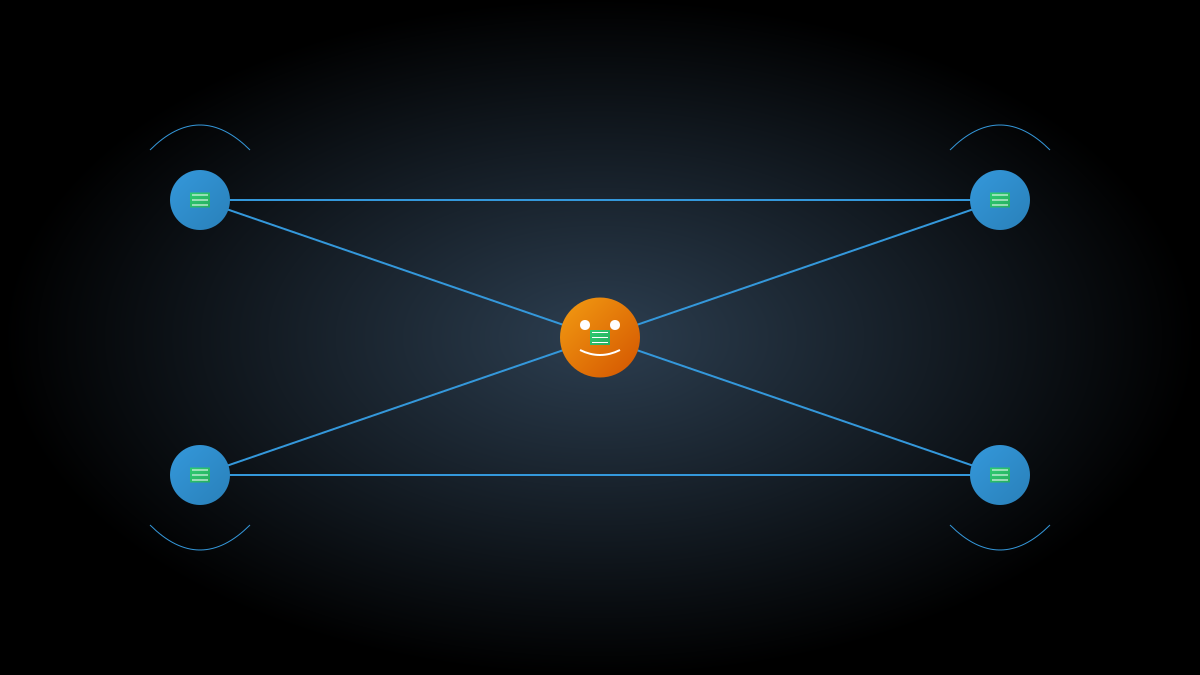
Monkey Troop is an open-source P2P network that allows users to donate idle GPU time in exchange for points, and use others' computing power for LLM inference when needed—similar to Folding@home but designed specifically for AI.

Monkey Troop去中心化AIP2P网络GPU共享LLM推理开源项目算力民主化TailscalevLLMOllama
Published 2026-03-30 08:04Recent activity 2026-03-30 08:18Estimated read 6 min
Monkey Troop: Technical Implementation of a Decentralized AI Computing Power Sharing Network
1

Section 01

[Introduction] Monkey Troop: Core Value of a Decentralized AI Computing Power Sharing Network

Monkey Troop is an open-source P2P network aimed at democratizing AI computing power. Its core concept is to allow users to donate idle GPU time in exchange for points, and use the network's computing power for LLM inference when needed—similar to Folding@home but designed specifically for AI. The project solves the problem of uneven distribution of computing resources through peer-to-peer matching, lowering the entry barrier for AI applications.


2

Section 02

Project Background: The Necessity of Decentralized AI Computing

Current AI inference faces the problem of uneven resource distribution: individual/small businesses have low utilization of idle GPUs, while the demand side faces high cloud computing costs. Traditional cloud computing has drawbacks such as high costs, privacy risks, and resource queuing during peak periods. Monkey Troop proposes a P2P network solution to directly match computing power supply and demand, improving resource utilization, reducing costs, and enhancing privacy protection.

3

Section 03

Core Architecture and Technical Implementation Details

Monkey Troop uses a three-layer component design:

  1. Coordinator: Built with Python + FastAPI, responsible for node discovery, authentication, and hardware verification, integrating Redis registry and PostgreSQL database.
  2. Worker Node: Written in Rust, monitors GPU status, sends heartbeat signals, and supports inference engines like Ollama, LM Studio, and vLLM (vLLM has the highest priority).
  3. Client: Written in Rust, provides an OpenAI-compatible API proxy, allowing users to access the network without modifying their code.
4

Section 04

Security Mechanisms and Economic Model Design

Security Mechanisms:

  • Network Layer: Uses Tailscale/Headscale (WireGuard protocol) to establish encrypted P2P connections, ensuring communication security.
  • Hardware Verification: Implements "hardware proof" through cryptographic benchmark tests to prevent false reporting of GPU specifications.

Economic Model:

  • Time-based point system with multipliers for different GPU models (e.g., RTX4090 has a 4x multiplier), fairly reflecting hardware value and incentivizing contributions of high-end resources. Users can choose between public networks or private clusters.
5

Section 05

Deployment Options and Open-Source Ecosystem Development

Deployment Options:

  • Individual Users: Quickly participate via precompiled binaries or automatic installation scripts, either as worker nodes contributing computing power or clients using resources.
  • Enterprises/Organizations: Can deploy private coordinators and build private VPN networks using Headscale, suitable for handling sensitive data.

Open-Source Ecosystem: Fully open-source under the MIT license, with code and documentation publicly available on GitHub. Community contributions are welcome, and detailed development guides and transparent audit mechanisms are provided.

6

Section 06

Conclusion: Future Outlook for Computing Power Democratization

Monkey Troop represents a new paradigm for AI infrastructure, solving the problem of uneven computing power through technology and economic models. The project still faces challenges such as stability, node reliability, and latency optimization, but it provides a feasible solution for decentralized AI computing. In the future, such projects are expected to promote computing power democratization, allowing AI infrastructure to be co-built and maintained by users worldwide.

