Zing Forum

Reading

MolCrawl: A Unified Framework for Building Multimodal Foundation Models in Life Sciences

A pipeline framework designed specifically for chemical and life science data, supporting unified processing and model training of multiple modalities including genomics, proteins, RNA, compounds, and molecular natural language.

多模态AI生命科学基因组学蛋白质化合物基础模型生物信息学药物发现
Published 2026-04-21 14:45Recent activity 2026-04-21 14:50Estimated read 8 min
MolCrawl: A Unified Framework for Building Multimodal Foundation Models in Life Sciences
1

Section 01

MolCrawl: Introduction to the Unified Framework for Multimodal Foundation Models in Life Sciences

MolCrawl is a pipeline framework designed specifically for chemical and life science data. It aims to address the challenge of diverse life science data (covering genomics, proteins, RNA, compounds, and biomedical literature) by building a multimodal foundation model that can uniformly process five modalities of data. Its core features include modularity and scalability, supporting cross-modal understanding and generation, lowering the technical barrier to building biological foundation models, and promoting the integrated use of biological data across different modalities.


2

Section 02

Challenges in Life Science AI and the Birth Background of MolCrawl

In recent years, AI has made breakthroughs in the life science field (e.g., AlphaFold), but it faces the challenge of data diversity: traditional models mostly focus on a single modality and struggle to capture the complex relationships between biological information at different levels. The MolCrawl project emerged to address this, aiming to create a general architecture that can simultaneously understand and generate genomics, proteins, RNA, compounds, and molecular natural language.

3

Section 03

Framework Architecture and Technical Implementation of MolCrawl

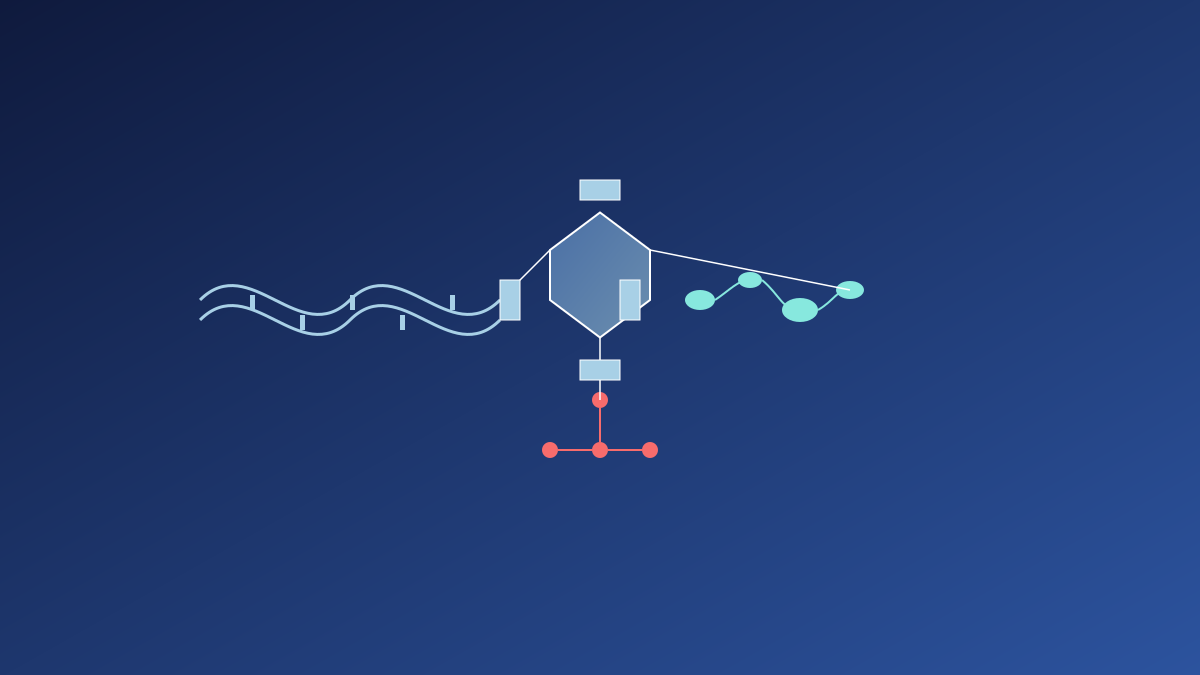
The framework adopts a modular design and supports unified processing of five modalities:

  1. Genomic sequences: Process DNA sequences using GPT-2-like autoregressive models;
  2. Protein sequences: Learn the patterns of amino acid sequences using language modeling methods;
  3. RNA sequences: Process sequence and structural information of mRNA and non-coding RNA;
  4. Compounds: Learn the relationship between structure and properties through SMILES string representation;
  5. Molecular natural language: Connect structured data with human knowledge and establish a mapping from structure to functional description. Technical implementation is divided into data preparation (specialized preprocessing scripts stored in the learning_source directory, requiring 100GB of space) and model training (supports GPT-2/BERT architectures, providing four scale configurations: Small/Medium/Large/XL).
4

Section 04

Distributed Training Support and Hardware Optimization

MolCrawl natively supports Distributed Data Parallel (DDP) training, enabling efficient multi-GPU training via the torchrun launcher, and allows specifying GPUs through CUDA_VISIBLE_DEVICES. Hardware requirements: Small/medium models can be trained on consumer-grade GPUs; large/extra-large models require professional GPUs with at least 32GB of VRAM. The gradient accumulation mechanism is used to balance training speed and resource consumption (adjust the batch_size and gradient_accumulation_steps parameters).

5

Section 05

Pretrained Models and Community Open Resources

The MolCrawl team has released pretrained model checkpoints for five modalities (covering different scales and architectures) on Hugging Face. Users can directly download them for inference or fine-tuning without training from scratch. The open strategy helps researchers/companies with limited resources adapt to downstream tasks (such as protein sequence generation, compound property prediction, etc.) through fine-tuning.

6

Section 06

Application Scenarios and Potential Value of MolCrawl

The multimodal design opens up new possibilities:

  • Cross-modal understanding and generation: Predict protein sequences from gene sequences, or generate natural language descriptions from molecular structures;
  • Drug discovery assistance: Virtual screening, molecular optimization, side effect prediction, and extracting drug-target interactions from literature;
  • Sequence design: Generate new sequences with specific functions to accelerate protein engineering and synthetic biology design;
  • Knowledge integration: Serve as a unified interface for heterogeneous information (sequence/structure databases, literature).
7

Section 07

Current Limitations and Future Development Directions

Limitations:

  1. It mainly supports autoregressive and masked language modeling; explicit structural modeling tasks (such as protein 3D structure prediction) need to be combined with specialized tools;
  2. Fine-tuning guidelines and evaluation benchmarks for downstream tasks are still being improved. Future directions:
  • Support more foundation model architectures (Transformer variants, state space models, etc.);
  • Integrate structural information (protein 3D coordinates, molecular graph representations);
  • Develop more adapters for downstream tasks.
8

Section 08

Summary of the MolCrawl Project

MolCrawl is an important step in the construction of AI infrastructure for life sciences. It lowers the technical barrier through a unified multimodal training framework and promotes the integrated use of biological data. For researchers and engineers in the fields of computational biology, drug discovery, and bioinformatics, it is an open-source project worth paying attention to and participating in.

