Zing Forum

Reading

MobiAgent: A Modular Mobile Agent Framework Supporting Android and HarmonyOS

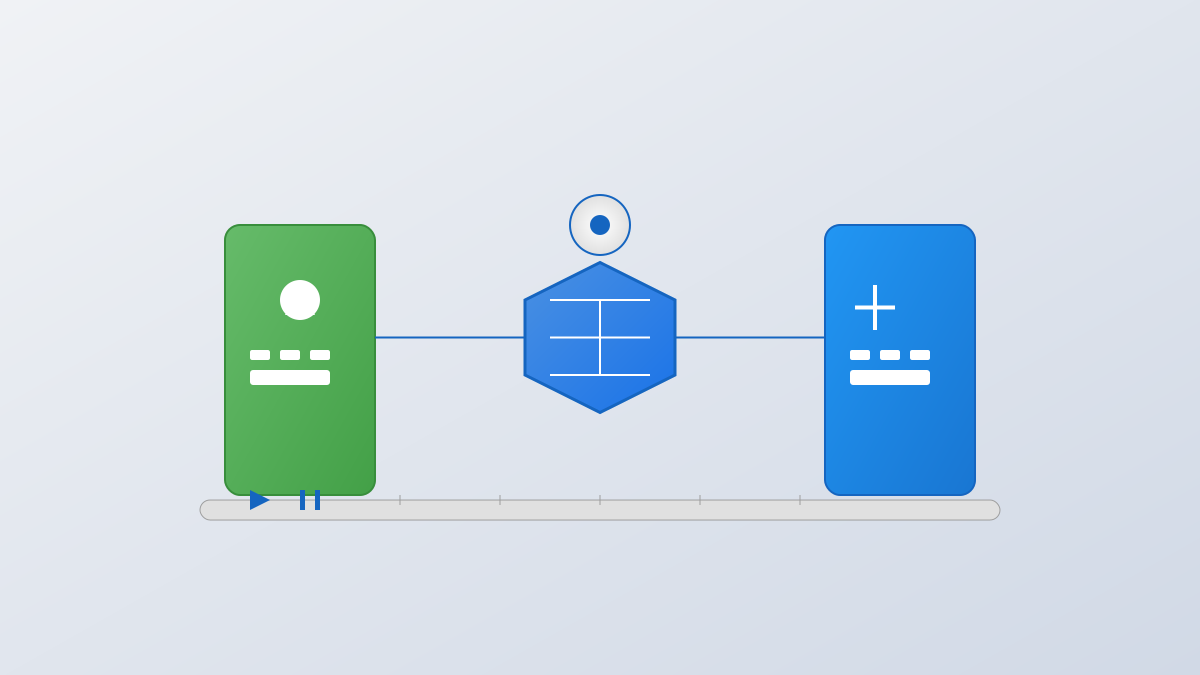
MobiAgent is an open-source mobile agent framework for Android and HarmonyOS, featuring a modular architecture that supports pluggable vision-language models, a built-in record-replay acceleration mechanism, and a real-device-based evaluation benchmark.

mobile agentAndroidHarmonyOSvision-language modelGUI automationAI agentrecord-replay
Published 2026-06-16 21:46Recent activity 2026-06-16 21:53Estimated read 7 min
MobiAgent: A Modular Mobile Agent Framework Supporting Android and HarmonyOS
1

Section 01

【Introduction】MobiAgent: A Cross-Platform Modular Mobile Agent Framework for Android and HarmonyOS

【Introduction】MobiAgent: A Cross-Platform Modular Mobile Agent Framework for Android and HarmonyOS

MobiAgent is an open-source mobile agent framework for Android and HarmonyOS, with core design principles of customizability (supports custom models), modularity (independent components), and authenticity (real-device evaluation). Its key features include:

  • A modular architecture supporting pluggable vision-language models
  • A built-in record-replay acceleration mechanism (AgentRR)
  • A real-device evaluation benchmark (MobiFlow)

The project is maintained by badhope, sourced from GitHub (link: https://github.com/badhope/MobiAgent), and released on June 16, 2026.


2

Section 02

【Background】Existing Pain Points of Mobile Agents and the Birth of MobiAgent

【Background】Existing Pain Points of Mobile Agents and the Birth of MobiAgent

With the development of large language models and multimodal technologies, it has become possible for AI to control mobile phones to complete complex tasks. However, existing solutions have the following problems:

  • Tight model binding, making expansion difficult
  • Lack of real-device evaluation

As a new open-source framework, MobiAgent addresses these pain points through its modular architecture, providing a flexible and scalable agent solution for both platforms.

3

Section 03

【Methodology】Analysis of Core Architecture and Components

【Methodology】Analysis of Core Architecture and Components

1. Agent Model Family

Adopts a multi-role division design:

  • Planner: Converts natural language tasks into high-level action plans
  • Decider: Analyzes screenshots to determine the next operation
  • Grounder: Locates the coordinates of interface elements Three specifications (3B, 4B, 7B) are available, and the 4B hybrid version can run on a single GPU.

2. AgentRR Acceleration Framework

Caches successful operation sequences as an experience tree, and reuses them for similar tasks to achieve 2-3x acceleration:

  • Millisecond-level matching between current screen and historical experience
  • Reuse rate of 30-60% for random tasks, and 60-85% under power-law distribution
  • Replay accuracy exceeds 99%.
4

Section 04

【Methodology】Three Deployment and Usage Methods

【Methodology】Three Deployment and Usage Methods

Method 1: Direct APK Usage

Build the APK from the app directory and install it. After registering an account, use the free quota of cloud models without local configuration.

Method 2: Python Development Interface

Supports Conda environment configuration. Developers can drive the agent via Python, facilitating integration into existing workflows.

Method 3: Local Inference on Mobile Phones

For privacy-sensitive scenarios, the quantized 4B model can be run for fully local deployment without the need for servers or cloud.

5

Section 05

【Evidence】Real-Device Evaluation Benchmark MobiFlow

【Evidence】Real-Device Evaluation Benchmark MobiFlow

MobiFlow is one of the rare real-device evaluation solutions in the industry:

  • Based on milestone-DAG design, allowing multiple execution paths
  • Runs on real devices (not simulators/screenshots)
  • Covers over 20 mainstream apps (Meituan, Taobao, etc.)
  • Tolerates real-environment noise (pop-ups, network delays, version differences).
6

Section 06

【Conclusion】Technical Highlights and Differentiated Advantages

【Conclusion】Technical Highlights and Differentiated Advantages

Technical Highlights

  • Modular design: Agent loop, acceleration framework, and evaluation benchmark are independent and can be used separately
  • Real-environment evaluation: All figures are from real devices
  • Cross-platform support: Covers Android and HarmonyOS

Application Scenarios

  • Automated testing: Natural language UI testing
  • Accessibility assistance: Helping visually impaired users operate devices
  • Efficiency tools: Automatically executing repetitive tasks
  • Intelligent customer service: In-app operation guidance.
7

Section 07

【Epilogue】Practical Significance and Prospects of MobiAgent

【Epilogue】Practical Significance and Prospects of MobiAgent

MobiAgent represents an important step towards the practicalization of mobile agents. Through its modular architecture, record-replay acceleration, and real-device evaluation, it provides developers with a pragmatic and scalable basic platform. As multimodal models evolve, such frameworks will play a more important role in the field of human-computer interaction.

This article is compiled based on the technical documentation of the open-source GitHub project MobiAgent, using an open-source license. Welcome to visit the original repository for details.

