Zing Forum

Reading

MMPhysVideo: Enhancing Physical Plausibility of Video Generation via Joint Multimodal Modeling

MMPhysVideo unifies semantic, geometric, and spatiotemporal trajectory perceptual cues into a pseudo-RGB format, uses a bidirectional control teacher architecture to decouple RGB and perceptual processing, and achieves efficient inference via knowledge distillation. It delivers dual improvements in physical plausibility and visual quality across multiple benchmarks.

视频生成物理合理性多模态建模扩散模型知识蒸馏视觉语言模型视频扩散
Published 2026-04-03 15:32Recent activity 2026-04-06 09:53Estimated read 8 min
MMPhysVideo: Enhancing Physical Plausibility of Video Generation via Joint Multimodal Modeling
1

Section 01

MMPhysVideo: Guide to Enhancing Physical Plausibility of Video Generation via Joint Multimodal Modeling

MMPhysVideo addresses the physical inconsistency issue in Video Diffusion Models (VDMs) by proposing a joint multimodal modeling approach: it unifies semantic, geometric, and spatiotemporal trajectory perceptual cues into a pseudo-RGB format, uses a bidirectional control teacher architecture to decouple RGB and perceptual processing, and achieves efficient inference via knowledge distillation. This method simultaneously improves both physical plausibility and visual quality of video generation across multiple benchmarks, providing a new paradigm for solving the physical consistency dilemma in video generation.


2

Section 02

The Dilemma of Physical Consistency in Video Generation

While Video Diffusion Models (VDMs) can generate visually stunning content, they suffer from fundamental physical inconsistency issues: trained only on pixel-level reconstruction, the models learn "what things look like" but not "how they should change physically". In practice, this manifests as objects disappearing/appearing out of thin air, unreasonable momentum transfer during collisions, fluids violating the principle of continuity, gravity effects being ignored, etc.—severely limiting their practical value in realistic scenarios.

3

Section 03

Core Idea of MMPhysVideo: Multimodal Physical Modeling

MMPhysVideo is the first to introduce physical plausibility as a scalable goal into video generation. Its core insight is that physical laws are embedded in multi-level perceptual cues such as semantics, geometry, and spatiotemporal trajectories. The framework encodes heterogeneous perceptual cues into a unified "pseudo-RGB" format, with advantages including: 1. Unified representation facilitates joint learning; 2. No need for an explicit physical engine—learning physical laws end-to-end from data; 3. High scalability—learning richer physical phenomena as data volume increases.

4

Section 04

Technical Architecture: Bidirectional Control Teacher and Knowledge Distillation

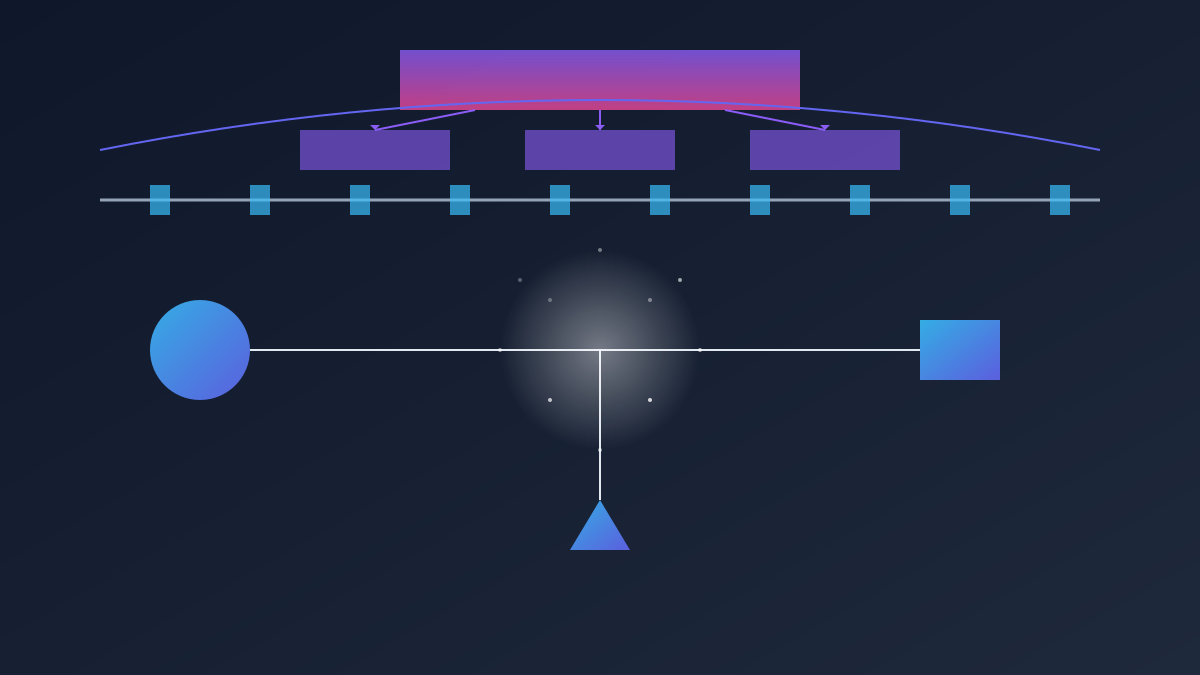
Bidirectional Control Teacher Architecture solves cross-modal interference: parallel branches decouple RGB and perceptual processing; zero-initialized control links gradually learn pixel-level consistency; bidirectional control forms a closed-loop optimization. Knowledge Distillation achieves efficient inference: the physical priors of the teacher model are transferred to a single-stream student model via representation alignment, requiring only a single path during inference—reducing computational costs with zero additional overhead.

5

Section 05

MMPhysPipe: A Physically Rich Multimodal Data Pipeline

MMPhysPipe is a scalable pipeline for building physically rich multimodal data: it uses a VLM process guided by visual evidence chain rules (physical subject localization → multi-granularity perceptual extraction → quality verification), combining the generalization ability of VLMs with the precision of expert models; it can scalably handle various physical phenomena such as rigid body dynamics, fluid dynamics, elastic deformation, gravity and friction, ensuring the breadth and quality of data coverage.

6

Section 06

Experimental Evaluation: Dual Improvements in Physical Plausibility and Visual Quality

MMPhysVideo performs excellently on authoritative benchmarks: in terms of physical plausibility, object motion continuity, collision response correctness, and long-term temporal consistency are significantly improved; in terms of visual quality, metrics like FID and FVD reach state-of-the-art levels, proving that physical modeling and visual optimization can mutually promote each other. Compared to pure pixel-based methods, it achieves a qualitative leap in physical plausibility; compared to explicit physical engine methods, it retains end-to-end flexibility.

7

Section 07

Practical Application Value, Limitations, and Future Directions

Application Value: Reducing manual adjustments in film and game production, training robot simulations in virtual environments, enhancing immersion in VR, aiding understanding in scientific visualization, testing autonomous driving simulation scenarios. Limitations: Dependence on training data coverage, degraded generation quality under extreme physical conditions, learning only statistical correlations rather than causal laws. Future Directions: Hybrid methods combining explicit physical constraints, few-shot physical concept learning, interpretable physical reasoning mechanisms.

8

Section 08

Conclusion: A New Paradigm for Physical Plausibility in Video Generation

MMPhysVideo achieves the first scalable improvement in physical plausibility of video generation through core technologies such as pseudo-RGB unified representation, bidirectional control teacher architecture, and knowledge distillation. It proves that physical laws can be learned from data via deep learning without an explicit physical engine, providing new ideas for video generation and other AI applications involving physical reasoning. As technology advances, physical plausibility will become a key standard for professional-level video generation tools, and MMPhysVideo lays an important foundation for this.

