Zing Forum

Reading

MIT Multimodal AI Course Project: Research on Multimodal Modeling of Tactile Perception and Grasping

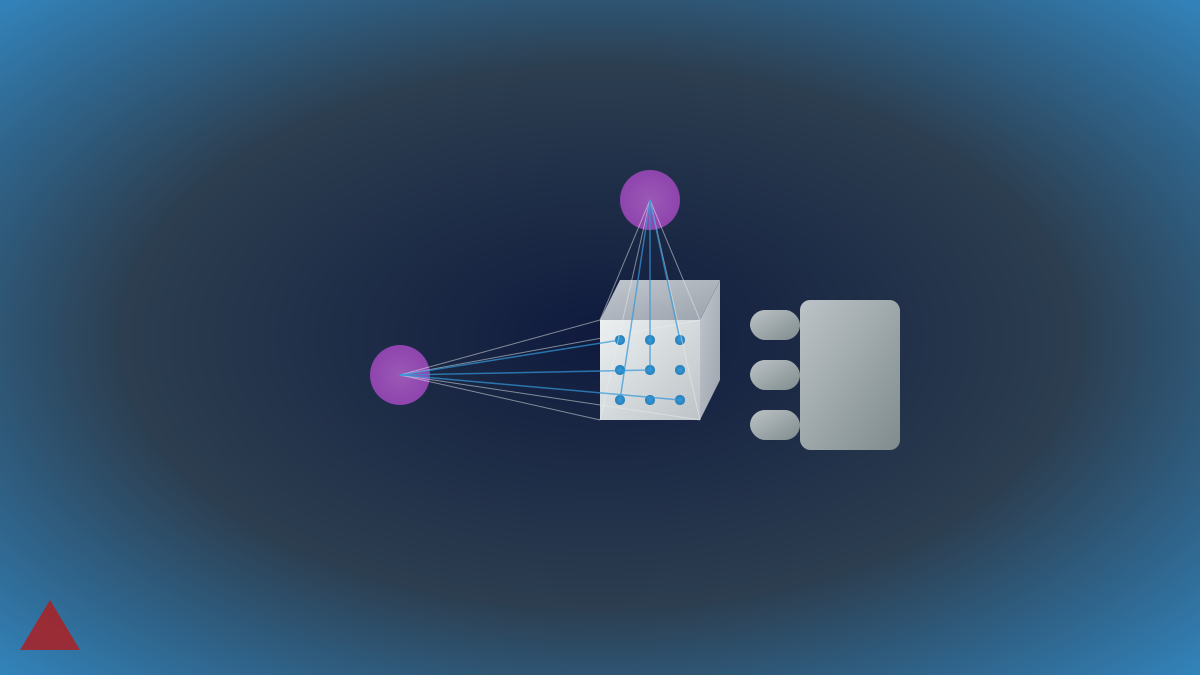
Final project of MIT 6.S985 Modeling: Multimodal AI course, exploring how to fuse tactile perception and visual information to build a more robust robotic grasping model, providing new research ideas for the field of multimodal perception and physical interaction.

multimodal AItactile sensingrobotic graspingvision-touch fusionMITphysical interactionrobotics
Published 2026-04-06 04:14Recent activity 2026-04-06 04:24Estimated read 6 min
MIT Multimodal AI Course Project: Research on Multimodal Modeling of Tactile Perception and Grasping
1

Section 01

MIT Multimodal AI Course Project: Guide to Research on Robotic Grasping with Tactile and Visual Fusion

The final project Tactile-Grasp of MIT 6.S985 "Modeling: Multimodal AI" course focuses on the fusion modeling of tactile perception and visual information in robotic grasping tasks, aiming to build a more robust robotic grasping model and provide new research ideas for the field of multimodal perception and physical interaction. The project is led by Cassandra Zhe, with the code repository created in February 2026 and the final version updated in early April.


2

Section 02

Course Background and Project Positioning

MIT 6.S985 "Modeling: Multimodal AI" is a cutting-edge course that explores integrating multiple perceptual modalities such as vision, language, audio, and touch to build intelligent systems. The final project requires students to complete a full research cycle from data collection to experimental evaluation. The Tactile-Grasp project was born in this context, focusing on robotic grasping modeling with tactile and visual fusion, and the code repository reflects the evolution from course assignment to reproducible research.

3

Section 03

Research Motivation: Why Tactile Perception Is Needed

Traditional robotic grasping relies on vision, but has limitations such as transparent objects, occlusion, and lighting changes, and cannot perceive physical properties like contact force. Tactile perception can directly measure contact force distribution, surface texture, etc., which complements vision. Humans integrate visual prediction and tactile feedback when grasping, and robots need similar capabilities, hence the need to fuse the two modalities.

4

Section 04

Technical Architecture and Methodology

Inferred technical route from the repository structure: The data layer includes visual and tactile multimodal datasets (collected via robotic arm platform), preprocessing includes standardization, time alignment, etc.; the baselines directory implements pure vision, pure tactile, and simple fusion baselines; the experiments directory designs evaluations for different object categories and strategies (metrics include grasping success rate, etc.); the reports directory contains project reports and documents.

5

Section 05

Technical Challenges of Multimodal Fusion

Core challenges include: Modal heterogeneity (differences between high-resolution visual images and low-resolution tactile pressure distributions, etc.); time synchronization (asynchronous inputs: vision before grasping, tactile after contact); fusion strategy selection (early/mid/late fusion, attention mechanisms, etc.); simulation-to-reality transfer (domain randomization, adaptive technologies).

6

Section 06

Academic Value and Application Prospects

Academically, it provides empirical research for the interdisciplinary field of multimodal perception and physical interaction, quantitatively analyzing the role of touch in grasping stability. In applications, it can improve the operational capabilities of warehouse logistics, flexible manufacturing, and service robots; in medical scenarios, it enhances the fine operation and safety of surgical assistance and rehabilitation robots; in human-robot collaboration, it perceives unexpected contacts to ensure safety.

7

Section 07

Educational Significance of the Course Project

Reflects the characteristics of top AI education: end-to-end research training (from problem definition to result analysis); hands-on practice orientation (implementing runnable code); open source and reproducibility (hosted on GitHub, MIT license).

8

Section 08

Conclusion

As a course assignment, Tactile-Grasp touches on the frontiers of robotics and AI, and multimodal perception and physical interaction are key paths for intelligent robots. We hope it provides a reference for related fields and look forward to more course projects producing high-quality open-source results.

