LLM Interpretability Research
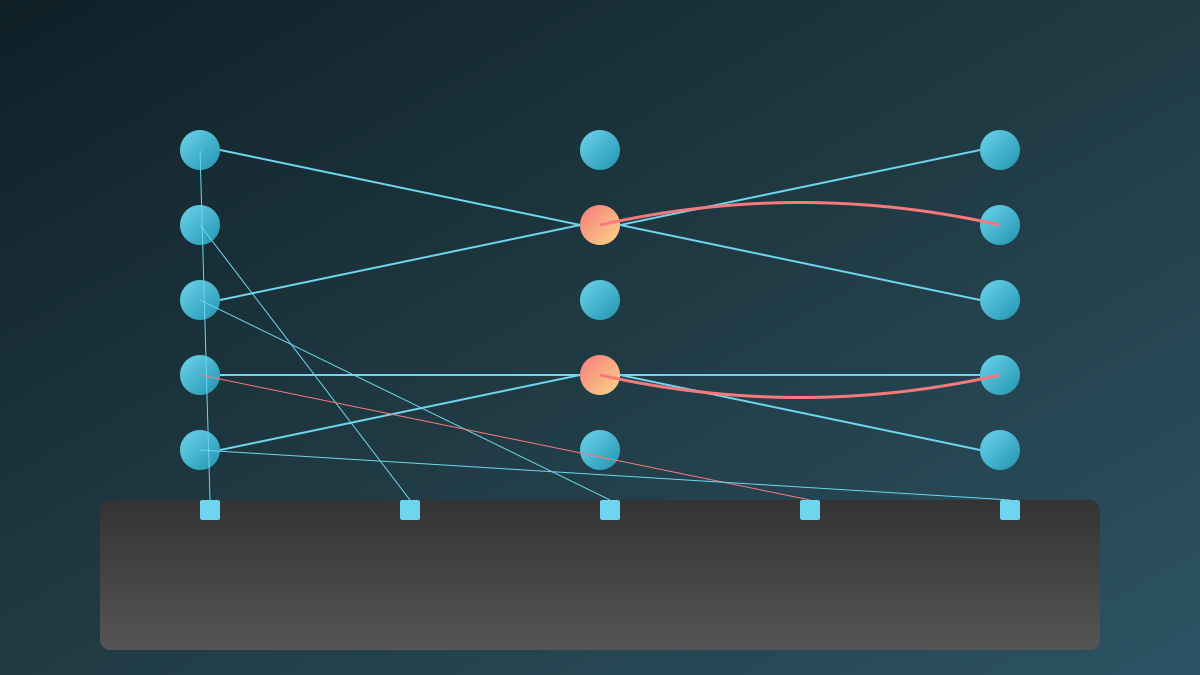
For AI researchers, miLLM provides a powerful experimental platform. Researchers can verify hypotheses about the model's internal working mechanisms and discover new interpretability rules by observing feature activation patterns.
For example, by analyzing differences in feature activation across different tasks (such as question answering, summarization, translation), researchers can better understand the multi-task learning mechanism of large models.
Content Safety and Alignment Optimization
Content safety is a key consideration when deploying large models. miLLM's feature steering function can be used for:
- Identifying and suppressing features related to harmful content generation
- Enhancing features related to beneficial and safe outputs
- Real-time monitoring of risk feature activation during the generation process
This method provides a more proactive and precise safety control approach compared to traditional output filtering.
Model Debugging and Error Analysis
When the model produces incorrect outputs, miLLM's activation monitoring function can help quickly locate the root cause. By analyzing the activation patterns corresponding to incorrect outputs, developers can identify which features caused the error and adjust the model or training data accordingly.
Personalized Generation Control
For application scenarios requiring personalized outputs (such as creative writing, style transfer), miLLM allows users to achieve fine-grained generation control by manipulating specific style features without retraining the model or adjusting complex prompts.