Zing Forum

Reading

Microsoft Semantic Kernel: A Comprehensive Analysis of the Lightweight SDK for Building AI Applications

An in-depth exploration of the architectural design, core features, and best practices of the Microsoft Semantic Kernel SDK, helping developers seamlessly integrate large language models (LLMs) into traditional applications.

Semantic KernelMicrosoftLLM SDKAI开发大语言模型PluginRAGAgent
Published 2026-04-01 19:09Recent activity 2026-04-01 19:20Estimated read 6 min
Microsoft Semantic Kernel: A Comprehensive Analysis of the Lightweight SDK for Building AI Applications
1

Section 01

[Introduction] Microsoft Semantic Kernel: Core Analysis of the Lightweight AI SDK

Microsoft Semantic Kernel (SK) is an open-source lightweight AI development SDK from Microsoft, designed to address the challenge of integrating large language models (LLMs) into traditional applications. It supports multi-language (C#, Python, Java) calls to mainstream model services through a unified interface. Its core components include Kernel, Plugins, Planners, and Memories, helping developers seamlessly integrate AI with traditional programming paradigms and lower the barrier to AI implementation.


2

Section 02

Background: Challenges in AI Application Development and the Birth of SK

With the rapid development of LLM technology, integrating it into traditional software has become a core challenge for developers. Microsoft launched Semantic Kernel, positioned as a lightweight SDK that provides a unified programming interface, allowing developers to call model services like OpenAI and Azure OpenAI in familiar languages without delving into underlying API differences.

3

Section 03

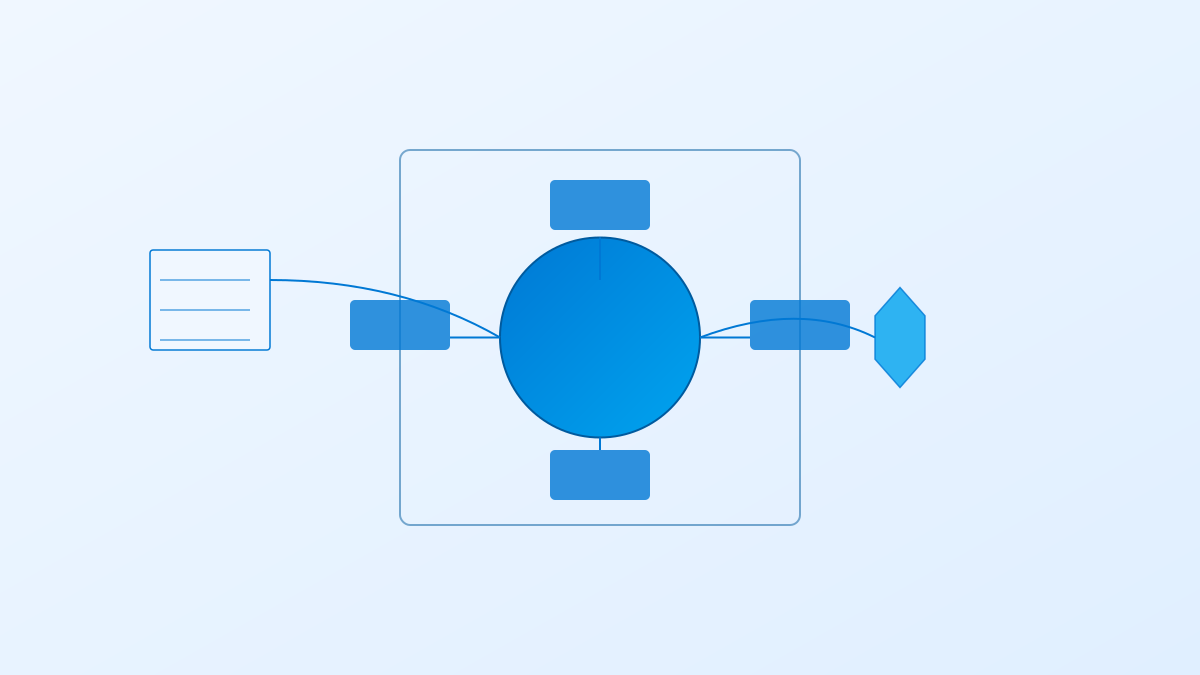
Core Architecture: Kernel, Plugins, Planners, and Memories Components

The SK architecture is built around key abstraction layers:

  1. Kernel: A central coordinator that manages AI service registration, configuration, and invocation, simplifying multi-model/service provider scenarios;
  2. Plugins: Functional modularization that encapsulates .NET/Python/Java methods into Plugins, allowing LLMs to automatically call and execute business logic;
  3. Planners: Intelligent task orchestration that generates execution plans for complex requests, automatically selecting Plugins and invoking them in order;
  4. Memories: Context persistence that enables semantic search and RAG capabilities through vector databases and Embedding models, addressing the LLM context window limitation.
4

Section 04

Application Scenarios: Intelligent Customer Service, Code Assistance, and Enterprise Automation

  • Intelligent Customer Service: Integrate knowledge bases (Memory), order query APIs (Plugins), and natural language understanding to build dialogue systems;
  • Code Assistance: Use Planners to analyze user intent and automatically call tools like code search and syntax checking;
  • Enterprise Automation: Connect to existing business systems to automatically handle email classification, information extraction, trigger approval processes, etc.
5

Section 05

Development Experience: Multi-Language Support and Ecosystem Integration

SK supports multi-language development in C#, Python, and Java, deeply integrates with the Azure ecosystem (friendly to Azure OpenAI), and is compatible with third-party services like OpenAI API and Hugging Face. Microsoft provides rich documentation and examples, allowing developers to incrementally add advanced features; it is especially friendly to .NET teams, enabling them to upgrade existing applications without switching technology stacks.

6

Section 06

Framework Comparison: Differences Between SK, LangChain, and LlamaIndex

SK competes with LangChain and LlamaIndex:

  • Compared to LangChain's "chain" abstraction, SK uses a "Kernel+Plugin" model, which is closer to traditional programming and offers better type safety and IDE support;
  • LangChain is more widely adopted in the Python community and has a richer ecosystem of tools;
  • The choice depends on the team's technology stack: SK is suitable for enterprise .NET environments, while LangChain is ideal for rapid experimentation.
7

Section 07

Summary and Outlook: SK's Strategic Value and Future Direction

SK is a strategic investment in Microsoft's AI application development infrastructure, providing a methodology for integrating AI into software engineering. Its Plugin and Planner architecture can be extended to adapt to technological developments like multimodality and Agents. For teams looking to productize LLMs, SK is a reliable choice, and its design philosophy (simplicity, standardization, integration) meets the needs of enterprise-level AI development.

