Zing Forum

Reading

Meta Releases TRIBE v2: Multimodal Brain Response Prediction Model Usheres in a New Era of NeuroAI

Meta AI Research has open-sourced TRIBE v2, a multimodal model that can predict human brain responses based on multimodal inputs such as vision and text, providing a powerful tool for interdisciplinary research between neuroscience and artificial intelligence.

Meta AITRIBE v2多模态模型脑响应预测神经编码fMRITransformer脑机接口计算神经科学开源
Published 2026-03-30 22:27Recent activity 2026-03-30 22:53Estimated read 6 min
Meta Releases TRIBE v2: Multimodal Brain Response Prediction Model Usheres in a New Era of NeuroAI
1

Section 01

Introduction: Meta Open-Sources TRIBE v2, Ushering in a New Chapter of Interdisciplinary NeuroAI Research

Meta AI Research recently open-sourced TRIBE v2 (Transformer for Brain Encoding v2), a multimodal brain response prediction model that can predict neural activity patterns in the human cerebral cortex based on multimodal inputs like vision and text. It provides a powerful tool for interdisciplinary research between neuroscience and artificial intelligence, marking a new stage in computational neuroscience.


2

Section 02

Project Background and Core Objectives

TRIBE v2 is Meta's latest achievement in the fields of brain-computer interfaces and neural encoding. Its core objective is to establish a mapping relationship between external stimuli and brain neural responses to understand the neural basis of perception, cognition, and consciousness. Compared to the first-generation model, it has significantly improved in architecture, training strategies, and multimodal fusion capabilities. Traditional neuroscience research relies on post-analysis of data from technologies like fMRI and EEG, while TRIBE v2 can predict response patterns in various brain regions in real time, laying the foundation for real-time neural feedback and brain-computer interface applications.

3

Section 03

Technical Architecture and Core Mechanisms

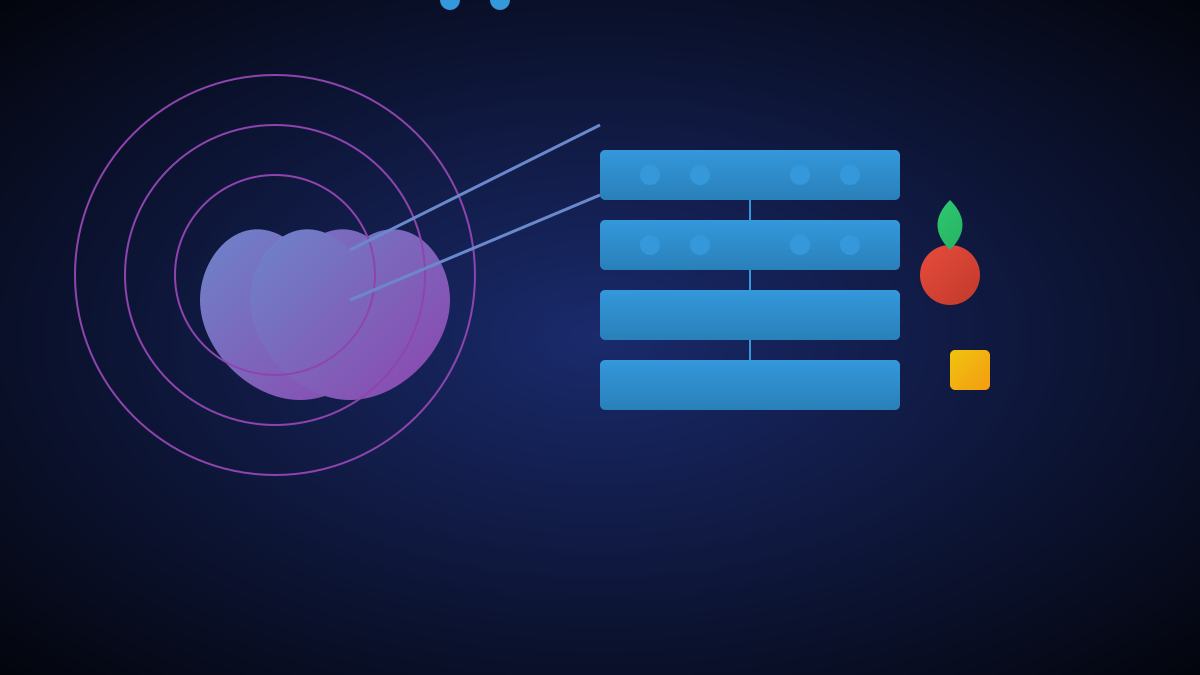
TRIBE v2 adopts a Transformer architecture, with its core innovation being a multimodal encoder that can simultaneously process inputs such as images, text, and audio and map them to a unified representation space. The neural prediction layer uses a hierarchical mechanism: early layers predict responses in the primary visual cortex (V1), while deeper layers predict activation patterns in high-level cognitive regions like the prefrontal cortex. Training data comes from large-scale human neuroimaging datasets (fMRI data from natural image viewing, language comprehension, etc.), and self-supervised techniques like contrastive learning are used to correlate sensory inputs with neural activity patterns.

4

Section 04

Innovative Features of Multimodal Fusion

TRIBE v2 has true multimodal processing capabilities and can integrate information from different sensory channels. For example, when inputting images and text, it can not only predict responses in the visual cortex and language areas separately but also capture the synergistic activation patterns of cross-modal integration regions. This is crucial for understanding the cognitive mechanisms of multi-sensory integration in real-world scenarios.

5

Section 05

Application Scenarios and Research Value

The open-sourced TRIBE v2 brings possibilities to multiple fields: basic neuroscience can verify theories of brain information processing; the clinical field can use it for early diagnosis and monitoring of neurological diseases; brain-computer interface technology can achieve faster adaptation and higher decoding accuracy, reducing user calibration training time.

6

Section 06

Limitation Analysis

TRIBE v2 has limitations: fMRI data has limited temporal and spatial resolution, making it unable to capture millisecond-level neural dynamics or single neuron activity; the model is trained on data from healthy adults, so its applicability to children, the elderly, or patients with neurological diseases needs to be verified.

7

Section 07

Future Research Directions

In the future, we will integrate EEG and MEG data with higher temporal resolution, develop personalized neural response models, and expand neural prediction capabilities to complex cognitive tasks such as decision-making and creative thinking.

8

Section 08

Conclusion

The release of TRIBE v2 is a new milestone in the integration of AI and neuroscience. The open-source tool provides the global research community with a new way to explore the mysteries of the brain. With model improvements and application expansion, it is expected to approach key breakthroughs in understanding the essence of intelligence, making it a project worth in-depth research in the frontiers of AI and brain science.

