Zing Forum

Reading

MEGA JARVIS UNIVERSE 3D: Autonomous AI Desktop Agent Driven by Multi-Model Routing

An autonomous AI desktop agent based on multi-model LLM routing, tool execution, and memory-driven reasoning, supporting real-time automation, programming, and system-level control

AI代理多模型路由桌面自动化LLM工具执行记忆系统开源
Published 2026-05-29 20:39Recent activity 2026-05-29 21:19Estimated read 6 min
MEGA JARVIS UNIVERSE 3D: Autonomous AI Desktop Agent Driven by Multi-Model Routing
1

Section 01

MEGA JARVIS UNIVERSE 3D: Core Overview of the Autonomous AI Desktop Agent

MEGA JARVIS UNIVERSE 3D is an open-source autonomous AI desktop agent project inspired by Iron Man's JARVIS. It integrates multi-model LLM routing, tool execution, and memory-driven reasoning to enable real-time automation, programming, and system-level control. Key features include dynamic model selection, system operation capabilities, and persistent memory for personalized interactions. The project is maintained by Orgio111 (MrOrgio) and released on GitHub on May 29, 2026.


2

Section 02

Project Background & Inspiration

Inspired by the JARVIS assistant from Iron Man, the project aims to build a comprehensive autonomous AI desktop agent that goes beyond simple chatbots. It targets deep integration into user workflows with system-level control capabilities.

3

Section 03

Core Architecture & Technical Highlights

Multi-model LLM Routing

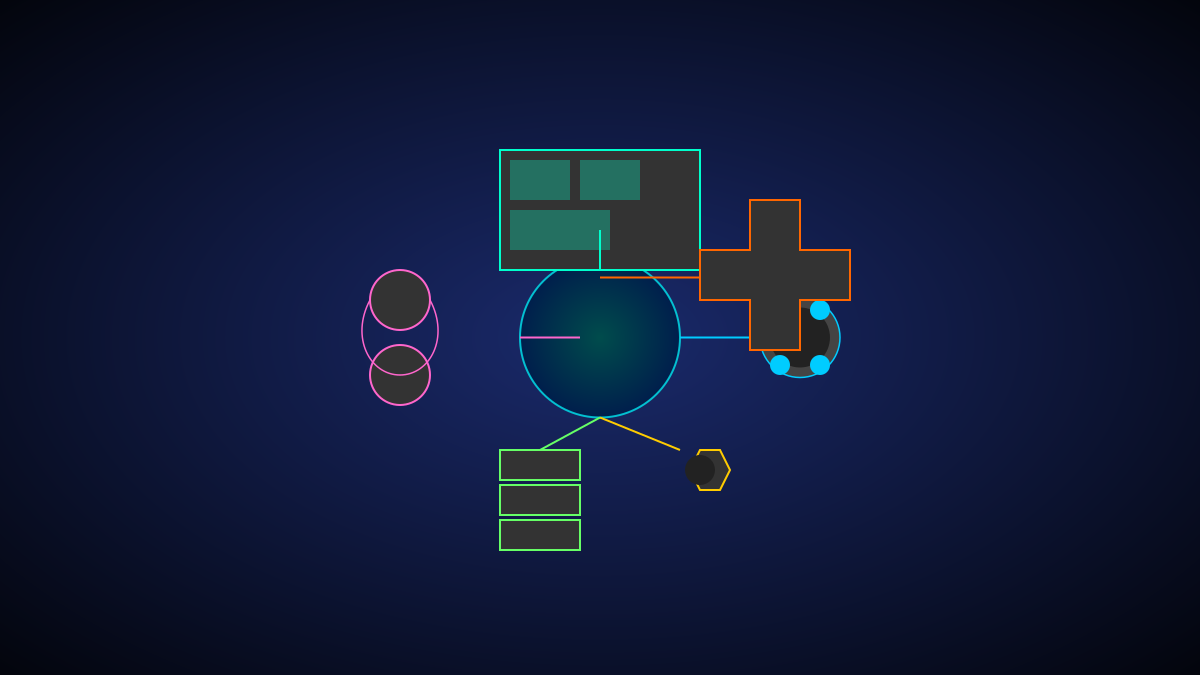
A smart routing layer dynamically selects models based on task type, complexity, speed needs, etc. Advantages: cost optimization (light models for simple tasks), faster response, complementary capabilities (code, writing, reasoning), and fault tolerance (switch to backups).

Tool Execution & System Control

Enables actual system operations: file management, code compilation, OS API integration, tool calls, and authorized system config/software installation.

Memory-driven Reasoning

Persistent memory system provides context continuity across sessions, personalized adaptation to user habits, knowledge accumulation, and smart retrieval of historical info.

4

Section 04

Application Scenarios & Practical Value

Developer Workflow

Automates code review, code generation/integration, dev environment setup, build monitoring & error fixing.

System Monitoring

Real-time resource monitoring, anomaly detection & auto-fix, dynamic parameter adjustment, and report delivery.

Office Assistant

Manages schedules/emails, document organization, data analysis/reports, and coordinates multi-office tools/services.

5

Section 05

Technical Implementation Considerations

Security Design

  • Permission classification (read-only vs dangerous operations requiring authorization)
  • Sandbox isolation for untrusted code
  • Audit logs for all operations
  • User confirmation for key actions

Model Selection Strategy

  • Task classifier for type/complexity
  • Cost-quality balance
  • Delay budget based on user tolerance
  • Real-time model health monitoring
6

Section 06

Open Source Ecosystem & Community Value

Licensed under MIT: free to use, modify, distribute; commercial use allowed. Benefits: community contributions, transparency for security audits, and lower enterprise adoption barriers. It represents a practical direction for AI agent development by integrating multi-model collaboration, tool use, and memory persistence.

7

Section 07

Summary & Future Outlook

The project combines multi-model routing (flexibility/cost-effectiveness), tool execution (expanded capabilities), and memory (personalization) into a complete AI agent architecture. It provides valuable design references for AI app developers. As LLM capabilities improve and API costs drop, such desktop AI agents are expected to become standard tools for developers and advanced users in the coming years.

