Zing Forum

Reading

MediaRouter: A Multimodal AI Agent Routing System Based on Notebook Environment

A multimodal AI agent built on Jupyter Notebook that can automatically identify user intent and route requests to corresponding workflows such as Q&A, text-to-image, or text-to-video, demonstrating a new approach to lightweight agent orchestration.

多模态AI智能体路由MediaRouterHuggingFaceGradio文生图文生视频Agent编排
Published 2026-05-19 02:03Recent activity 2026-05-19 02:17Estimated read 6 min
MediaRouter: A Multimodal AI Agent Routing System Based on Notebook Environment
1

Section 01

MediaRouter Project Introduction: Lightweight Multimodal AI Agent Routing System

MediaRouter is a multimodal AI agent system built on Jupyter Notebook. Its core is intelligent routing—automatically identifying user intent and distributing requests to workflows such as Q&A, text-to-image, and text-to-video, demonstrating a new approach to lightweight agent orchestration. The project is open-sourced by farjamazizi, implemented in Python, integrates models from the HuggingFace ecosystem, provides an interactive interface via Gradio, and supports lightweight deployment suitable for local/cloud notebook environments.


2

Section 02

Project Background and Technical Foundation

MediaRouter was open-sourced by developer farjamazizi and implemented in Python. Its tech stack integrates multiple pre-trained models from the Hugging Face ecosystem and builds an interactive interface via Gradio. The system is fully based on the Jupyter Notebook environment, featuring lightweight characteristics, allowing rapid deployment and iteration on local or cloud environments.

3

Section 03

Core Architecture and Workflow

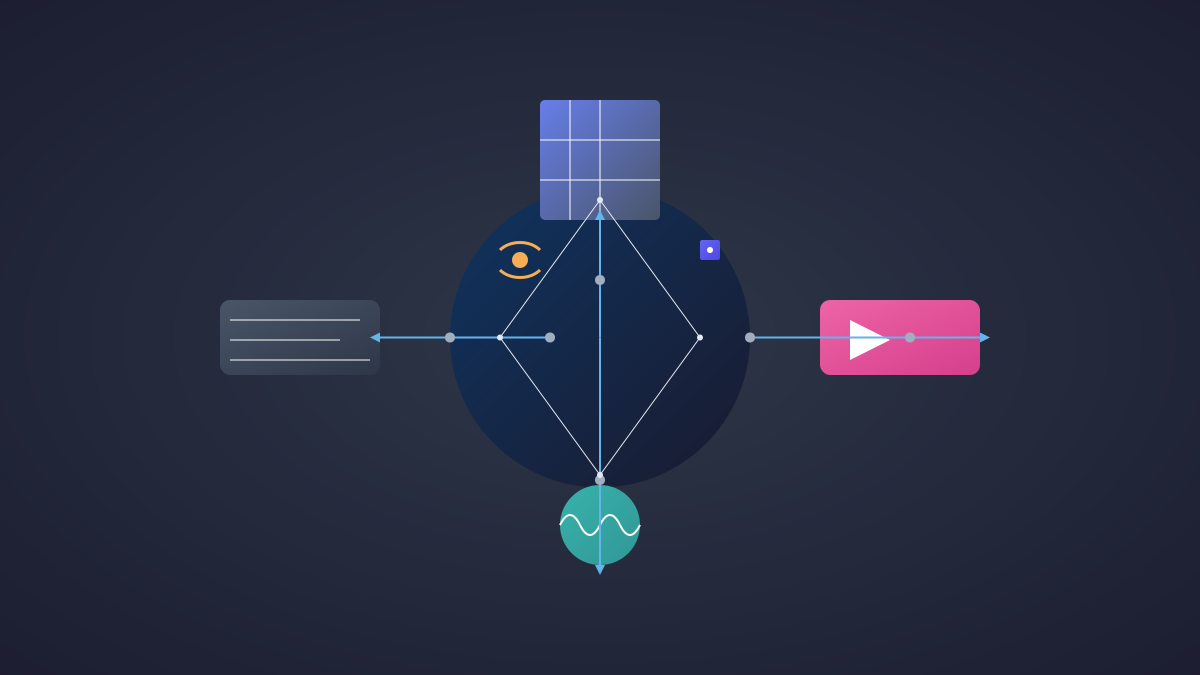
The system follows the agent orchestration pattern, with core components including:

  1. Intent Classification Module: A lightweight classifier determines the user's input intent (Q&A, text-to-image, text-to-video);
  2. Model Routing Layer: Forwards to the corresponding model based on task type (e.g., Flan-T5 for Q&A, Stable Diffusion for text-to-image);
  3. Interactive Interface Layer: Builds a user-friendly web interface with Gradio, supporting multimodal input and output.
4

Section 04

Highlights of Technical Implementation

Highlights of technical implementation:

  • Lightweight Deployment: Notebook environment offers developer-friendliness, controlled resources (model loading on demand), and rapid iteration;
  • Unified Multimodal Interface: A unified framework for text/image/video generation tasks, extensible to more modalities like audio and 3D;
  • Extensible Architecture: Reserved interfaces support adding new intent categories, integrating professional models, and implementing multi-step workflows.
5

Section 05

Application Scenarios and Practical Value

Application scenarios and practical value:

  • Content Creation Assistance: A unified entry reduces the cost of switching between cross-modal creation tools;
  • Education and Research: Serves as a multimodal learning case to help understand core concepts like agent architecture;
  • Rapid Prototype Validation: Low-cost MVP building, followed by engineering refactoring after requirement validation.
6

Section 06

Limitations and Improvement Directions

Limitations and improvement directions:

  • Intent Classification Robustness: Current logic is simple, insufficient for recognizing ambiguous/compound intents; need to introduce stronger semantic models or support parallel multi-intent processing;
  • Error Handling: Lacks elegant failure fallback mechanisms; need to design alternative model switching strategies;
  • Context Memory: No conversation history management, affecting coherence in multi-turn interactions.
7

Section 07

Industry Trends and Project Insights

MediaRouter reflects the trend of AI applications evolving from single-model calls to agent orchestration: multi-model scheduling can optimize costs, improve quality, and enhance flexibility. Similar ideas are seen in OpenAI GPTs, LangChain Agent framework, etc. This project demonstrates feasibility in a concise notebook form, providing an entry-level reference for developers. Conclusion: MediaRouter is small but inspiring, serving as an excellent case for understanding agent architecture and multimodal development, and will play a role in more scenarios in the future.

