Zing Forum

Reading

LTX-2 Audio Reconstruction Branch: Experiment on Enhancing Audio Capabilities of Video Generation Models

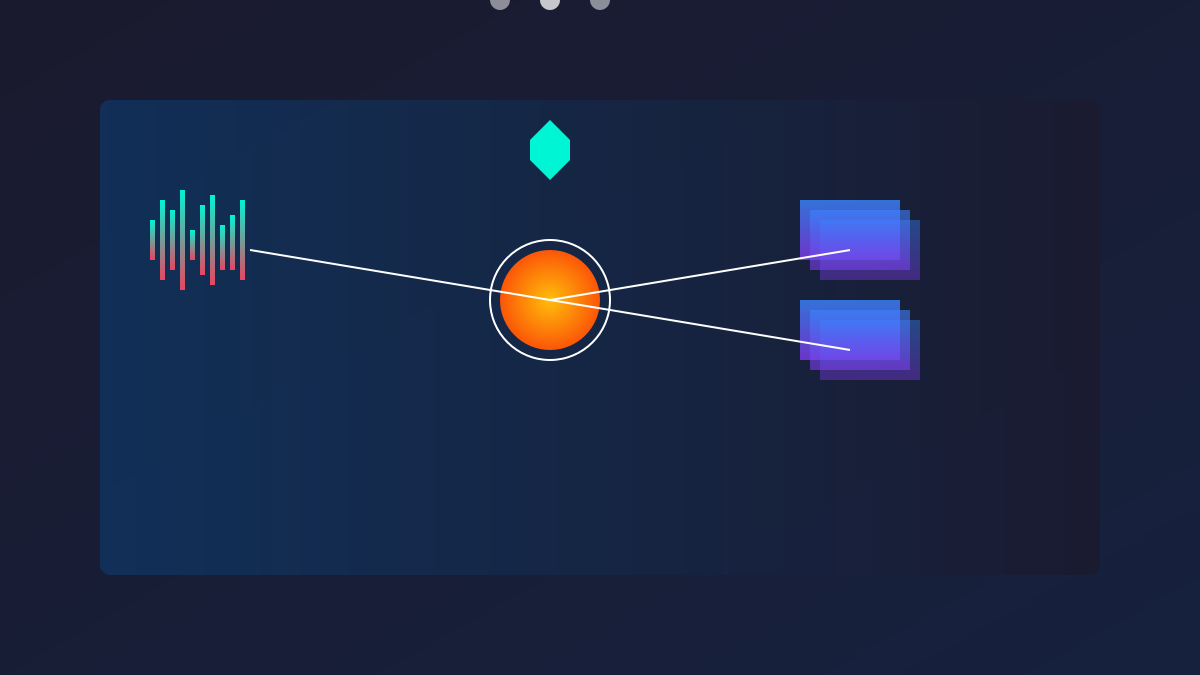
The LTX-2 Audio Reconstruction Branch adds optional audio joint training capabilities to video generation models by introducing a time-frequency mixer, audio-aware training loss, and a two-stage audio retention strategy, while maintaining compatibility with the original LTX-2.

LTX-2视频生成音频建模多模态AILoRA微调Lightricks联合训练时频混合器
Published 2026-04-23 19:02Recent activity 2026-04-23 19:23Estimated read 7 min
LTX-2 Audio Reconstruction Branch: Experiment on Enhancing Audio Capabilities of Video Generation Models
1

Section 01

Core Guide to the LTX-2 Audio Reconstruction Branch

This article introduces the core content of the LTX-2 Audio Reconstruction Branch: By introducing a lightweight time-frequency mixer, multi-scale audio-aware training loss, and a two-stage audio retention strategy, this branch adds optional audio joint training capabilities to video generation models while maintaining compatibility with the original LTX-2. Its goal is to enhance the synchronized audio-visual generation capability in video generation and improve the immersive experience.


2

Section 02

Background and Motivation

Video generation models have made significant progress in recent years, but most focus on visual content, with audio often added post-production. LTX-2.3 is a powerful video generation model developed by Lightricks, supporting functions such as text/image-to-video generation and two-stage high-quality generation. However, synchronized audio-visual generation is crucial for immersive experiences in practical applications. Therefore, community developer starsFriday launched an experimental branch aimed at enhancing the audio modeling capabilities of LTX-2.3 to achieve joint audio-visual training and generation.

3

Section 03

Core Architecture Improvements

While maintaining compatibility with the original LTX-2, this branch introduces three key components:

  1. Lightweight Time-Frequency Mixer: A multi-layer convolutional structure that captures local time-frequency dependencies of audio. Key parameters include latent_channels (default 8), mel_bins (default 16), etc.
  2. Audio-Aware Training Loss: Combines multiple loss functions (audio reconstruction loss weight 1.25, high-frequency weighted loss 0.5, etc.) to supervise joint training.
  3. Two-Stage Audio Retention Strategy: Retains and optimizes the audio latent representation from the first stage during the second stage generation to ensure audio-visual synchronization.
4

Section 04

Training Process and Data Preparation

Environment Configuration: Use uv to manage dependencies with the command: git clone https://github.com/starsFriday/LTX-2.git && cd LTX-2 && uv sync --frozen && source .venv/bin/activate; Model Resources: Need to download the base model (e.g., ltx-2.3-22b-dev.safetensors), spatial/temporal upsamplers, and text encoder Gemma-3-12b-it from Hugging Face; Data Preprocessing: Organize data into latents/, conditions/, and audio_latents/ directories, and enable with_audio in the configuration; LoRA Support: Full support for LoRA fine-tuning, including checkpoint handling for the audio mixer state, which can be used in inference or ComfyUI workflows.

5

Section 05

Experimental Recommendations and Ablation Studies

The official recommendation is to verify component contributions through ablation studies:

  1. Enable only the time-frequency mixer with standard loss;
  2. Use only audio-aware loss without adding the mixer;
  3. Freeze some parameters to observe the effect of the audio retention strategy;
  4. Enable full reconstruction with all components. Understand the impact of each design decision through comparative experiments.
6

Section 06

Limitations and Notes

This branch has the following limitations:

  1. Experimental nature: APIs and configurations may change;
  2. Data quality: Ensure audio data is reliable; otherwise, training in non-audio mode is recommended;
  3. Resource requirements: Joint training requires more VRAM and computing resources;
  4. Compatibility: Some advanced use cases may depend on specific model versions.
7

Section 07

Practical Significance and Application Prospects

This branch lays the foundation for multi-modal video generation, with application scenarios including:

  1. Auto-scored video generation: Synchronously generate video and audio based on text descriptions;
  2. Lip synchronization: Generate speaking videos that match the audio;
  3. Sound effect generation: Automatically add environmental and action sound effects;
  4. Music video creation: Generate synchronized visual content based on music. This capability will lower the threshold for multimedia creation and improve efficiency.
8

Section 08

Summary

The LTX-2 Audio Reconstruction Branch adds audio joint training capabilities to video generation models through three core improvements while maintaining compatibility with the original LTX-2. Its modular design allows flexible enabling of audio functions, which is of great value to multi-modal generation research and the development of next-generation AI video creation tools, and is worth the attention and participation of developers.

