Zing Forum

Reading

LoopForge: An Agent OS Built with Rust for Long-Term Autonomous Workflows

An open-source Agent OS written in Rust, focusing on long-running autonomous workflows, with persistent memory, tool sandboxing, and multi-provider LLM routing capabilities.

RustAgent OS长期工作流LLM路由工具沙箱持久化记忆开源项目软件交付
Published 2026-04-06 00:14Recent activity 2026-04-06 00:22Estimated read 6 min
LoopForge: An Agent OS Built with Rust for Long-Term Autonomous Workflows
1

Section 01

LoopForge: An Agent OS Built with Rust, Focused on Long-Term Autonomous Workflows

LoopForge is an open-source Agent OS written in Rust, designed to address the shortcomings of existing Agent frameworks in long-term operation, cross-session state preservation, secure tool execution, and other aspects. Positioned as a "personal AI engineer", it focuses on the full lifecycle of software delivery, with core capabilities such as persistent memory, tool sandbox isolation, and multi-provider LLM routing, providing a complete runtime environment for complex autonomous workflows.


2

Section 02

Background: Limitations and Needs of Existing Agent Frameworks

Current AI Agent technology is developing rapidly, but most frameworks focus on single-task execution and have limited support for complex workflows involving long-term operation, cross-session state preservation, and secure execution of external tools. LoopForge is designed to fill this gap, meeting the needs of scenarios such as automated software maintenance, large-scale code refactoring, and continuous integration optimization.

3

Section 03

Technology Choice: Performance and Security Guarantees from Rust

LoopForge chooses Rust as its implementation language based on three main points: 1. Memory safety guarantees (no GC pauses, memory leaks, or null pointer issues) to ensure long-term operational stability; 2. Zero-cost abstractions and async programming support, balancing high performance and concurrent processing; 3. Cross-platform capabilities, running consistently on environments like Linux and macOS, adapting to different deployment scenarios.

4

Section 04

Core Architecture: The Trinity of Memory, Sandbox, and Routing

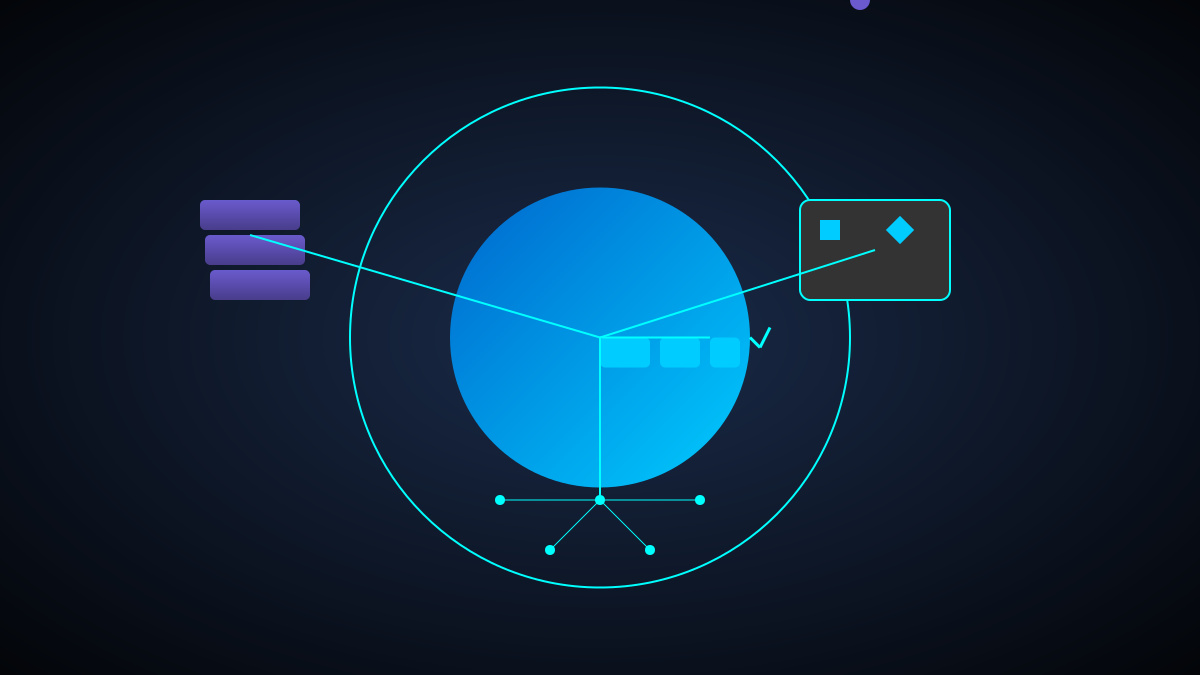
LoopForge architecture is built around three core components:

  • Persistent Memory System: Addresses cross-session state preservation issues, can store workflow states and intermediate results, and supports resuming from breakpoints;
  • Tool Sandbox: Isolates external command execution (e.g., compilation, testing), restricts permissions, and prevents system damage or data leakage;
  • Multi-Provider LLM Routing: Supports OpenAI-compatible APIs (Ollama, DeepSeek, etc.), Anthropic Claude, Google Gemini, and other domestic and international platforms, allowing flexible model selection based on task types.
5

Section 05

Configuration and Quick Start: Low-Threshold Onboarding Experience

LoopForge uses TOML format configuration (~/.loopforge/config.toml), supporting multi-provider definitions and fine-grained routing (e.g., using cloud models for coding tasks, local Ollama for chat). Installation methods include precompiled binaries and Cargo source installation; it is recommended to use the loopforge onboard command to quickly complete initial configuration and sample tasks. It is user-friendly for Ollama users, with default support for local models and data that can be kept locally.

6

Section 06

Workflow Design and Ecosystem Integration

LoopForge manages workflow execution via "Harness", and uses Checkpoints to save intermediate states, enabling fault tolerance and breakpoint recovery. It deeply collaborates with existing development toolchains (Git, Docker, compilers, testing frameworks), and also supports NVIDIA NIM integration, adapting to enterprise-level deployment scenarios and integrating into users' existing development processes.

7

Section 07

Open Source Value and Future Outlook

LoopForge is open-source and hosted on GitHub, providing detailed documentation and an automated release process (GitHub Actions). In the future, it needs to improve production-level features (scheduling, monitoring, fault recovery), enrich preset templates and tool integrations. Its differentiated advantages lie in its focus on long-term operation and software delivery scenarios, as well as the performance reliability brought by Rust, making it expected to become an important choice for developers' automation tools.

