Zing Forum

Reading

Loom: A Unified Intelligent Agent Ecosystem for Multi-AI Tool Collaboration

Loom is a unified agent ecosystem that supports seamless collaboration between multiple AI tools (jcode, crush, claude-code, opencode, goose, etc.), enabling the sharing of skills, sessions, and MCP servers. It also functions as a workflow engine to flexibly select the appropriate agent tool for each task.

agentMCPmulti-agentworkflowecosystemAI-toolscollaborationorchestration
Published 2026-05-21 00:45Recent activity 2026-05-21 00:56Estimated read 5 min
Loom: A Unified Intelligent Agent Ecosystem for Multi-AI Tool Collaboration
1

Section 01

Introduction to Loom: A Unified Intelligent Agent Ecosystem for Multi-AI Tool Collaboration

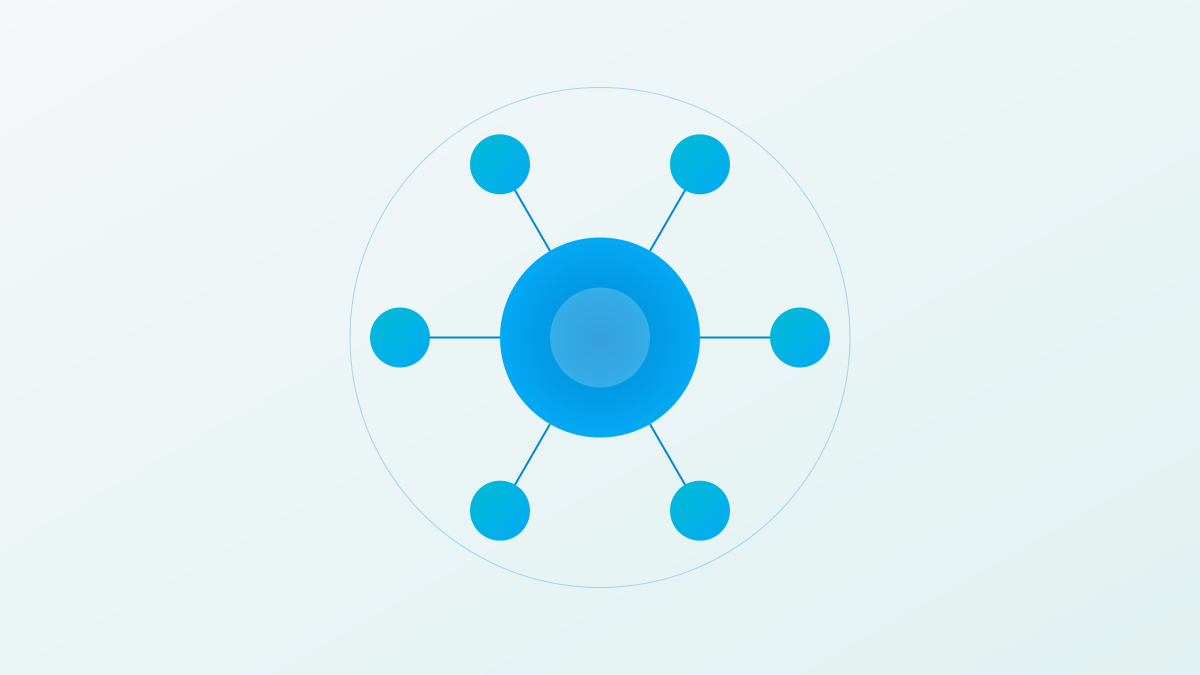
Loom is a unified intelligent agent ecosystem designed to address the fragmentation of AI tools. It supports seamless collaboration among multiple AI tools such as jcode, crush, and claude-code, enabling the sharing of skills, sessions, and MCP servers. Additionally, it acts as a workflow engine to flexibly select agent tools for tasks, achieving coexistence of multiple tools and complementary capabilities.


2

Section 02

Background: Challenges from AI Tool Fragmentation

With the explosive growth of AI programming assistants and intelligent agent tools (e.g., Claude Code, OpenCode, Goose), developers face pain points such as cumbersome tool switching, repeated configuration of skills and MCP servers, fragmented context, and collaboration difficulties. Loom addresses these issues by providing a unified ecosystem for multi-tool collaborative operation.

3

Section 03

Core Design: Four Key Goals and Values of Loom

Loom is positioned as a unified agent ecosystem with four core goals: 1. Coexistence of multiple tools; 2. Resource sharing (skills, sessions, MCP servers); 3. Task routing (automatic/manual agent selection); 4. Workflow orchestration. It solves problems like repeated configuration of AI tools, fragmented context, single capability, and collaboration difficulties.

4

Section 04

Technical Implementation: Key Architectural Components of Loom

Loom is implemented through the following mechanisms: 1. Unified interface layer: Standardizes the interaction methods of different AI tools; 2. Shared state management: Centralized management of sessions, skills, MCP servers, and project configurations; 3. Task routing engine: Supports automatic/manual/hybrid modes for agent selection; 4. Workflow orchestration: Supports complex processes such as sequence, conditional branching, parallel processing, and result aggregation.

5

Section 05

Application Scenarios and Supported AI Tools

Loom already supports or plans to support tools like Claude Code, OpenCode, Goose, Crush, and jcode. Application scenarios include: complex project development (switching tools at different stages), multi-agent collaborative tasks (dividing work into requirement understanding, coding, review, etc.), and skill ecosystem sharing (reusing custom skills across tools).

6

Section 06

Industry Significance: Promoting AI Tool Ecosystem from Competition to Collaboration

Loom represents the evolutionary direction of the AI tool ecosystem, shifting from tool competition to ecological collaboration. Its values include: reducing user switching costs, promoting differentiated competition among vendors, accelerating ecosystem maturity, and enhancing user experience.

7

Section 07

Future Outlook: Expansion Directions of the Loom Ecosystem

In the future, Loom may achieve: integration of more AI tools, a market for community-contributed skills and MCP servers, a library of automated workflow templates, and enterprise-level multi-agent collaboration solutions, providing an exploration direction for AI tool interoperability.

