Zing Forum

Reading

LogRoute CI Shunt Proxy: Building an Auditable Intelligent Troubleshooting Workflow

Explore how to implement automatic extraction of CI failure logs, intelligent routing, and evidence retention via AI agents, transforming continuous integration troubleshooting from a manual chore into a traceable automated process.

CI/CDDevOpsAI代理故障排查持续集成可审计开源项目自动化工作流
Published 2026-04-29 00:45Recent activity 2026-04-29 01:00Estimated read 7 min
LogRoute CI Shunt Proxy: Building an Auditable Intelligent Troubleshooting Workflow
1

Section 01

[Introduction] LogRoute CI Shunt Proxy: Building an Auditable Intelligent Troubleshooting Workflow

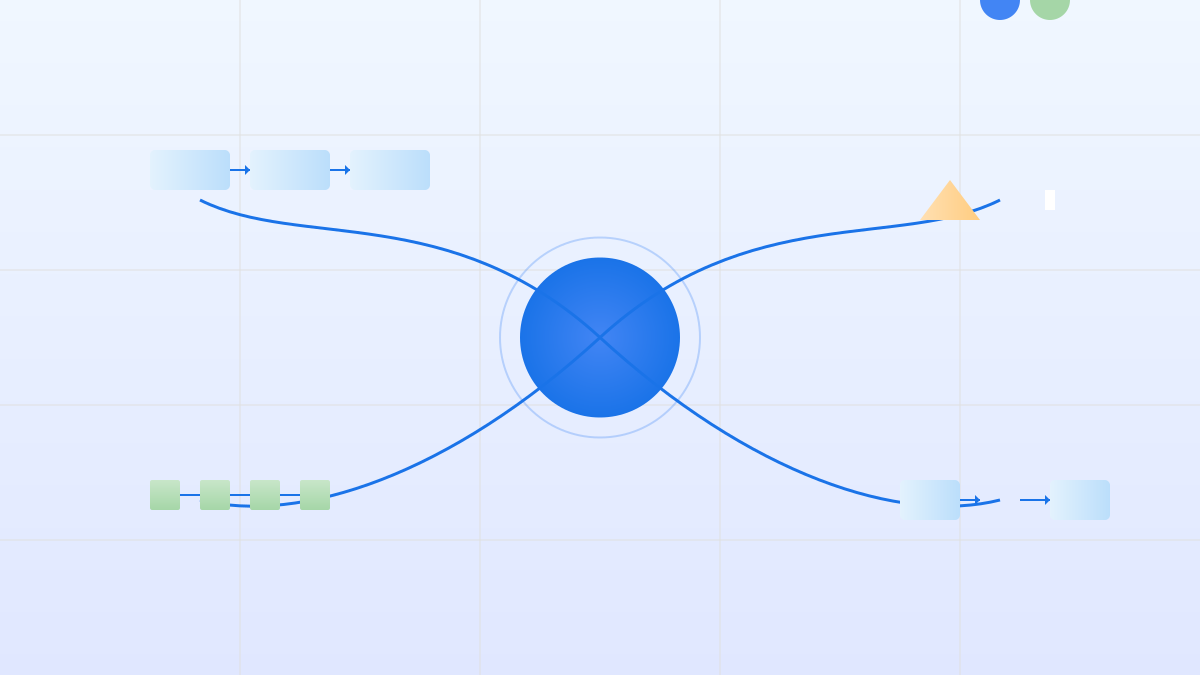
Continuous Integration/Continuous Deployment (CI/CD) is the lifeblood of modern software development, but handling CI failures has long plagued teams. The LogRoute CI Shunt Proxy project proposes an innovative solution: using AI agents to implement automatic extraction of CI failures, intelligent routing, and evidence retention, turning troubleshooting from a manual chore into a traceable automated process. The core is to build an auditable workflow to address pain points such as delayed responses, inconsistent judgments, and difficulty in knowledge accumulation.


2

Section 02

Diagnostic Dilemmas of CI Failures

CI pipelines for large projects trigger dozens of builds daily, with various failure causes (code errors, test failures, dependency timeouts, etc.). Developers need to answer: What type of failure is it? Who is responsible? What's the root cause? Is it a known issue? Traditional manual handling has limitations like slow response, inconsistent judgments, and difficulty in knowledge accumulation—problems the LogRoute project aims to solve.

3

Section 03

Core Design of the Auditable Workflow

Log Extraction: Capturing Signals from Noise

Intelligently extract key log fragments, including error stacks, failed test contexts, environment configuration snapshots, and dependency version associations.

Intelligent Routing: Assigning to the Right Person

Automatically notify responsible persons based on code change associations, failure pattern matching, impact scope assessment, and urgency grading.

Agent Review: AI-Assisted Analysis

AI agents act as first responders: understanding logs, extracting error information, generating root cause hypotheses, retrieving knowledge bases, and producing structured reports (assisting rather than replacing humans).

Evidence Retention: Building Knowledge Assets

Completely record original logs, AI analysis processes, human feedback, and resolution tracking for auditing and continuous improvement.

4

Section 04

Key Components of Technical Implementation

Log Parsing and Feature Extraction

Supports log formats from multiple CI systems (Jenkins, GitLab CI, etc.), using regular expressions, Grok patterns, or LLMs to extract structured information.

Vector Retrieval and Knowledge Base

Use vector databases to store semantic embeddings of historical failures for fast similarity retrieval to match known issues.

LLM Agents and Reasoning Chains

Guide LLM analysis via prompts and reasoning chains, and orchestrate multi-step processes using LangChain/AutoGen.

Workflow Orchestration and Event-Driven

Trigger processes based on Webhooks/message queues; workflow engines manage shunt phases (retry, timeout, human intervention).

Observability and Audit Tracking

Record agent decisions, routing judgments, and human reviews to form complete audit logs.

5

Section 05

Application Scenarios and Value Proposition

  • Large Teams: Resolve manual processing bottlenecks and ensure timely and accurate routing of issues.
  • Cross-Timezone Collaboration: AI agents respond 24/7 and provide preliminary analysis.
  • Quality Gates: Quickly identify blocking failures and speed up PR merges.
  • Flaky Test Governance: Identify unstable tests and guide quality improvements.
  • Compliance Auditing: Meet record-keeping requirements for regulated industries.
6

Section 06

Tool Integration and Open Source Value

Tool Integration

Integrate with CI platforms (Webhook/API), communication tools (Slack/DingTalk), ticketing systems (Jira), code hosting platforms, and monitoring tools (Prometheus).

Open Source Value

  • Transparency: Allows auditing of sensitive log processing.
  • Customizability: Adapts to different team workflows.
  • Knowledge Sharing: Community contributions of rules, parsers, and integrations.
  • Best Practice Dissemination: Learn from CI governance experiences of other organizations.
7

Section 07

Future Development Directions and Conclusion

Future Directions

  • Predictive Shunting: Identify potential CI issues in advance.
  • Proactive Fix Recommendations: Generate specific repair code.
  • Cross-Project Learning: General model training under privacy protection.
  • Natural Language Interaction: Conversational querying of failure details.

Conclusion

LogRoute represents the intelligent direction of DevOps, injecting AI into CI failure diagnosis to free developers' creativity. Its auditable design transforms failure handling into knowledge assets, making it a standard tool for high-performing teams.

