Zing Forum

Reading

LocalLLMChromebook: Deploying Local Large Models on Chromebooks with Zero-Configuration Secure Public Network Access Solution

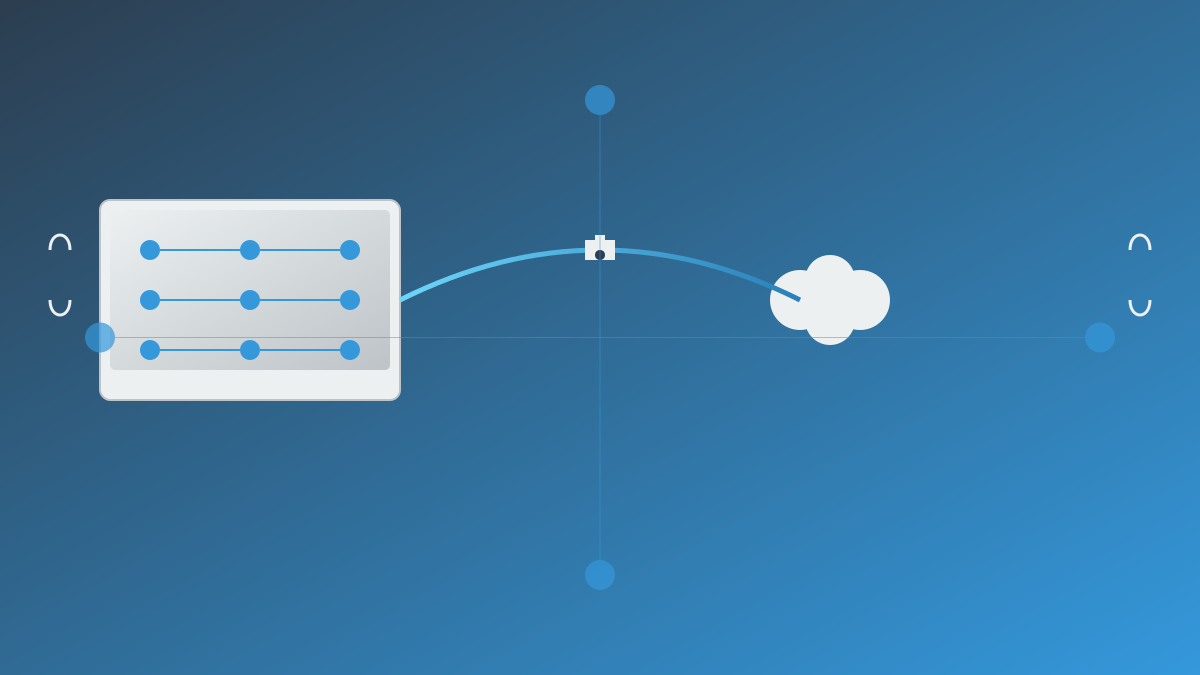
The LocalLLMChromebook project demonstrates how to run local large language models (LLMs) on ordinary Chromebooks and achieve secure internet access via Cloudflare Tunnel. No public IP or port forwarding is required, turning low-power devices into personal AI servers and providing a complete private LLM deployment solution for budget-constrained users.

本地LLMChromebookCloudflare Tunnel隐私保护边缘计算开源模型Ollamallama.cpp
Published 2026-05-08 04:44Recent activity 2026-05-08 04:55Estimated read 7 min
LocalLLMChromebook: Deploying Local Large Models on Chromebooks with Zero-Configuration Secure Public Network Access Solution
1

Section 01

LocalLLMChromebook Project Guide: Local Large Models on Chromebooks and Secure Public Network Access Solution

The LocalLLMChromebook project demonstrates how to run local large language models (LLMs) on ordinary Chromebooks and achieve secure internet access via Cloudflare Tunnel. No public IP or port forwarding is needed, turning low-power devices into personal AI servers and providing a complete private LLM deployment solution for budget-constrained users. Key advantages include privacy protection (local data processing), cost-effectiveness (using existing or low-cost Chromebooks), and zero-configuration networking (simplified public access process).


2

Section 02

Project Background: High Barriers of LLMs and Chromebooks' Potential

Traditional LLM deployment requires high-performance GPU servers, complex environment setup, or expensive cloud costs, making it inaccessible to ordinary users. Chromebooks, however, have advantages like ARM architecture processors (high energy efficiency), built-in Linux development environment (Crostini container), lightweight system (low resource usage), and affordability (entry-level models cost $200-$300), making them underrated devices for running local LLMs. This project aims to break the high barriers of LLMs, allowing ordinary users to have their own private AI assistants.

3

Section 03

Technical Solution: Local LLM Deployment and Public Network Access Implementation

Local LLM Operation

  • Inference Frameworks: Use llama.cpp (ARM-optimized, supports quantization) and Ollama (simplified model management).
  • Recommended Models:
    Model Parameter Count Quantized Size Use Cases
    Llama3.2 3B ~2GB Lightweight Q&A/Text Generation
    Phi-3 Mini 3.8B ~2.5GB Code Assistance/Reasoning
    Gemma2B 2B ~1.5GB Embedded/Fast Response
    Mistral7B(Q4) 7B ~4GB Complex Tasks (requires 8GB RAM)

Public Access: Cloudflare Tunnel

  • Principle: Establishes an outbound connection from local to Cloudflare's edge, no public IP/port forwarding needed, with automatic HTTPS encryption.
  • Steps: Install cloudflared → Authenticate and create a tunnel → Configure DNS routing → Start the tunnel.
4

Section 04

Use Cases and Performance

Use Cases

  • Privacy-sensitive users (medical/legal/financial professionals): Local data processing to protect privacy.
  • Network-restricted environments: Independent solution, no API access restrictions.
  • Budget-constrained users: No need for high-priced GPUs, use existing Chromebooks.
  • Developers/researchers: Flexibly experiment with different models.
  • Offline scenarios: Usable without internet.

Performance

  • Generation Speed: ~5-10 tokens/sec for 3B models; ~2-5 tokens/sec for 7B models.
  • Memory Usage: At least 8GB RAM recommended (16GB better).
  • Battery Life: 8-12 hours under light load, 4-6 hours under full load, suitable for long-term operation.
5

Section 05

Expansion Directions and Limitations

Expansion Possibilities

  • RAG: Integrate local vector databases (e.g., ChromaDB) to support Q&A based on personal documents.
  • Multimodal: Support Ollama multimodal models for image processing.
  • Voice Interaction: Combine Whisper speech recognition and TTS synthesis.
  • Automation: Integrate with tools like n8n to achieve workflow automation.

Limitations

  • Hardware Limitations: Chromebooks' NPU/GPU acceleration capabilities are limited, cannot compare to high-end GPUs.
  • Model Capabilities: Lightweight models are not as good as top models like GPT-4 in complex reasoning.
  • Maintenance Responsibility: Users need to update, back up, and maintain security on their own.
6

Section 06

Project Summary and Usage Recommendations

The LocalLLMChromebook project embodies the power of technological democratization, building private AI infrastructure with affordable hardware. Though not the most powerful, it excels in simplicity, affordability, privacy, and control. Recommendations:

  • Choose a Chromebook with at least 8GB RAM.
  • Select models based on needs (3B/2B for lightweight tasks, 7B for complex tasks with sufficient memory).
  • For users sensitive to privacy and cost who own a Chromebook, this is an excellent entry-level solution for local LLMs.

