Zing Forum

Reading

llmrust: A Unified Large Language Model API Framework in the Rust Ecosystem

llmrust is a modern Rust ecosystem project dedicated to providing developers with a unified Large Language Model (LLM) API interface, simplifying the process of multi-model integration and invocation.

RustLLMAPI大语言模型异步编程工具调用开源
Published 2026-06-06 12:14Recent activity 2026-06-06 12:21Estimated read 7 min
llmrust: A Unified Large Language Model API Framework in the Rust Ecosystem
1

Section 01

llmrust: Introduction to the Unified LLM API Framework in the Rust Ecosystem

llmrust is an open-source framework in the Rust ecosystem dedicated to providing a unified Large Language Model (LLM) API interface, aiming to simplify the process of multi-model integration and invocation. The project is maintained by llmrust, hosted on GitHub with the original link: https://github.com/llmrust/llmrust, and its release/update time is 2026-06-06T04:14:27Z. Its core value lies in encapsulating the interface differences of various LLM providers (such as OpenAI, Anthropic, Google, etc.) through a unified abstraction layer, allowing developers to focus on business logic rather than API details.


2

Section 02

Project Background and Motivation

In today's booming LLM era, developers face the problem of huge API interface differences between different providers: OpenAI, Anthropic, Google, Azure and other vendors each have unique authentication methods, request formats, and response structures. Rust developers need to write and maintain a large amount of adaptation code for each provider, increasing development costs and maintenance burdens. Therefore, the llmrust project was born, aiming to build a modern Rust ecosystem that allows developers to interact with various LLMs in a consistent way through a unified abstraction layer—similar to how database ORM frameworks encapsulate underlying differences.

3

Section 03

Core Architecture Design

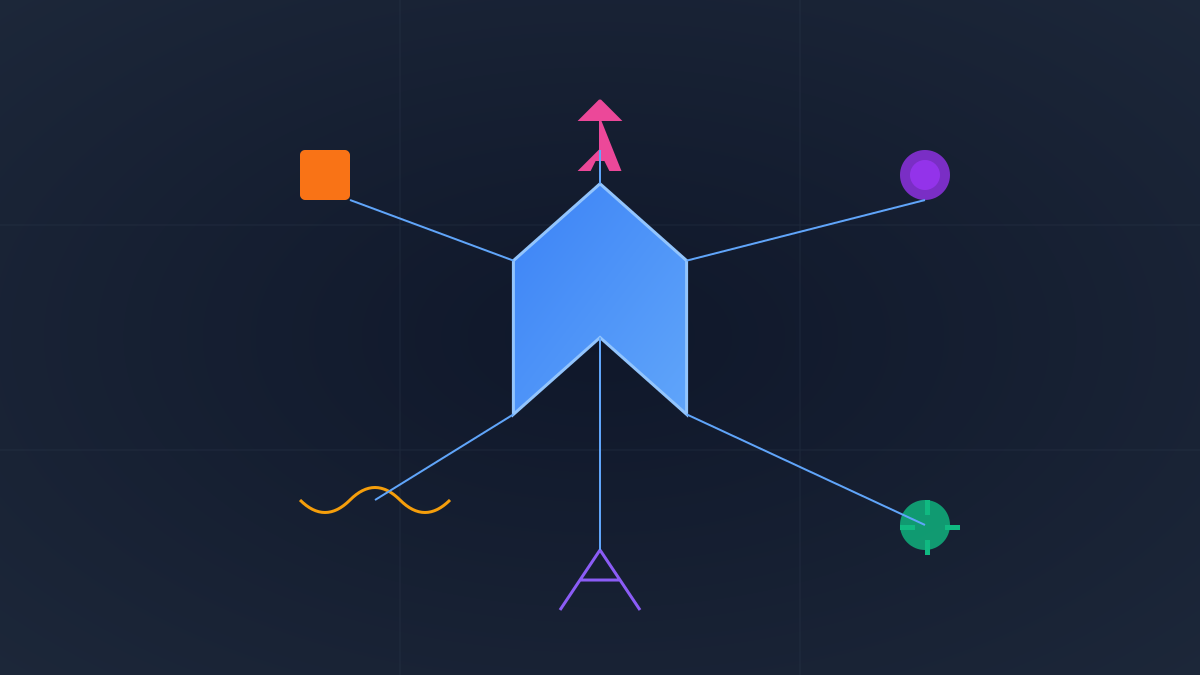
llmrust adopts a modular architecture, with functions divided into multiple independent crates. The lowest layer is the core abstraction layer, which defines common traits and types (such as chat completion requests, streaming responses, tool calls, etc.) and does not depend on specific providers. The upper layer consists of adapter modules for major LLM providers, which are responsible for converting unified requests into provider-specific formats and converting responses back to standard formats. Currently, it supports mainstream models like OpenAI, Anthropic Claude, and Google Gemini.

4

Section 04

Key Feature Analysis

The key features of llmrust include: 1. Deep support for asynchronous programming: Based on Rust's async/await syntax, all API calls are non-blocking, enabling efficient handling of concurrent requests; 2. Built-in streaming response support: Abstracted as a standard asynchronous stream interface, allowing users to see model outputs in real time and enhance the interactive experience; 3. Type-safe tool calls: Define tool parameters through Rust structs and enums, automatically handle serialization and validation, catch potential errors at compile time, and improve code robustness.

5

Section 05

Practical Application Scenarios

The practical application scenarios of llmrust include: 1. AI assistant development: Simplify multi-model switching logic, dynamically select models based on tasks (e.g., use lightweight models for simple queries to reduce costs, and strong models for complex reasoning); 2. Enterprise application failover: The unified interface allows seamless switching to a backup provider when a provider's API is unavailable, without modifying business code; 3. Proxy workflow construction: Type safety and asynchronous support help build complex proxy chains, and compile-time type checks ensure process reliability.

6

Section 06

Ecosystem and Future Outlook

llmrust is building an ecosystem, planning to provide supporting middleware, cache layers, rate limits, and other components to form a complete LLM development toolchain. Rust's performance and security make it suitable for latency-sensitive or sensitive data processing scenarios, providing additional reliability guarantees compared to the Python ecosystem. The project will actively follow the latest LLM API features (multimodal input, structured output, long context, reasoning capabilities, etc.) and easily adapt to new features through abstract design.

7

Section 07

Conclusion

llmrust represents an important advancement of the Rust ecosystem in the LLM field. Through unified, type-safe, and high-performance API abstraction, it lowers the threshold for Rust developers to integrate LLM capabilities. For technical teams pursuing code quality and operational efficiency, this is an open-source project worth paying attention to.

