Zing Forum

Reading

LLMFlow: A Declarative Framework for Building Testable LLM Pipelines

LLMFlow provides a lightweight solution that allows developers to build and test LLM-based content generation pipelines in a declarative way, addressing the pain points of complex and hard-to-maintain processes in LLM application development.

LLM框架流水线声明式测试Python内容生成
Published 2026-04-05 06:43Recent activity 2026-04-05 06:47Estimated read 7 min
LLMFlow: A Declarative Framework for Building Testable LLM Pipelines
1

Section 01

LLMFlow: Introduction to the Declarative and Testable LLM Pipeline Framework

LLMFlow is a lightweight Python framework developed by NIDA Institute, designed to address the pain points of complex and hard-to-maintain processes in LLM application development. It builds testable LLM content generation pipelines in a declarative way, with core features including declarative configuration, composability, and testability, helping developers integrate LLM capabilities into production-grade applications more elegantly.


2

Section 02

Background: Complexity Challenges in LLM Application Development

With the popularization of LLMs in various scenarios, developers face the challenge of integrating LLM capabilities into production applications. Traditional programming paradigms lead to intertwined code that is hard to maintain and test when handling prompt engineering, model calls, output parsing, and other links. LLMFlow was created precisely to address this pain point.

3

Section 03

Overview of the LLMFlow Framework

LLMFlow is a Python framework developed by NIDA Institute. Its core idea is to abstract the LLM content generation process into composable and reusable pipeline components. It encourages the 'pipeline as code' mindset—each step has clear inputs and outputs, and the process can be serialized, version-controlled, and unit-tested. Its design philosophy emphasizes declarative configuration (clear intent), composability (flexible construction of complex scenarios), and testability (ensuring production stability), allowing engineers without a machine learning background to get started quickly.

4

Section 04

Core Architecture and Design Philosophy

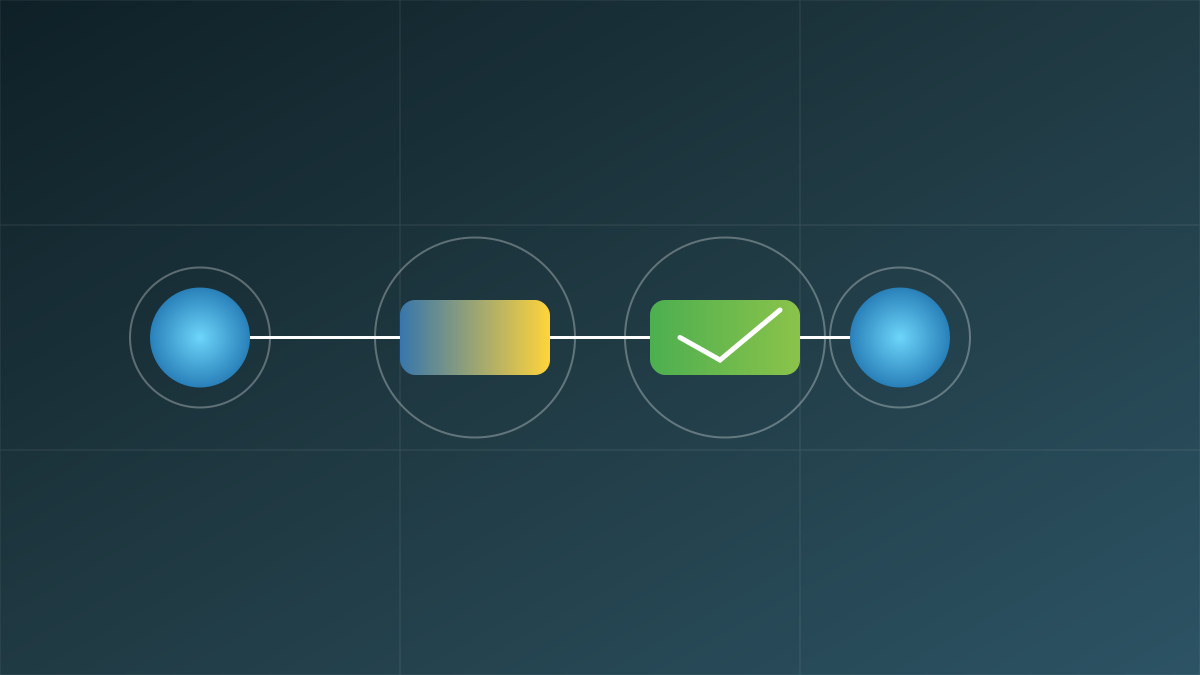
The LLMFlow architecture is based on the data flow programming paradigm of nodes and edges. Nodes represent processing units (such as prompt template rendering, model calls, post-processing, etc.), and edges define data flow paths. The advantage lies in separation of concerns: business logic is broken down into independent testable units, each with a single responsibility, reducing debugging difficulty. The framework also supports intermediate state persistence—long processes can be paused and resumed, making it suitable for scenarios like manual review or external system callbacks.

5

Section 05

Advantages of Declarative Configuration

Declarative configuration is a core feature of LLMFlow. Pipelines are defined via YAML or Python dictionaries, describing intent in natural language without getting bogged down in implementation details. Benefits include: improved readability (new members can understand quickly), separation of configuration and code (non-technical personnel can participate in adjustments), clear version control (changes can be reviewed and rolled back via diff), and convenient A/B testing and dynamic adjustments (operation teams can modify configurations without redeployment).

6

Section 06

Testability: The Cornerstone of Production-Grade Applications

The pain point of LLM applications being hard to test is addressed by LLMFlow through multiple mechanisms: support for mock nodes (replacing LLM calls with predefined outputs to test overall logic), output schema validation (automatically checking if returns conform to structured formats like JSON Schema), and built-in regression testing tools (recording historical input-output pairs to detect version changes). These features ensure that pipelines are fully validated in continuous integration environments, meeting enterprise-level reliability requirements.

7

Section 07

Practical Application Scenarios and Value

LLMFlow is applicable to multiple scenarios: content generation (topic selection → outline → paragraph writing process), dialogue systems (multi-turn context flow and intent recognition), and data processing (chaining multiple LLM calls to complete complex text analysis). It has outstanding value in multi-model collaboration scenarios: easily configure different steps to use different models (e.g., lightweight models for filtering + large models for complex tasks), balancing cost and quality.

8

Section 08

Conclusion and Outlook

LLMFlow is an important evolution in LLM application development methodology, integrating glue code into clear pipelines and allowing developers to focus on business value. As the LLM ecosystem matures, such frameworks will become standard tools for building reliable AI applications. For developers exploring LLM engineering practices, LLMFlow is a starting point worth in-depth study.

