Zing Forum

Reading

The Enigma of Implicit Bias Between Humans and LLMs: Deep Differences in Semantic Memory Structures of System 1 and System 2

This article explores the cognitive mechanisms of implicit bias in humans and large language models (LLMs). Through semantic memory network modeling, it reveals that LLMs lack the types of conceptual knowledge unique to humans, providing a new perspective for understanding cognitive differences between humans and machines.

隐性偏见双过程理论System 1System 2语义记忆网络LLM偏见概念知识多层网络认知架构性别偏见
Published 2026-04-14 22:43Recent activity 2026-04-15 10:21Estimated read 6 min
The Enigma of Implicit Bias Between Humans and LLMs: Deep Differences in Semantic Memory Structures of System 1 and System 2
1

Section 01

[Introduction] Research on Cognitive Mechanism Differences in Implicit Bias Between Humans and LLMs

This article explores the cognitive mechanisms of implicit bias in humans and large language models (LLMs). Through semantic memory network modeling, it reveals that LLMs lack the types of conceptual knowledge unique to humans, and the association between semantic memory structure and implicit bias exists only in humans. This research provides a new perspective for understanding cognitive differences between humans and machines, and has important implications for AI bias governance and the development of cognitive science.


2

Section 02

Background: Social Risks of Implicit Bias and the Dual-Process Theory Framework

Implicit bias exists in the form of stereotypes, has negative impacts on social groups, and often arises automatically and unconsciously. Although LLMs perform well in explicit bias tests, they still have harmful implicit biases, which parallel the phenomenon of separation between implicit attitudes and explicit beliefs in humans. The dual-process theory divides cognition into the fast and automatic System 1 (source of implicit bias) and the slow and deliberate System 2 (relying on bias regulation), but existing research lacks mechanistic explanations.

3

Section 03

Research Gap: Lack of Transition from Functional Description to Mechanistic Explanation

Existing theories have two limitations: 1. Confusion between structure and process: The associative system defines both structure and processing dynamics, while the rule-based system focuses on processing dynamics but does not fully explain the underlying knowledge structure; 2. Excessive abstraction: It is difficult to operationalize, measure, or empirically compare representational differences. We need to go beyond functional descriptions to explore how knowledge organization forms lead to differences in biased behavior.

4

Section 04

Methods: Semantic Memory Networks and Multi-Layer Network Framework

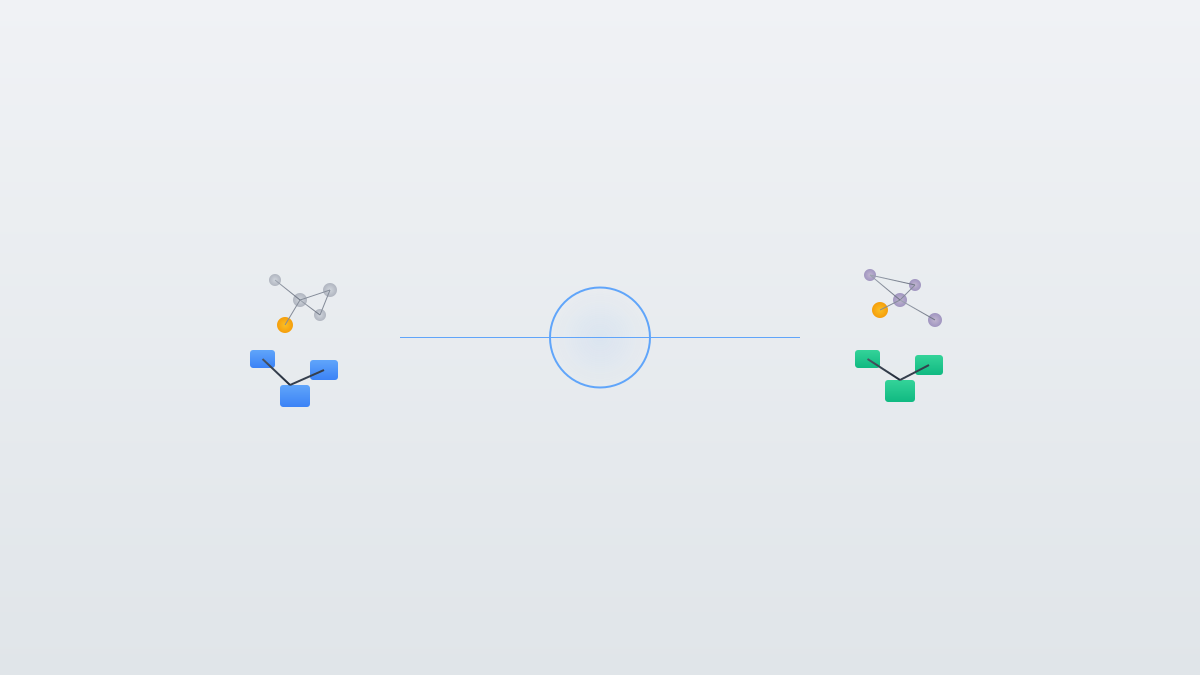
Semantic memory networks are used to model conceptual knowledge: Associative memory captures System 1 attributes using concept networks constructed from free associations; rule-based memory retains propositional knowledge using relational networks (features/classifications). The multi-layer network framework treats different relationship types as independent layers, preserving unique organizations while allowing unified analysis, and models associative, feature-based, and classification-based knowledge as different layers.

5

Section 05

Key Findings: Semantic Structure Differences Between Humans and LLMs and Their Association with Bias

  1. Human semantic memory structure is irreducible, and LLMs lack certain conceptual knowledge unique to humans; 2. The association between semantic memory structure and implicit bias exists only in humans, and System 2 structure corresponds to lower bias levels. These differences highlight the fundamental cognitive distinctions between humans and machines.
6

Section 06

Research Significance: New Insights for AI Bias Governance and Cognitive Science

For AI safety: Simply imitating human bias tests is insufficient; new methods need to be developed to measure implicit bias in LLMs; For cognitive science: It provides an operable model to study the impact of knowledge organization on cognitive functions; For human-machine differences: LLMs differ qualitatively from humans in how they process conceptual knowledge and lack key representational mechanisms.

7

Section 07

Limitations and Future Directions: Expanded Research and Intervention Strategies

Current limitations: Only gender bias is focused on, and other types have not been verified; network representation abstracts away some symbolic operations and logical rules. Future directions: Expand to other types of implicit bias, compare differences between different LLM architectures, develop bias mitigation strategies, and explore ways for AI to integrate human conceptual knowledge organization.

8

Section 08

Conclusion: Deep Insights into Human-Machine Cognitive Differences and Directions for AI Development

This research reveals the deep differences in implicit bias processing between humans and machines through semantic memory network modeling, challenging the simplistic view of LLMs having human-like thinking. Future AI needs to go beyond pattern matching and statistical learning and integrate human conceptual knowledge organization mechanisms to achieve fair and trustworthy artificial intelligence.

