Zing Forum

Reading

LLM Serving Mastery: A Complete Learning Roadmap from User to Infrastructure Engineer

A systematic open-source course that helps developers grow from LLM users to LLM infrastructure engineers, covering ten core skills including model deployment, inference optimization, and post-training.

LLM基础设施模型部署推理优化学习课程开源Kubernetes模型微调AI工程
Published 2026-08-09 12:21Recent activity 2026-08-09 12:32Estimated read 6 min
LLM Serving Mastery: A Complete Learning Roadmap from User to Infrastructure Engineer
1

Section 01

LLM Serving Mastery: Introduction to the Complete Learning Roadmap from User to Infrastructure Engineer

Core Introduction to LLM Serving Mastery

This open-source course is maintained by rushikesh-cloud and published on GitHub (link) on August 9, 2026. The course aims to help developers grow from LLM users to LLM infrastructure engineers, covering ten core skills such as model deployment, inference optimization, and post-training.

The course is designed with a "learn by doing" philosophy, including 26 weeks of core content + 24 weeks of professional deepening. It requires about 12-15 hours of investment per week, balancing depth with the learning rhythm of working developers.


2

Section 02

Background: The Knowledge Gap Between LLM Applications and Production Deployment

Background and Problem

With the rapid popularization of LLMs, most tutorials stay at the level of API calls or Prompt writing. However, when developers need to deploy LLMs to production environments, handle high-concurrency requests, or optimize inference costs, they often find their knowledge reserves insufficient. The LLM Serving Mastery project was created to fill this gap, teaching you to understand, deploy, and optimize production-level LLM infrastructure from first principles.

3

Section 03

Course Structure and Learning Path

Course Structure and Learning Methods

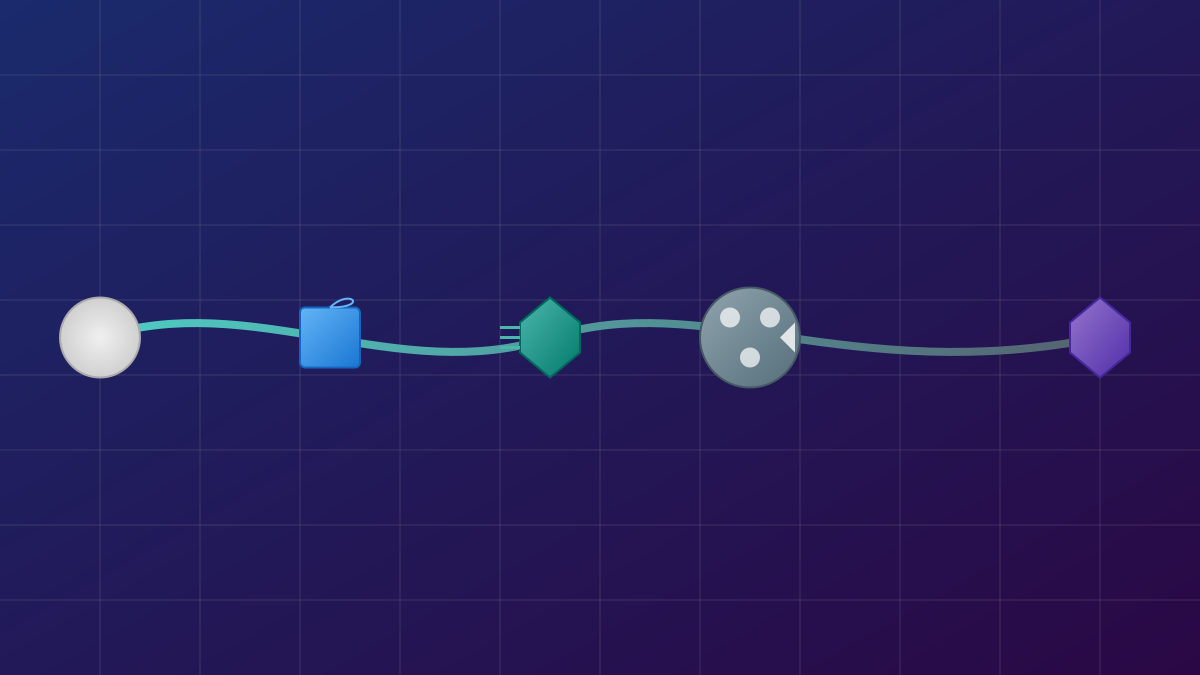
The course is divided into ten progressive skill modules: Basic Principles, Inference & Serving, Model Lifecycle, Compression & Optimization, Post-training Data Engineering, Post-training, Platform & Kubernetes, Evaluation & Observability, Security & Governance, and Professional Deepening.

There are dependency relationships between modules (e.g., Basic Principles → Inference & Serving → Model Lifecycle, etc.), and some modules can be learned in parallel. Each module includes theoretical explanations and hands-on practice, with 26 weeks of core content + 24 weeks of professional deepening, requiring 12-15 hours of investment per week.

4

Section 04

Unique Advantages of the Course

Unique Features of the Course

  1. Focus on infrastructure rather than application layer: Unlike most courses that teach building applications with LangChain, this course focuses on the efficient operation of LLMs on GPUs (faster, cheaper, more stable).
  2. Open-source models first: Centered around open-source models such as Llama, Qwen, and DeepSeek, without relying on closed-source APIs, allowing learners to fully control the technology stack.
  3. Executable design: Each module is equipped with code repositories and experimental environments, emphasizing hands-on practice rather than passive learning.
  4. Community-driven: As an open-source project, content is continuously updated, and contributors can submit improvement suggestions and supplementary cases.
5

Section 05

Target Audience and Supporting Resources

Target Audience and Resources

Suitable for: Backend engineers (expanding AI infrastructure skills), ML engineers (filling deployment and operation knowledge gaps), technical leaders (evaluating and planning LLM technology stacks), researchers (translating results into deployable systems).

Supporting resources: Official website rushikesh-cloud.github.io/llm-serving-mastery, including detailed learning path documents, code repositories, experimental guides, and community discussion forums.

6

Section 06

Conclusion: The Long-term Value of Mastering LLM Infrastructure

Conclusion

LLM technology evolves rapidly, but the underlying infrastructure principles are relatively stable. Mastering these principles not only keeps you competitive in the current technology wave but also adapts to future technological changes.

LLM Serving Mastery provides a transformation roadmap from "AI application developer" to "AI infrastructure engineer". If you are tired of staying at the API call level and want to deeply control the complete LLM technology stack, this project is worth investing time and energy in.