Zing Forum

Reading

LLM Roguelike: When Large Model Training Becomes a Deck-Building Roguelike Game

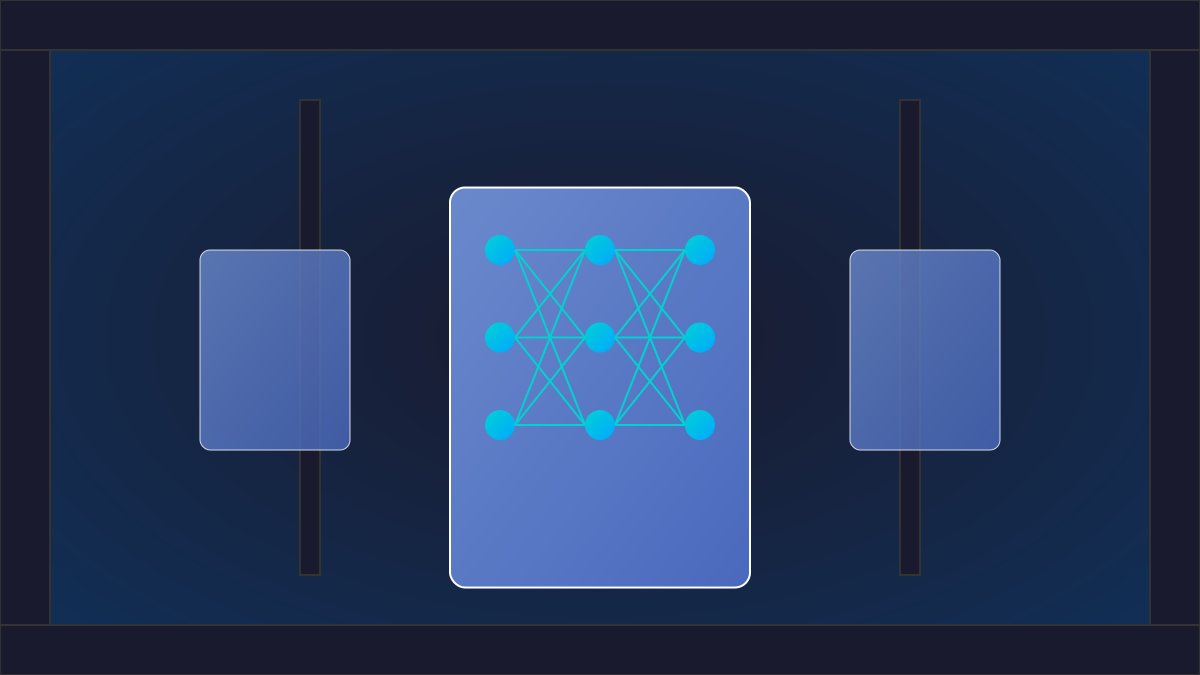
A creative project that transforms the large language model (LLM) training process into a roguelike deck-building game, allowing players to experience all stages of model training in the game.

roguelike卡牌游戏大语言模型AI教育游戏化学习机器学习Python游戏
Published 2026-05-27 09:43Recent activity 2026-05-27 09:54Estimated read 7 min
LLM Roguelike: When Large Model Training Becomes a Deck-Building Roguelike Game
1

Section 01

LLM Roguelike: Introduction to the Creative Project That Turns Large Model Training Into a Roguelike Deck-Building Game

LLM Roguelike is a creative project that transforms the obscure large language model (LLM) training process into a roguelike deck-building game. It allows players to experience the complete AI training workflow from data preparation to model deployment through gameplay. The project combines entertainment and educational value, aiming to lower the barrier to AI learning and help users intuitively understand the core concepts and challenges of model training through gamification.


2

Section 02

Project Background and Core Overview

Original Author and Source

Project Overview

LLM Roguelike turns the LLM training process into an intuitive and fun roguelike deck-building game, where players can personally experience the complete AI training workflow from data preparation to model deployment through deck building.

3

Section 03

Analysis of Core Game Mechanics

Integration of Roguelike Elements

Combining the randomness and permadeath mechanics of roguelike games, each training session is a brand-new journey. Players need to face different datasets, random training bottlenecks, and unforeseen model behaviors.

Deck-Building System

The core gameplay revolves around cards, with each card corresponding to a key training link:

  • Data Preprocessing Cards: Clean, label, and augment datasets
  • Architecture Selection Cards: Transformer, RNN, etc.
  • Hyperparameter Cards: Adjust learning rate, batch size, etc.
  • Regularization Cards: Dropout, weight decay, etc.
  • Hardware Acceleration Cards: GPU resources, distributed training

Materialization of Training Process

Replacing traditional battles with training iterations, players need to balance computational resource consumption and model performance improvement to build the optimal language model within a limited number of rounds.

4

Section 04

Educational Significance and Innovative Value

Lowering the Barrier to AI Learning

Through gamification, complex model training concepts (such as environment configuration and mathematical principles) become accessible, helping beginners overcome their fear of difficulty.

Intuitive Understanding of Training Dynamics

Random events in the game simulate real training challenges (gradient explosion, overfitting, data bias, etc.), and the player's decision-making process is the process of learning to balance engineering trade-offs.

Creative Inspiration

It demonstrates the potential of gamified education, serving as both an entertainment product and a teaching tool, inspiring developers to transform complex computer science concepts into interactive experiences.

5

Section 05

Target Audience and Usage Suggestions

Target Players

  1. AI Beginners: Intuitively understand the LLM training workflow
  2. Game Enthusiasts: Like roguelike deck-building games and are interested in AI
  3. Educators: Looking for vivid teaching aids
  4. Developers: Understand methods for gamifying technical concepts

Usage Suggestions

  • Icebreaker project for AI courses, establishing basic concepts through entertainment
  • Team-building activities to promote common understanding of AI technology
  • Personal learning paired with real code practice to deepen impressions
6

Section 06

Speculations on Technical Implementation

Based on the project description, the following are speculated:

  • Development Technology: Python with game frameworks (e.g., Pygame)
  • Card System: May adopt the ECS (Entity Component System) architecture
  • Model Training Simulation: Simplified algorithms to maintain playability
  • UI Design: Abstract numerical visualization presentation
7

Section 07

Community Response and Future Outlook

Community Response

Such hardcore technical gamification projects are likely to attract widespread attention, making the tech community feel familiar while also drawing people outside the circle to become interested in AI.

Future Expansion Directions

  • Multiplayer Battle Mode: Compare model performance
  • More Architecture Options: Diffusion, GAN, etc.
  • Level Editor: Community-customized challenges
  • Linkage with Real Training Frameworks: Export game strategies as actual code
8

Section 08

Conclusion: A New Approach to Technical Communication

LLM Roguelike represents a new approach to technical communication—replacing boring documents with immersive game experiences. In the era of rapid AI development, such edutainment projects help more people cross technical barriers and truly understand the principles behind large language models.

