Zing Forum

Reading

LLM Research Assistant 2.0: Reconstruct Your Literature Reading Workflow with AI

An open-source intelligent research assistant that allows you to directly converse with PDF documents, using large language models to completely transform the way of academic reading and information extraction.

LLMPDF研究助手文献阅读RAG文档问答AI工具开源项目
Published 2026-05-20 01:15Recent activity 2026-05-20 01:19Estimated read 6 min
LLM Research Assistant 2.0: Reconstruct Your Literature Reading Workflow with AI
1

Section 01

Main Floor: Core Introduction to LLM Research Assistant 2.0

LLM Research Assistant 2.0: Reconstruct Your Literature Reading Workflow with AI

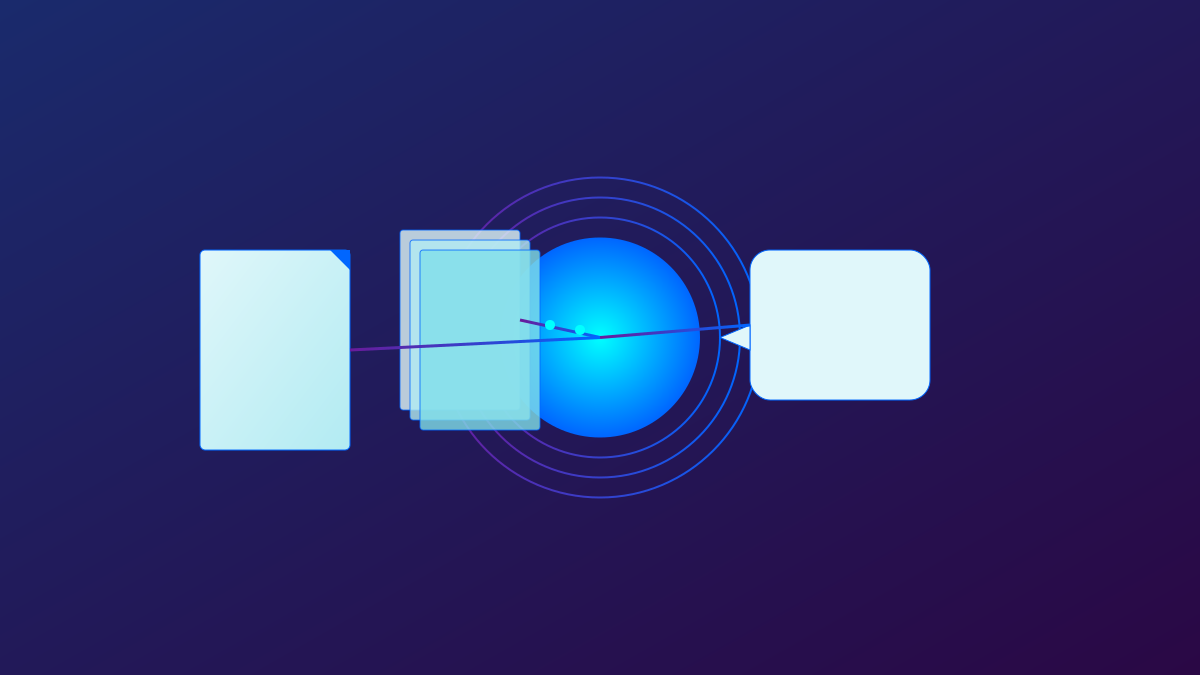
This is an open-source intelligent research assistant that supports direct conversation with PDF documents. By combining large language models (LLM) with Retrieval-Augmented Generation (RAG) technology, it completely transforms the way of academic reading and information extraction. Its core goal is to help users free themselves from tedious document processing and focus on creative thinking.


2

Section 02

Background: Pain Points of Traditional PDF Reading and the Birth of the Tool

Introduction: When PDFs Meet Large Language Models

In academic research and professional work, PDFs are core information carriers. However, traditional reading requires a lot of time for reading, annotating, and extracting key information. The emergence of LLM Research Assistant 2.0 is precisely to solve this problem—allowing users to directly interact with PDFs in a conversational way and accelerate the research process.

3

Section 03

Core Features: A Complete Workflow Beyond PDF Conversation

Project Overview and Core Features

This project is not simply inputting PDF content into an LLM; it is a complete research workflow tool. Its core concept is to enable researchers to converse with their document library. Key features include:

  1. Direct PDF Conversation: Ask questions in natural language (e.g., "Summarize the experimental design in the third section"), and the system will provide accurate answers based on the document content;
  2. Intelligent Context Understanding: Recognize document structure and logical connections to give in-depth answers;
  3. Research Workflow Integration: Integrate into daily research scenarios, supporting quick browsing, in-depth understanding, and data organization.
4

Section 04

Technical Implementation: Combination of Document Parsing and Retrieval Augmentation

Technical Architecture Ideas

From the project's positioning, we can infer its technical architecture:

  • Document Parsing Layer: Convert PDFs into text that LLMs can process while retaining structural information;
  • Retrieval Augmentation: Adopt RAG technology to first locate relevant content before generating answers;
  • Dialogue Management: Maintain dialogue context and support multi-turn interactions.

This architecture balances answer accuracy and interaction flexibility.

5

Section 05

Application Scenarios: Value for Multiple Groups

Application Scenarios and Value

Different user groups can gain clear value:

  • Academic Researchers: Quickly screen papers, extract key information, and accelerate literature reviews;
  • Industry Analysts: Quickly locate data and viewpoints in industry reports through Q&A;
  • Student Groups: Understand complex textbooks/papers, clarify concepts, and improve learning efficiency.
6

Section 06

Privacy Considerations, Limitations, and Future Outlook

Privacy, Limitations, and Future Directions

Privacy: The tool faces a choice between cloud APIs and local models; local deployment ensures sensitive documents do not leave the local environment; Limitations: The complexity of PDF formats (charts, formulas) challenges parsing accuracy, and LLM hallucinations require users to maintain critical thinking; Outlook: Support more document formats, improve multimodal understanding (e.g., chart parsing), and deeply integrate into research workflows.

7

Section 07

Conclusion: Core Value of AI-Assisted Research

Conclusion

LLM Research Assistant 2.0 represents an important direction of AI-assisted research—it does not replace human thinking, but frees users from tedious information extraction to focus on creative work. For knowledge workers, the value of such tools is self-evident.

