Zing Forum

Reading

Practical Implementation of LLM Inference Service System: Technical Realization of Continuous Batching, KV Cache, and Speculative Decoding

This article introduces an open-source implementation of a production-grade LLM inference service system, detailing core optimization techniques such as continuous batching, block-based KV cache management, and speculative decoding, and demonstrates how to achieve 3.4x higher throughput than naive batching.

大语言模型推理优化连续批处理KV缓存推测解码模型部署吞吐量优化
Published 2026-05-17 22:45Recent activity 2026-05-17 22:51Estimated read 4 min
Practical Implementation of LLM Inference Service System: Technical Realization of Continuous Batching, KV Cache, and Speculative Decoding
1

Section 01

[Introduction] Practical Core Optimization Techniques for LLM Inference Service Systems

This article introduces the open-source project "LLM-Inference-Serving-System". Through three core technologies—continuous batching, block-based KV cache management, and speculative decoding—it achieves 3.4x higher throughput than naive batching in mixed-length request scenarios, addressing inference latency and throughput issues in large model deployment.


2

Section 02

[Background] Core Challenges of LLM Inference Services

Large model inference faces computational characteristics of autoregressive generation (computation increases with sequence length, complex memory access, large variation in request lengths, latency sensitivity), while naive batching has issues like padding waste, synchronous waiting, and low GPU utilization.

3

Section 03

[Methods] Analysis of Three Core Optimization Techniques

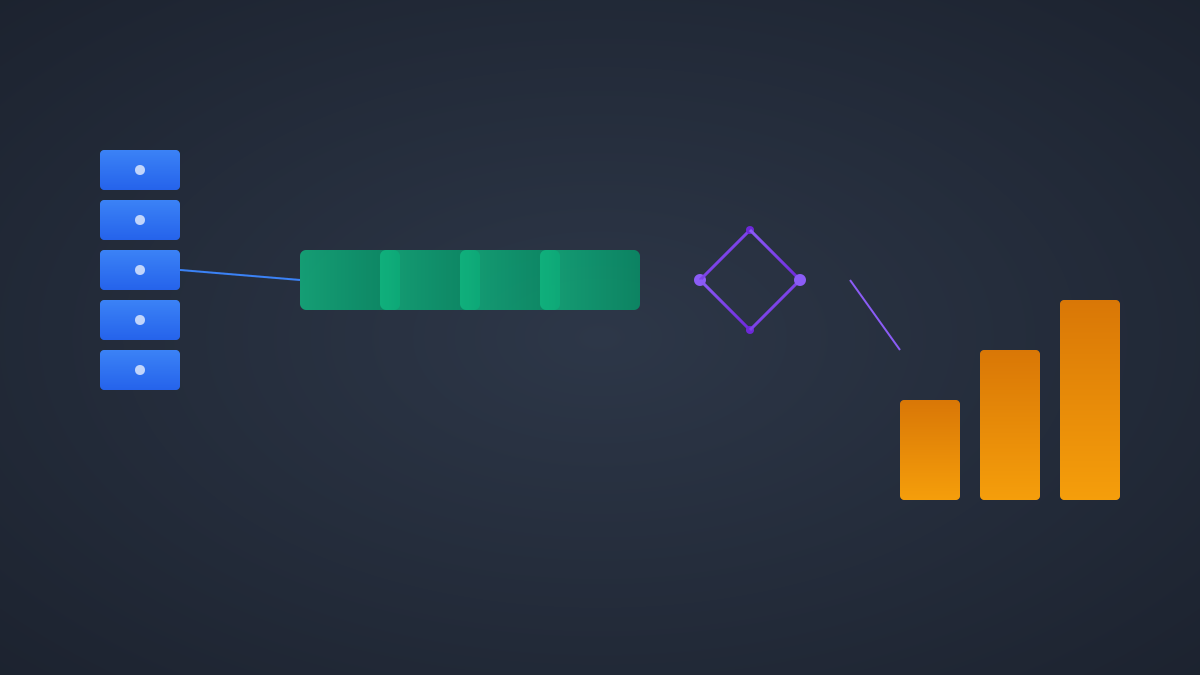
  1. Continuous Batching: Dynamically schedule requests, replace upon completion to maintain high GPU utilization; 2. Block-based KV Cache: Fixed block size allocated on demand, supporting sharing and defragmentation; 3. Speculative Decoding: Use a draft model to generate candidate tokens, verified by the target model to accelerate generation.
4

Section 04

[Architecture] System Modular Design and Performance Optimization

The system includes a scheduler (request management), KV cache manager (memory allocation), execution engine (inference computation), and token generator (sampling and conversion); it also optimizes operator fusion, quantization support, pipeline parallelism, asynchronous IO, etc.

5

Section 05

[Evidence] Experimental Results and Performance Analysis

In mixed-length request scenarios, throughput increased by 3.4x; latency is affected by first-token, per-token, and tail latency; in terms of resource utilization, it maintains high GPU utilization, reduces memory fragmentation, and dynamically adapts to load.

6

Section 06

[Recommendations] Application Scenarios and Deployment Considerations

Applicable to high-concurrency online services, mixed loads, and cost-sensitive deployments; deployment requires selecting appropriate GPUs, tuning batch size, speculative parameters, and scheduling strategies, monitoring key metrics, and setting up operation and maintenance mechanisms.

7

Section 07

[Summary] Industry Insights and Future Directions

Inference optimization is as important as training; open-source projects drive technological progress; future directions include multimodal support, edge deployment, adaptive optimization, and heterogeneous computing; this project provides practical references for LLM inference services.

