Zing Forum

Reading

Tri-Party Agent Framework: Building Trustworthy Multi-Model Collaborative Workflows

Explore how the tri-party-framework addresses output consistency and credibility issues in multi-agent collaboration through the cross-audit mechanism of Codex, Claude, and Gemini.

多智能体工作流编排交叉审计CodexClaudeGemini模型协作输出验证可信AI
Published 2026-06-13 05:45Recent activity 2026-06-13 05:52Estimated read 5 min
Tri-Party Agent Framework: Building Trustworthy Multi-Model Collaborative Workflows
1

Section 01

Tri-Party Agent Framework: Building Trustworthy Multi-Model Collaborative Workflows (Introduction)

The Tri-Party Agent Framework (tri-party-framework) is an open-source multi-model collaborative workflow orchestration framework designed to address output consistency and credibility issues in multi-agent collaboration. Through the cross-audit mechanism of three mainstream models—Codex, Claude, and Gemini—combined with merge gating and source tracking capabilities, the framework enhances result reliability, making it suitable for scenarios requiring high accuracy such as code generation and content moderation.


2

Section 02

Background: Trust Dilemma in Multi-Agent Collaboration

With the development of large language models, a single model can hardly meet the needs of complex tasks, making multi-model collaboration a trend. However, outputs from different models (e.g., Codex, Claude, Gemini) may vary, and the lack of effective verification mechanisms leads to uncertain result quality. This is the core trust dilemma in multi-agent collaboration, which the tri-party-framework aims to solve.

3

Section 03

Core Mechanisms: Cross-Audit and Merge Gating

The core innovations of the framework lie in the cross-audit and merge gating mechanisms:

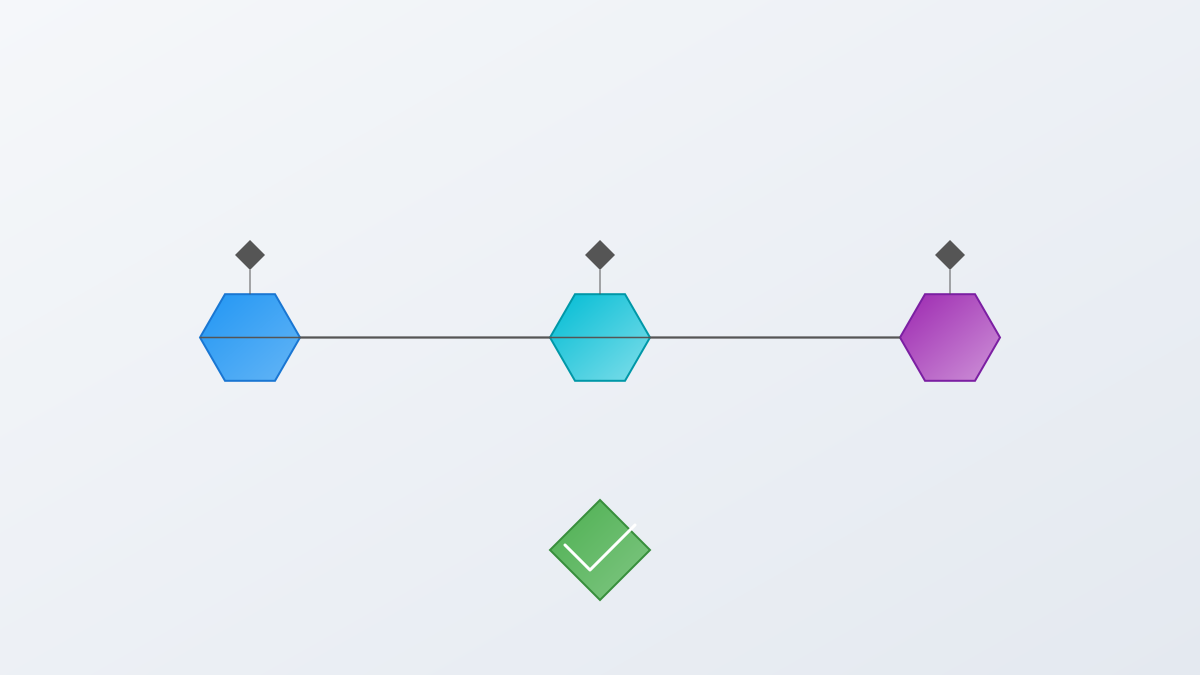
  1. Cross-Audit: Distribute the same task to multiple models, collect outputs, and use structured algorithms to evaluate consistency. Only when the consistency reaches a threshold is the result marked as trustworthy;
  2. Merge Gating: Define output merging conditions, which can be flexibly configured (e.g., full consensus or majority voting) to control workflow progression.
4

Section 04

Source Tracking and Key Technical Implementation Points

Source Tracking: Record the participating models, input parameters, output results, and consistency scores for each step. This supports backtracking the generation path, identifying model performance, and analyzing divergence patterns; Technical Implementation: Adopt a configuration-driven approach. Define model parameters, workflow stages, audit strategies, etc., via YAML/JSON files, allowing adjustment of collaboration strategies without modifying code.

5

Section 05

Practical Application Scenarios

The framework is suitable for the following scenarios:

  • Code Generation and Review: Combine Codex's coding capabilities, Claude's analytical capabilities, and Gemini's multilingual support to build a multi-model review pipeline;
  • Content Moderation: Multi-model consensus reduces the misjudgment rate;
  • Complex Reasoning Tasks: Cross-audit captures errors missed by a single model.
6

Section 06

Limitations and Considerations

The framework has limitations:

  • Increased Cost: Multi-model calls lead to higher API costs and latency, making it more suitable for scenarios requiring high accuracy;
  • Dependence on Model Diversity: If models have similar training data/methods, they may make the same mistakes, reducing the value of cross-audit.
7

Section 07

Summary and Outlook

The tri-party-framework provides an engineering approach to enhance the credibility of multi-agent systems, drawing on distributed consensus ideas to solve the model "hallucination" problem. Future directions include: more intelligent gating strategies, dynamic model selection based on historical performance, and deep integration with retrieval-augmented generation (RAG) technology.

