Zing Forum

Reading

Tri-modal Deep Learning Stress Detection: An Emotion Recognition System Fusing Video, Audio, and Text

This article introduces the Stress-Detection project, a deep learning system for emotion recognition using tri-modal data (video, audio, and text), which achieves accurate stress detection by fusing pre-trained models like BERT and ResNet.

多模态学习情感识别压力检测深度学习BERTResNet
Published 2026-04-13 02:32Recent activity 2026-04-13 02:52Estimated read 7 min
Tri-modal Deep Learning Stress Detection: An Emotion Recognition System Fusing Video, Audio, and Text
1

Section 01

Tri-modal Deep Learning Stress Detection System: An Emotion Recognition Solution Fusing Video, Audio, and Text

This article introduces the Stress-Detection project, a deep learning system for emotion recognition using tri-modal data (video, audio, and text). By fusing pre-trained models such as BERT (for text) and ResNet (for video), the system achieves accurate stress detection. Multi-modal fusion can compensate for the limitations of single modalities, opening up new possibilities in fields like mental health monitoring, user experience research, and human-computer interaction.


2

Section 02

Background: Limitations of Single Modality and Advantages of Multi-modal Fusion

Traditional emotion recognition relies on a single data source (facial expressions, voice, text), but has limitations: facial expressions can be deliberately controlled, voice is susceptible to noise interference, and text cannot capture non-verbal cues. Multi-modal fusion, by integrating multiple information sources, can make up for these shortcomings, improve robustness and accuracy, and adapt to different scenarios.

3

Section 03

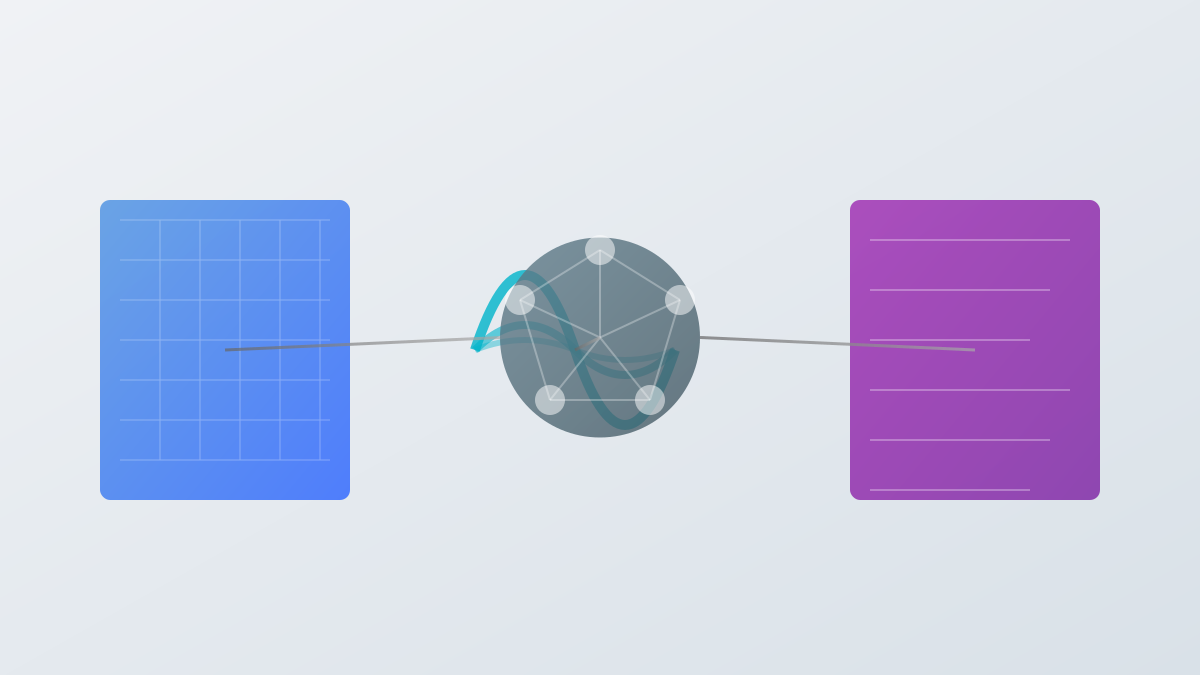
Technical Architecture: Tri-modal Feature Extraction and Fusion Strategy

The system adopts a modular design:

  • Video Modality: Uses ResNet to extract facial expression features, capturing micro-expression changes through processes like keyframe extraction and face localization;
  • Audio Modality: Extracts features such as pitch and MFCC, and learns emotion mapping via an audio neural network;
  • Text Modality: Uses BERT to extract context-aware semantic features, identifying emotional vocabulary and implicit attitudes;
  • Fusion Layer: Adopts a late fusion strategy, combining attention mechanisms to dynamically adjust the weights of each modality, preserving specificity and handling modality missing.
4

Section 04

Dataset and Model Training Optimization

The CREMA-D dataset (containing multi-modal emotional data from 91 actors, verified via crowdsourcing) is used. Preprocessing includes video frame normalization, audio framing, text encoding, etc. Training is divided into three stages: individual training of each modality → freezing the backbone to train the fusion layer → end-to-end fine-tuning. The loss function includes classification loss, modality consistency loss, and regularization loss; optimization techniques include cosine annealing learning rate, gradient clipping, and early stopping mechanism.

5

Section 05

Application Scenarios and Potential Value

The system can be applied in multiple fields:

  • Mental Health: Emotional assessment in remote counseling, stress warning, auxiliary screening for emotional disorders;
  • User Experience: Product testing feedback, advertising effect evaluation, game immersion measurement;
  • Intelligent Customer Service: Real-time identification of customer emotions, adjustment of service strategies;
  • Educational Technology: Student engagement monitoring, recognition of learning frustration emotions;
  • Security Monitoring: Abnormal emotion detection, driver stress monitoring.
6

Section 06

Technical Challenges and Solutions

Challenges faced and solutions:

  • Modality Alignment: Solve data desynchronization issues through time window alignment and interpolation techniques;
  • Modality Missing: Design a degradation strategy to ensure reasonable prediction even when some modalities are missing;
  • Computational Efficiency: Achieve near-real-time processing through model quantization, inference optimization, and edge deployment.
7

Section 07

Limitations and Future Improvement Directions

Current limitations: The dataset is based on actor performances, which differ from real emotions; cultural background influences are not fully considered; individual difference modeling is insufficient. Future directions: Introduce physiological signals; develop lightweight models to support mobile deployment; establish cross-cultural recognition capabilities; explore emotional causal reasoning.

8

Section 08

Key Technical Implementation Points and Outlook for Multi-modal AI

Key technical implementation points: Based on the PyTorch framework, requiring Python 3.8+, Transformers library, etc.; modular code (data, model, training, etc.); fine-tuning using pre-trained models like ResNet and BERT. Conclusion: Multi-modal deep learning has great potential in emotion computing, and will promote more intelligent human-computer interaction in the future, providing solutions for complex perception problems.

