Zing Forum

Reading

Four-Tier Cascading Architecture: Engineering Practice for Cost Optimization in Large Model Inference

An open-source project proposes a four-tier cascading architecture for large model inference, achieving a balance between performance and cost through intelligent routing strategies. The system dynamically selects model tiers based on query complexity, enabling efficient multi-model orchestration and providing a practical cost optimization solution for LLM deployment in production environments.


大模型级联推理优化成本管理模型编排智能路由LLM工程多模型架构生产部署
Published 2026-04-12 18:10Recent activity 2026-04-12 18:23Estimated read 7 min
Four-Tier Cascading Architecture: Engineering Practice for Cost Optimization in Large Model Inference
1

Section 01

[Introduction] Four-Tier Cascading Architecture: Engineering Practice for Cost Optimization in Large Model Inference

The open-source project Multimodel-Support proposes a four-tier cascading architecture for large model inference. Its core idea draws on cache hierarchy design, dynamically selecting model tiers via intelligent routing strategies to enable efficient multi-model orchestration, striking a balance between performance and cost, and providing a practical cost optimization solution for LLM deployment in production environments.

2

Section 02

Practical Dilemmas in Large Model Deployment

Enterprises face sharp contradictions when integrating LLMs: top-tier models have extremely high inference costs (GPT-4-level models cost dozens to hundreds of times more than lightweight models), but lightweight models cannot handle complex tasks; the "one-size-fits-all" approach (using all expensive models or all cheap models) fails to meet requirements, necessitating an intelligent adaptive model selection mechanism.

3

Section 03

Layered Design of the Four-Tier Cascading Architecture

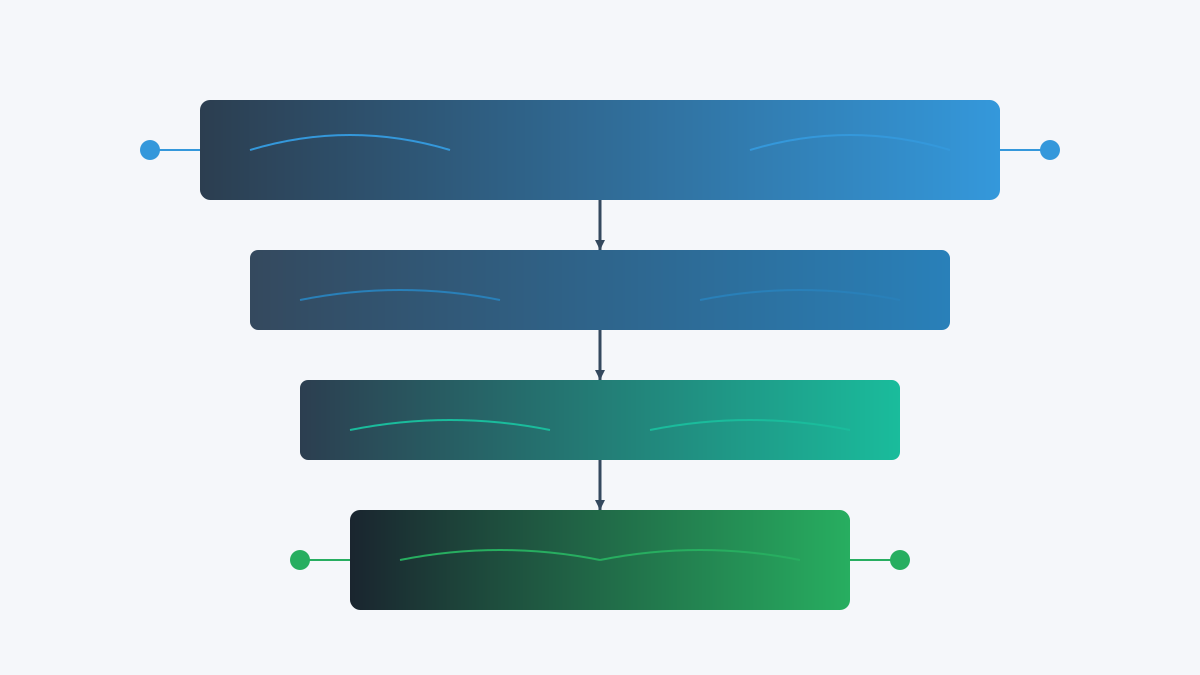
The four-tier cascading architecture classifies models into four tiers based on capability and cost:

  • Tier1: Lightweight local/edge models with extremely low cost, handling simple queries (FAQ, format conversion, etc.);
  • Tier2: Medium-scale open-source/economical commercial models, handling medium inference tasks (text analysis, basic code generation, etc.);
  • Tier3: Large models, handling complex reasoning/professional Q&A, serving as the core of business operations;
  • Tier4: Top flagship models, handling extremely complex tasks or acting as a fallback, used cautiously.
4

Section 04

Intelligent Routing and Multi-Model Orchestration Mechanism

Intelligent Routing Strategies

  1. Rule-based routing: Keyword/regex/length-based traffic splitting;
  2. Confidence fallback: After generating results with low-cost models, evaluate confidence—upgrade to higher tiers if confidence is insufficient;
  3. Learning-based routing: Train classifiers using historical data to predict the optimal tier.

Multi-Model Orchestration

  • Subtask decomposition: Split complex tasks into subtasks and select the most suitable model for each;
  • Model integration: Parallelly call multiple models for key tasks and fuse outputs to improve accuracy.
5

Section 05

Cost-Benefit Analysis: Economic Value of the Cascading Architecture

Average cost per call formula: Average Cost = P1×C1 + P2×C2 + P3×C3 + P4×C4 (where C1<<C2<<C3<<C4, and P represents the proportion of queries handled by each tier)

Reasonable routing allows a large number of simple queries to be processed by low-cost models, reducing the average cost by an order of magnitude compared to using Tier4 exclusively; it is necessary to control the fallback ratio and tune the confidence threshold to find the Pareto optimal point between cost and quality.

6

Section 06

Engineering Implementation Considerations for Production Environments

  1. Delay Management: Asynchronous preloading, caching routing results, and using lightweight routing models to control overhead;
  2. Fault Tolerance and Degradation: Health checks + failover—automatically degrade if a tier becomes unavailable;
  3. Observability: Monitor metrics such as call volume, response time, cost, and routing accuracy;
  4. Flexible Configuration: Adjust routing strategies, model preferences, and fallback thresholds via configuration files.
7

Section 07

Applicable Scenarios and Best Practice Recommendations

Applicable Scenarios

  • High-concurrency customer service systems;
  • Content generation platforms;
  • Code assistance tools;
  • Multi-tenant SaaS platforms (configure strategies based on customer tiers).

Best Practices

  • Start with small-scale experiments and optimize routing using real data;
  • Continuously monitor model performance and adjust thresholds;
  • Establish an A/B testing framework to verify strategy changes;
  • Reserve degradation plans to ensure availability in extreme cases.
8

Section 08

Limitations, Improvement Directions, and Conclusion

Limitations

  • Routing errors: Misjudgment leads to cost waste or quality degradation;
  • Delay accumulation: Total delay from multi-tier fallback may exceed direct use of high-tier models;
  • Model ecosystem dependency: Insufficient mid-tier model options limit benefits.

Improvement Directions

  • Predictive routing (predict tiers during input processing);
  • Model distillation/quantization to reduce local deployment costs;
  • Cross-model consistency alignment to improve integration effects.

Conclusion

The four-tier cascading architecture achieves an optimal balance between cost and quality through intelligent system design, providing a sustainable cost optimization path for LLM application deployment.
