Zing Forum

Reading

Large Language Models Empower Emotion Recognition for People with Disabilities: Innovative Applications of Multimodal Fusion and Integrated Deep Learning

This article introduces a study on an auxiliary communication system combining large language models and integrated deep learning technologies, designed specifically for people with disabilities. It can recognize and understand their emotional states, thereby enhancing the inclusiveness and effectiveness of human-computer interaction.

大语言模型情感识别残障辅助技术集成学习多模态融合辅助沟通系统深度学习包容性AI
Published 2026-05-14 18:14Recent activity 2026-05-14 18:21Estimated read 5 min
Large Language Models Empower Emotion Recognition for People with Disabilities: Innovative Applications of Multimodal Fusion and Integrated Deep Learning
1

Section 01

[Introduction] Innovative Applications of Large Language Models Empowering Emotion Recognition for People with Disabilities

This article introduces a study on an auxiliary communication system combining large language models and integrated deep learning technologies, designed specifically for people with disabilities. It aims to recognize and understand their emotional states, enhance the inclusiveness and effectiveness of human-computer interaction, and address the limitations of traditional auxiliary technologies in emotional expression and understanding.


2

Section 02

Background: Challenges and Technical Gaps in Emotional Communication for People with Disabilities

Hundreds of millions of people with disabilities worldwide face communication barriers, and traditional auxiliary technologies have limitations in emotional understanding. Existing emotion recognition technologies mostly target the general population, ignoring the unique expression characteristics of people with disabilities (such as differences in facial expressions, voice, and body language), leading to reduced accuracy. Developing specialized systems has become an important direction in the AI field.

3

Section 03

Technical Architecture: Core Design of Multimodal Fusion and Integrated Learning

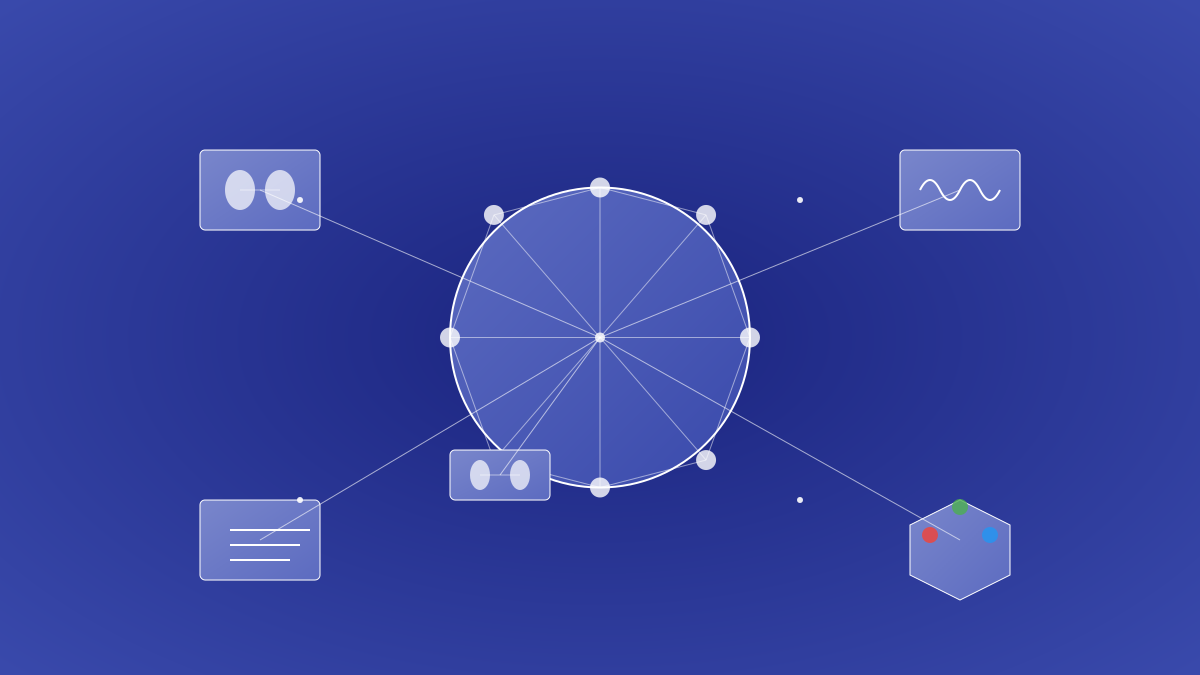
The system adopts a hybrid architecture: combining large language models (LLMs) and integrated deep learning. The technology stack includes: a multimodal input layer (facial expressions, voice, text), a feature extraction module (pre-trained models extract high-dimensional features), and an integrated learning layer (fusing results from multiple base learners).

Roles of large language models: semantic understanding (capturing emotional clues and implicit intentions), context reasoning (judging based on historical conversations), and knowledge integration (incorporating knowledge from fields like disability psychology).

Advantages of integrated learning: combining models such as CNN/RNN/Transformer to reduce overfitting, complement features, and provide confidence estimation; using weighted voting and stacking strategies.

4

Section 04

Application Scenarios: Practical Value in Medical Rehabilitation and Education Fields

Medical rehabilitation: Deployed on intelligent wheelchairs and auxiliary devices to help caregivers understand patients' emotions (such as anxiety and depression) in real time and provide humanized care.

Education scenarios: For special children (such as autistic patients), it helps teachers understand emotional feedback, adjust teaching strategies, and create an inclusive learning environment.

Social significance: Reflects AI's humanistic care, promotes social inclusion, and narrows the digital divide.

5

Section 05

Challenges and Prospects: Data Privacy and Future Research Directions

Challenges: Data privacy and security (emotional data is sensitive and needs strict protection), real-time performance optimization (latency issues on edge devices).

Future directions: Expand multilingual support; explore federated learning to protect privacy; integrate brain-computer interfaces to serve people with severe disabilities.

6

Section 06

Conclusion: Humanistic Orientation of AI Technology Serving the Disabled Group

Large language models and integrated deep learning open up new possibilities for auxiliary technologies for people with disabilities. The study demonstrates the application value of AI, emphasizing that technology should serve people, especially groups in need of help. We look forward to more innovations to make AI a positive force for promoting social inclusion.

