Zing Forum

Reading

Sparse Autoencoders Crack the Black Box of Large Models: A Deep Case Study on Mechanistic Interpretability

This article deeply analyzes an open-source project on mechanistic interpretability of large language models based on Sparse Autoencoders (SAE). By addressing the polysemanticity problem, the project decomposes entangled neuron activations in neural networks into interpretable single-semantic features and implements activation-guided intervention techniques without fine-tuning.

机械可解释性稀疏自编码器大语言模型多语义性激活引导神经网络SAELLM特征解释因果干预
Published 2026-04-20 05:13Recent activity 2026-04-20 05:18Estimated read 6 min
Sparse Autoencoders Crack the Black Box of Large Models: A Deep Case Study on Mechanistic Interpretability
1

Section 01

Introduction: Core Breakthroughs of Sparse Autoencoders in Cracking the Black Box of Large Models

This article introduces the open-source project mech_interpretability_case_study. Using Sparse Autoencoder (SAE) technology to address the polysemanticity problem, it decomposes entangled neuron activations in large language models into interpretable single-semantic features and implements activation-guided intervention techniques without fine-tuning, providing a systematic methodology for mechanistic interpretability of large models.


2

Section 02

Background: Polysemanticity—A Core Barrier to Neural Network Interpretability

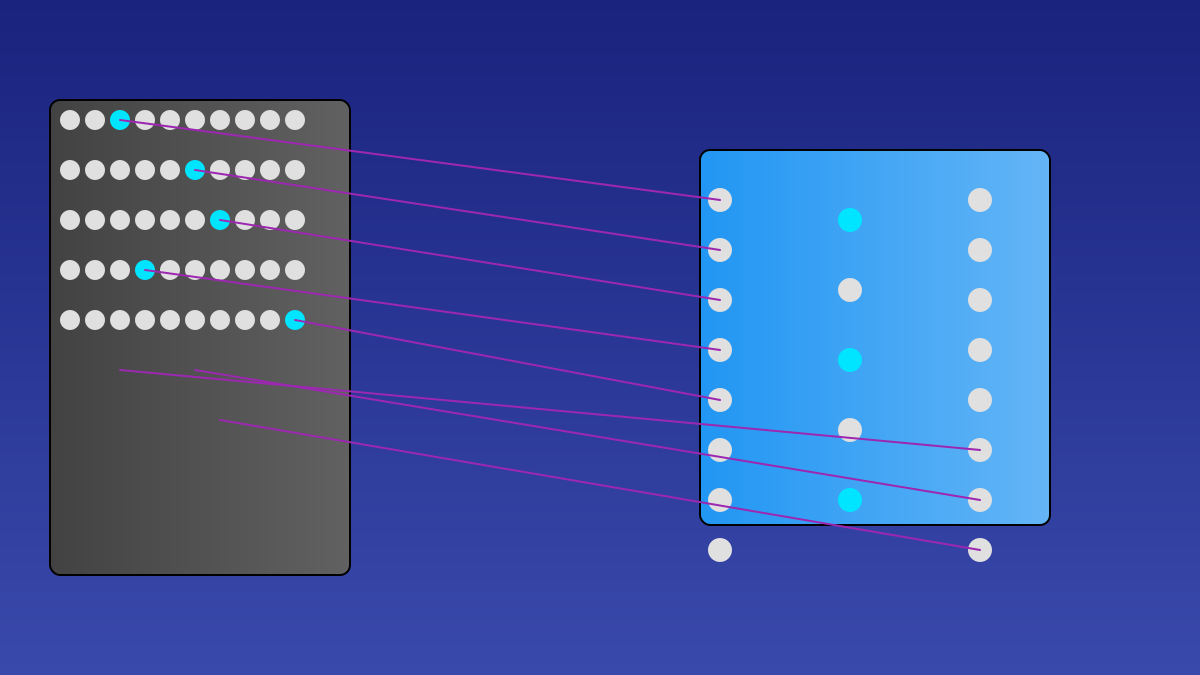
Polysemanticity is a core challenge in the field of neural interpretability. The traditional view holds that a single neuron encodes a specific concept, but in reality, a single neuron often responds to multiple unrelated concepts (e.g., numbers, punctuation, grammatical structures) simultaneously, leading to entangled activations that form complex distributed representations—this is the deep-seated reason why large models are difficult to interpret.

3

Section 03

Methodology: Sparse Autoencoder (SAE)—A Key Tool from Entanglement to Disentanglement

The core idea of SAE is to learn latent single-semantic basis vectors and decompose entangled activations into sparse, interpretable features. The architecture uses overcomplete dictionary learning: the encoder maps residual stream activations (896 dimensions) to a larger latent space (28672 dimensions); L1 regularization encourages sparsity; the decoder reconstructs the original activations. Overcompleteness provides degrees of freedom, and sparsity constraints ensure interpretability.

4

Section 04

Experimental Evidence: A Complete Workflow from Data Collection to Causal Intervention

The project's 5-stage experimental workflow:

  1. Activation Collection: Collect residual stream activations from the 12th layer of Qwen2.5-0.5B using the FineWeb-Edu dataset (2 million tokens);
  2. SAE Training: Composite loss function (MSE + L1 regularization + decoder norm constraint) with an L1 coefficient warm-up mechanism;
  3. Quality Evaluation: Quantitative metrics such as FVE, sparsity, and the proportion of dead features;
  4. Feature Interpretation: Analyze activation contexts to build a feature dictionary;
  5. Activation Guidance: Inject specific feature vectors to intervene in model behavior and verify the semantic authenticity of features.
5

Section 05

Technical Implementation Highlights: Modular and Reproducible Design

Engineering highlights of the project:

  1. Modular Architecture: Independent modules for each stage (data collection, training, evaluation, interpretation, intervention);
  2. Unified Configuration Management: config.py centrally manages hyperparameters and supports command-line overrides;
  3. Experimental Tracking Integration: ClearML records metrics, hyperparameters, and model versions to facilitate collaborative reproduction.
6

Section 06

Research Significance and Conclusions: A Key Step Toward Interpretable AI

Significance of the project:

  1. From Black Box to Gray Box: SAE provides a mapping tool from the model's internal state to human concepts;
  2. Causal Verification: Activation guidance achieves a leap from correlation to causal intervention;
  3. Model Safety and Alignment: Understanding internal representations helps identify and intervene in harmful features;
  4. Scalability: The methodology can be extended to larger-scale models. Conclusion: Lays a solid foundation for mechanistic interpretability research.
7

Section 07

Future Outlook and Recommendations: Next Steps in Mechanistic Interpretability

Current challenges: Ensuring features correspond to real semantics, translating feature understanding into overall behavior prediction, and maintaining effectiveness in large-scale models. Future exploration can focus on the similarities and differences of features across models of different architectures/scales. It is recommended that interested readers refer to the project's complete code and documentation as a high-quality resource for getting started with mechanistic interpretability.

