Zing Forum

Reading

Asynchronous Intent Routing Engine: A Hybrid Architecture Solution for Low-Latency Voice Interaction

This article introduces an innovative voice assistant architecture design that separates local fast classification from cloud-based complex cognition, ensuring response speed while achieving robust conversational capabilities.

语音助手智能家居混合架构边缘计算自然语言理解异步处理Home Assistant
Published 2026-05-09 17:42Recent activity 2026-05-09 17:48Estimated read 5 min
Asynchronous Intent Routing Engine: A Hybrid Architecture Solution for Low-Latency Voice Interaction
1

Section 01

[Introduction] Asynchronous Intent Routing Engine: A Hybrid Architecture Solution for Low-Latency Voice Interaction

This article presents an innovative hybrid architecture solution for voice assistants. The core is a strategy that separates local fast classification from cloud-based complex cognition, addressing the pain points of high latency in pure cloud solutions and limited computing power in pure local solutions. It achieves a balance between low-latency responses and robust conversational capabilities, suitable for scenarios like smart homes.


2

Section 02

Project Background and Core Ideas

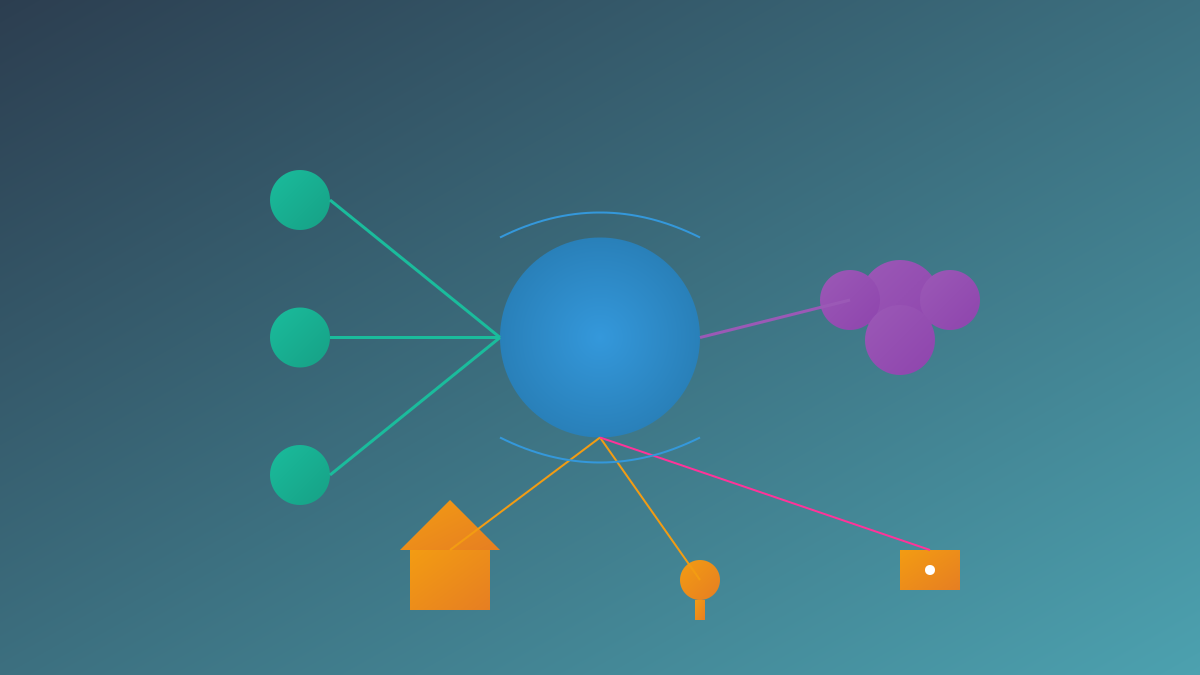
In voice assistant development, pure cloud solutions have strong capabilities but unavoidable network latency, while pure local solutions respond quickly but are limited by device computing power. This project proposes a hybrid architecture of "fast local domain classification + cloud-based complex cognition fallback", drawing on the idea of CPU multi-level caching: placing common simple operations locally and offloading complex computations to the cloud.

3

Section 03

Local End Capability Boundary: Handling Latency-Sensitive Standardized Tasks

The local end is responsible for wake-up detection, speech recognition (ASR), lightweight natural language understanding (to determine if cloud support is needed), Home Assistant local control, media playback, and interruption handling. These tasks have fixed patterns, controllable computation loads, and extremely high latency requirements—for example, "turn on the light" needs an immediate response.

4

Section 04

Cloud End Deep Cognition: Handling Complex Dialogue and Reasoning Tasks

When the local NLU determines that a request exceeds its capabilities, the cloud handles complex dialogue management, reasoning and planning, model adaptation, and cross-service tool calls. The cloud's advantages lie in unlimited computing power, rich models, knowledge bases, and multi-service collaboration capabilities.

5

Section 05

Essence of Asynchronous Routing Design: Local Fast Response + Cloud Asynchronous Processing

Asynchronous design steps: 1. Local fast judgment of intent type; 2. Immediate execution and response for simple intents; 3. Initiate cloud processing for complex intents while preparing for subsequent interactions; 4. Seamlessly continue the context after the cloud result is returned. This design balances local response speed and cloud cognitive capabilities.

6

Section 06

Practical Application Scenario Example: Collaborative Processing of Temperature Adjustment and Music Playback

When a user says, "I'm a bit cold, turn up the temperature, and play some light music", the local end immediately adjusts the temperature via Home Assistant, while initiating the cloud music recommendation process. After the cloud result returns, it continues: "Temperature has been turned up for you. I recommend playing 'Moonlight Sonata'—would you like to play it?"

7

Section 07

Key Technical Implementation: Intent Classification, Context Synchronization, and Degradation Strategy

Three core issues need to be addressed: 1. Accuracy of intent classification (to avoid misjudging simple/complex tasks); 2. Context synchronization (seamless continuation of dialogue state with cloud results); 3. Degradation strategy (ensuring local functions work normally when the network or cloud is unavailable).

8

Section 08

Open Source Significance and Future Outlook: Resource Optimization Balance Between Edge and Cloud

This open-source project provides developers with an architectural paradigm, demonstrating the balance between edge devices and cloud services. The development of end-side AI chips will enhance local capabilities, but layered processing remains a resource optimization strategy, which is of reference value to smart home and voice interaction engineers.

