Zing Forum

Reading

Application of Multimodal Graph Neural Networks in Lung Cancer Subtyping: A Deep Learning Scheme Integrating Gene Expression and Clinical Features

This article introduces a lung cancer subtyping project combining graph neural networks with multimodal data fusion. By integrating gene expression, copy number variation, methylation data, and clinical features, it achieves accurate classification of lung adenocarcinoma (LUAD) and lung squamous cell carcinoma (LUSC).

图神经网络GNN肺癌分型多模态融合生物信息学深度学习精准医疗LUADLUSCGAT
Published 2026-04-23 21:50Recent activity 2026-04-23 22:22Estimated read 6 min
Application of Multimodal Graph Neural Networks in Lung Cancer Subtyping: A Deep Learning Scheme Integrating Gene Expression and Clinical Features
1

Section 01

[Introduction] Core Overview of the Application of Multimodal Graph Neural Networks in Lung Cancer Subtyping

This article focuses on the application of multimodal graph neural networks in lung cancer subtyping. By integrating gene expression, copy number variation (CNV), methylation data, and clinical features, it achieves accurate classification of lung adenocarcinoma (LUAD) and lung squamous cell carcinoma (LUSC). The project covers key aspects such as technical architecture, model interpretability, and data processing, providing a reference for precision medicine.


2

Section 02

Research Background and Medical Significance

Lung cancer is one of the malignant malignant tumors with the highest incidence and mortality rates globally, mainly divided into lung adenocarcinoma (LUAD) and lung squamous cell carcinoma (LUSC). These two subtypes differ significantly in pathogenesis, treatment plans, and prognosis, so accurate subtyping is crucial for personalized treatment. Traditional subtyping relies on pathological experts' microscopic observation, which is time-consuming and experience-dependent. Classification methods based on molecular features have great potential, and this project explores the use of deep learning to integrate multi-dimensional biological information for automated and accurate subtyping.

3

Section 03

Technical Architecture of Multimodal Data Fusion

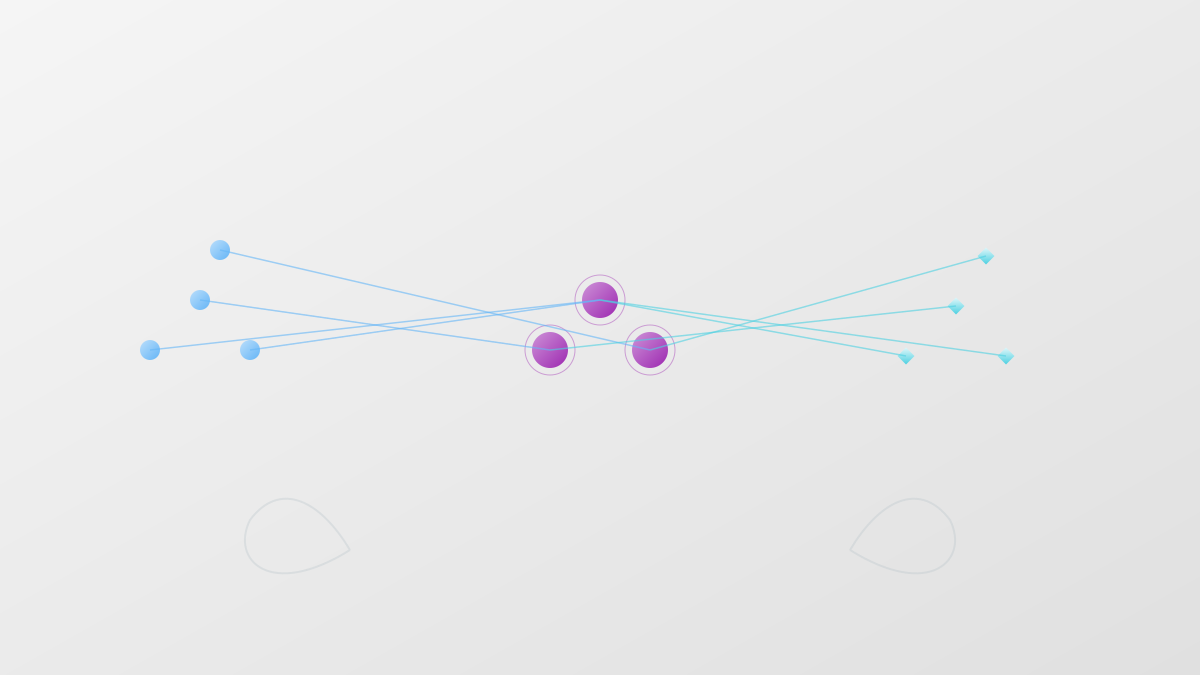
The core innovation of the project is the Multimodal Graph Neural Network (MultiModalGNN) architecture, which processes four types of data simultaneously: gene expression data (RNA-seq) reflects gene activity; copy number variation (CNV) data reveals genomic structural changes; DNA methylation data provides epigenetic information; clinical features (age, gender, tumor stage, etc.) combined with molecular features can enhance prediction ability.

4

Section 04

Biological Modeling of Graph Neural Networks

The choice of graph neural networks (GNN) stems from the graph structure characteristics of biology (protein-protein interaction networks are graphs: nodes are proteins, edges are interactions). Using graph attention networks (GAT) can learn the importance weights between nodes. Each patient's multi-omics data is encoded into a graph: node features include gene expression, CNV, and methylation information; edge features encode the confidence of protein-protein interactions, preserving biological priors and supporting data-driven learning.

5

Section 05

In-depth Analysis of Model Interpretability

Medical AI requires high interpretability: Graph attention score analysis identified key genes such as KRT17 and DDR2; significance analysis quantifies the contribution of genes to decision-making; clinical feature importance analysis shows that the contribution of age, gender, etc., is lower than that of genetic features, suggesting that molecular information has higher diagnostic value.

6

Section 06

Engineering Practice of Data Processing Pipeline

The data comes from the GDC portal, including subsets of clinical information, CNV, methylation, etc. Preprocessing includes integrating scattered data, ID mapping of protein-protein interaction data from the STRING database, methylation data parsing, and clinical feature encoding. Dividing training/validation/test sets ensures the objectivity of evaluation.

7

Section 07

Model Generalization and Transferability

The model architecture can be adapted to other tumor types: it requires modifying tumor type label mapping, clinical feature dimensions, number of output categories, and initialization parameters. The modular design enhances code reusability, facilitating transfer to other cancer research.

8

Section 08

Implications for Precision Medicine

This project demonstrates the potential of AI in precision medicine, which can capture complex patterns and provide objective basis for subtyping. From prototype to clinical implementation, it requires large-scale multi-center data validation, regulatory approval, etc. It provides a reference for medical AI researchers in data preprocessing, model design, and interpretability analysis, promoting the cross-fusion of bioinformatics and deep learning.

